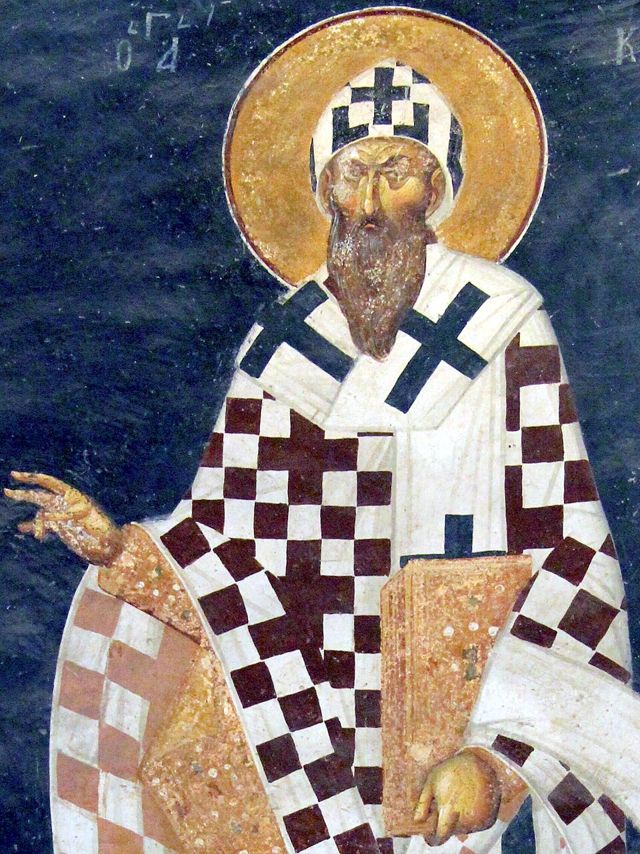
This great champion of the faith has been criticized by modern writers as passionate and intolerant. It is true that he made several mistakes during his time as patriarch, and that his impulsiveness led to serious violations of justice. However, we must remember that no man, not even the greatest of saints, is without flaws in character. The greatest saints are those who, despite having significant natural defects, have overcome them through their faith and self-control.
Cyril began his time as patriarch under difficult circumstances. He was the nephew of Theophilus, the patriarch of Alexandria, who was the worst enemy of Chrysostom. Theophilus was a man without principles, completely consumed by pride in his position. On October 15th, 412, he ended his episcopate after twenty-seven years, serving as a sad example of how great abilities can be harmful to the Church when combined with a worldly spirit and a violent temper. Cyril succeeded his uncle. The negative influence of his uncle's example lingered over him for some time, obscuring the nobility that would later emerge.
Cyril desired above all else the dominance of the Church. As for the means to achieve this, he had fewer scruples than would be expected from a minister of Him who rebuked the attack on Malchus. He closed the Novatian church, took away its sacred items, and stripped its Bishop of his property. The Jews of Alexandria—a powerful community for many centuries—had caused the disgrace and punishment of Hierax, who admired Cyril's sermons. Naturally indignant, Cyril threatened the leader of their community. In retaliation, the Jews raised a cry at midnight, claiming, "The Church of S. Alexander is on fire!" This led to the massacre of Christians who rushed out to save their church.
Cyril seemed to believe that the Christians must take matters into their own hands, without expecting justice from the prefect Orestes. He organized a group at daybreak that attacked the synagogues, expelled the Jews from Alexandria, and treated their property as rightful loot. Orestes, furious about this hasty and unlawful vengeance, refused to listen to Cyril's explanations. The archbishop, after unsuccessfully trying to use the Gospels to promote reconciliation, lost all hope for peace.
Five hundred monks from Nitria, driven by extreme partisanship, entered the city and insulted the prefect as a pagan. "I am a Christian," he shouted; "Atticus of Constantinople baptized me." A monk named Ammonius contradicted his own claim to Christianity by throwing a stone at the prefect, causing a severe wound. He was captured and died under torture, but Cyril disgracefully referred to this violent man as an "admirable" martyr, a decision he later deeply regretted.
Then a darker tragedy unfolded. Hypatia, a learned woman and philosophy teacher who was a pagan, held significant influence in the city against Christianity. She was believed to have turned Orestes against Cyril. Some zealous individuals, led by a church reader named Peter, dragged her from her home and brutally killed her, tearing her apart limb from limb. Cyril was not involved in this horrific act, but it was carried out by men whose passions he had initially incited. If there had been no attack on the synagogues, there would have been no murder of Hypatia.
The people of Alexandria were known for their fiery tempers and propensity for civil strife. Gibbon remarks about them, "The most trifling occasion, a transient scarcity of flesh or lentils, the neglect of an accustomed salutation, a mistake of precedence in the public baths, or even a religious dispute, were at any time sufficient to kindle a sedition among that vast multitude, whose resentments were furious and implacable." A brutal civil war that lasted twelve years and devastated the city began over a dispute between a soldier and a townsman about a pair of shoes.
Cyril had inherited all of his uncle's intense dislike for John Chrysostom. Pope Innocent had not been able to secure the restoration of Chrysostom's reputation in Constantinople. However, shortly after Innocent's death, Atticus, his successor, who was a good man but weak and timid, and a known opponent of Chrysostom, who had resisted the Pope's encouragement, gave in to public sentiment and the advice of Emperor Theodosius. The Emperor believed that "for peace and unity there would be no harm in writing a dead man's name on a diptych," which means on the list of names of the deceased for whom prayers are offered during Mass. Atticus justified this decision in a letter to Cyril, stating that these Eucharistic commemorations included both laypeople and bishops.
Cyril, being the nephew of Theophilus, was not easily satisfied by this reasoning. He obtained from Atticus's messengers the admission that Chrysostom was now being commemorated as a bishop. Cyril believed that Chrysostom was merely a man who had lost his position as a bishop. He demanded that Atticus "remove from the list of priests the name of one who was no minister," clearly suggesting that unless Atticus chose to uphold the authority of the Council of the Oak, he would lose the communion of the patriarchate of Alexandria.
As time went on, Cyril reconsidered his stance and felt remorse for his harshness and bias. Isidore of Pelusium, a devout abbot, wrote to him, "Put an end to these dissensions, lest you incur the judgment of God," and urged him not to create a lasting division in the Church by refusing to commemorate Chrysostom. Cyril then included Chrysostom's name on his diptychs and was immediately restored to communion with Rome, from which he had been separated due to his uncle's prejudices.
Atticus, the patriarch of Constantinople, was succeeded in 426 by Sisinius, who died on Christmas Eve in 427. Nestorius, a Syrian raised in Antioch, known for his strong reputation and impressive speaking abilities, was consecrated to the position on April 10, 428. His first sermon showed a passionate and combative spirit. "Give me," he exclaimed, addressing the Emperor, "give me the earth free of heretics, and I will give you heaven in return! Help me to defeat the heretics, and I will help you to defeat the Persians." He began his time as bishop by attacking an Arian meeting-house. In their desperation, the Arians set fire to it, and the flames spread to other buildings. As a result, the new patriarch earned the ominous nickname "the Incendiary."
The early violence of Cyril should neither be minimized nor exaggerated; however, there was somewhat less justification for the persecuting zeal of Nestorius. Shortly before Christmas in 428, a priest named Anastasius, whom the new archbishop had brought from Antioch, was preaching in S. Sophia. During the sermon, he stated, "Let no one call Mary the Mother of God; for she was a human creature, of whom God could not be born." Nestorius was present and approved of this statement. On Christmas Day, he himself began a series of short sermons, in which he labeled the title as heathenish and referred to Mary's Son as merely a man, the instrument used, and the garment worn by God. Eusebius, a lawyer in the city, stood up in the full church and declared that the Eternal Word Himself was born in the flesh. Nestorius rejected this doctrine, saying, "It was not the Word that was born; it was only the man Jesus."
Soon after, during a festival in honor of the Virgin, likely the Annunciation, a certain Bishop Proclus preached in the great church before Nestorius. After speaking of St. Mary in glowing terms, comparing her to the burning bush that was not consumed, the cloud that carried the cherub-throne, and Gideon's fleece filled with heavenly dew, he moved on to the practical implications of Catholic doctrine.
"If the Word had not dwelt in the womb, Flesh would never have sat on the holy throne. It was necessary that either the sentence of death should be carried out on all, since all have sinned, or that a price should be paid in exchange that could fully secure the release. Man could not save himself, as he was burdened by the debt of sin. An angel could not redeem humanity, as he lacked the necessary ransom. Only one course remained: that the sinless God should die for sinners. It was God who, out of His compassion, became Man. We do not proclaim a man who has been deified, but we confess a God who is Incarnate. The same being was in the Father's bosom and in the Virgin's womb; in a mother's arms and on the wings of the wind. He was adored by angels while He dined with tax collectors. The servant struck Him, and creation trembled. He was laid in the tomb, and He spread out the heavens like a curtain. O the mystery! I see the miracles, and I proclaim the Godhead; I see the sufferings and I declare the Manhood."
Nestorius rose from his throne and rebuked the preacher. He claimed that to speak of God as virgin-born was incorrect, and in later sermons he argued that God, who "held the circle of the earth," could not be wrapped in grave-clothes; that the Sustainer of all things could not rise from the dead. He stated that Christ was a sinless man, the image of the Godhead through His goodness; and that since a child shares the same nature as its mother, Christ could not be divine as Mary was not divine. He allowed for Christ to have a divinity, but not the divinity, placing Him more as the greatest of saints than as God. This was Arianism in another form.
His sermons caused a great deal of excitement both at home and abroad. People realized that the issue was not just a matter of words. Laypeople, who believed that Catholic truth was their inheritance just as much as it was for the clergy, recoiled from the communion of a bishop who undermined the Incarnation. Clergy members began to preach against him. "They are croaking frogs," said Nestorius, and he obtained an imperial order to silence them. A priest started to celebrate Mass in private, and an abbot and a monk confronted Nestorius directly, telling him he was wrong. They were brutally beaten and imprisoned for their actions. A monk who dared to call him a heretic was whipped and exiled. Among his supporters, a bishop named Dorotheus was the most prominent. When he preached his heresy, the congregation cried out in indignation and rushed out of the church, but Nestorius continued with the service and administered Communion to the preacher.
The careful distribution of the archbishop's sermons brought them to the Egyptian monks. Cyril tried to counter their impact by writing a letter to the monks around the end of April 429. He suggested that they would have been better off avoiding the controversy, but given the circumstances, it was necessary to emphasize the positive truth. Since Christ was Emmanuel, since He who was in the form of God took on the form of a servant, since the Son of Man was worthy of adoration, and since the Lord of glory was crucified, it was impossible to divide the persons and separate the humanity from the divinity. To summarize it in one simple statement: "If our Lord Jesus Christ is God, how can His Mother, the holy Virgin, not be the Mother of God?" He made it clear to avoid misrepresentation that it was from Mary that Christ received His human nature, but that He did not derive His divine nature from her. He was God; from her, He received His humanity, but He was not dependent on her for His divinity.
Around Midsummer, he wrote his first letter to Nestorius, urging him not to create scandal and division by claiming that God dwelled in Christ instead of proclaiming the Catholic doctrine that Christ was God. In February 430, Cyril wrote his second letter to Nestorius—the significant Epistle that later received formal approval from the Church in subsequent councils. He expressed his faith in clear terms, insisting on a real, not merely moral, union of God and Man in Christ. Nestorius replied, showing a strange confusion of thought on the matter, which stood in stark contrast to the bright, clear, and lucid style of Cyril. He was willing to accept that Christ was a combination of God and the man, Jesus; however, he would not agree that God and man formed one Christ.
Now Cyril shone like a bright star in the sky of the Church and proved to be a pillar in the house of God, upholding the truth. God raised him up to defend the Unity of the Person in our Blessed Lord against heresy. Just as S. Athanasius had defended the Church when it was attacked by Arianism, Cyril was called to do the same when it was challenged by Nestorianism. "I do not care for distress, or insult, or the harshest revilings," he wrote in a letter to his clergy, "Only let the faith be kept safe."
In early August, a council met in Rome. Pope Celestine quoted a stanza from the Christmas hymn of S. Ambrose:—
"Redeemer of Earth's tribes forlorn.
Come, show Thyself the Virgin-born;
Let every age the marvel greet—
No common birth for God were meet."
He added, "Thus, our brother Cyril's meaning, when he calls Mary the mother of God, entirely agrees with Talis decet partus Deum." He cited S. Hilary and S. Damasus as teaching the same doctrine of One Christ, and the council declared Nestorius guilty of heresy. On August 11th, he wrote to Cyril, accepting his doctrinal statements and giving him an important commission. "Join the authority of our see to your own, and freely occupying our place, execute this sentence with strictness and rigor; so that, unless within ten days from this warning, he condemns in writing his unholy doctrine and assures us that he holds the faith regarding the birth of Christ our God, which is held by the Roman Church, by your Holiness' Church, and by all who belong to our religion, your Holiness may provide for his Church and let him know that he must be cut off from our body."
On November 19th, the emperor Theodosius, at the request of Nestorius and his opponents, summoned a general council to meet in Ephesus at the upcoming Pentecost. In addition to the circular letter, Cyril received a private letter from the emperor, which was angry in tone, asking, "Why have you despised us and raised all this agitation, as if rash impetuosity were more fitting than careful inquiry, or audacity and versatility more pleasing to us than good taste and straightforwardness?" In a council held in Alexandria, Nestorius was declared heretical and was excommunicated.
On Sunday, December 7th, four bishops entered the cathedral of Constantinople during the service and presented to Nestorius the letters from Celestine and Cyril excommunicating him.
About four or five days before Whit Sunday, which in 431 fell on June 7th, Cyril arrived in Ephesus, accompanied by fifty bishops. He found that Nestorius had already arrived with sixteen bishops before him. The Roman legates, Arcadius and Projectus, both bishops, along with Philip, a priest, were on their way. Pope Celestine had already shared his opinion with Cyril that if Nestorius was willing to repent, he should definitely be welcomed, despite the sentence already issued by Rome and Alexandria. The bishops from the patriarchate of Antioch had not yet arrived. The church in Africa, devastated by the Vandals, could not send any prelate; however, Capreolus of Carthage wrote, urging the bishops to uphold the ancient doctrine.
In a sense, hostilities had already begun between the factions before the council officially opened. Memnon, the bishop of Ephesus, excluded the Nestorians from the churches, leaving them without a place to celebrate Pentecost or to hold matins and vespers.
Acacius, the bishop of Melitene, tried to convert Nestorius. A bishop from the Nestorian party said to him, "The Son who suffered is one, God the Word is another." Acacius withdrew in horror, but another statement made by Nestorius left an even deeper impression on every Catholic heart. On June 19th, some prelates were debating with him about the divinity of Jesus. "For my part," he said repeatedly, "I cannot say that a child of two or three months old was God." In this way, he expressed his disbelief in the foundational doctrine of Christianity.
On Sunday, June 21st, two weeks had passed since the scheduled start of the council. The bishops were tired of waiting; illness and even death had affected some of them, and John, the patriarch of Antioch, had not yet arrived. Therefore, the majority sent a message to Nestorius, informing him that the council would begin the next day. On Monday, June 22nd, when 198 bishops gathered in St. Mary's Church, he personally protested against the council starting until the bishops from the patriarchate of Antioch had arrived. It was in vain; Cyril and the majority firmly refused to delay. On the episcopal throne, in the center of the assembly, the Gospels were placed; the bishops sat on either side. Cyril, being the highest in rank and holding the proxy of Celestine until the Roman legates arrived, presided over the assembly. It might have been better if another bishop had taken on this role; however, it seems that Cyril's main function in the proceedings was to present evidence, and he called on the council to judge between himself and Nestorius. A second summons was then issued to Nestorius, but soldiers with clubs prevented the deputies from reaching him, and he sent word that he would attend when all the bishops had arrived in the city.
A third message was then sent to him, making sure to treat him simply as an accused bishop, not as a condemned heretic. Again, the rude guards pushed back the deputies. "If you stand here all night, you will get no satisfaction; Nestorius has ordered that no one from your council shall enter." They returned to St. Mary's. "Nestorius," said the Bishop of Jerusalem, "shows a bad conscience. Let us now compare all recent statements with the creed of Nicæa."
After the great confession had been read, the second letter of Cyril to Nestorius, and excerpts from the sermons of the accused, the bishops proceeded to depose and excommunicate Nestorius in the name of "our Lord Jesus Christ whom he has blasphemed." The sentence was signed by all the bishops, with the first signature being, "I, Cyril, Bishop of Alexandria, subscribe to the judgment of the council." It was now late in the summer evening. As the bishops left the church, they were greeted with loud applause by the people who had crowded the streets all day. Torches and perfumes were burned before them as they made their way to their respective homes; thus ended the memorable first session of the council of Ephesus. It is interesting to think that while the bishops were going home that night, after a day of intense excitement, Paulinus of Nola was calmly passing away. His last words, spoken softly in a chant at the hour of vespers, were from Psalm 132:17, "I have prepared a lamp for my Christ."
On Saturday, June 27th, John of Antioch arrived with fifteen bishops. The council sent deputies to his lodging; he agreed to see them but allowed Count Irenæus, a friend of Nestorius, to beat them cruelly. Dusty and travel-stained, John then gathered a meeting of the supporters of Nestorius, totaling forty-three bishops, and deposed Cyril of Alexandria and Memnon of Ephesus.
Theodosius, the emperor, biased in favor of Nestorius, and thinking, perhaps not without reason, that the bishops of Antioch should have been waited for before the council opened, wrote on June 29th in harsh terms, ordering that no bishop should leave Ephesus until the doctrinal question had been thoroughly examined, and declaring the proceedings invalid.
Now the Roman legates arrived, and the second session was held in Memnon's house on July 10th. Celestine's letter to the council, dated May 8, expressed full confidence that the council would join with the legates in carrying out what Rome had already decided was good. The bishops responded with applause, "One Celestine, one Cyril, one faith of the council, one faith of the world!"
The next day, in the third session, the council wrote to the emperor that the entire Church was against Nestorius. In a fourth session, John, the patriarch of Antioch, who supported the heretic, was deposed and excommunicated. The emperor then sent his high treasurer, Count John, to resolve the differences in a straightforward manner. Upon his arrival, he immediately arrested Cyril, Memnon, and Nestorius, and soldiers were placed at the doors of their bedrooms to keep them as close prisoners.
The bishops of the council wrote a letter to the clergy of Constantinople, describing the distress they were experiencing. "We are dying from the heat, the air is unhealthy, there is a funeral nearly every day, and all the servants have gone home sick; but if we die here, we will not change what Christ has ordained through us." Many of the bishops were very ill; some had to sell everything they owned to pay for their expenses. Cyril also wrote, but there was a problem getting these letters delivered. The Nestorians in Constantinople surrounded the ships and roads, not allowing any ordinary messenger to enter the city. It was decided to give the letters to a beggar, who could carry them in the hollow of a cane he leaned on. This clever plan worked. The clergy of Constantinople received the sentence of deposition against their patriarch, along with the letters from Cyril and the council. The clergy openly addressed the emperor on behalf of Cyril. There was a great commotion among the monks, who were mostly determined opponents of Nestorianism. The elderly abbot Dalmatius had not left his monastery for nearly fifty years. The emperor had unsuccessfully tried to make him participate in processional services during earthquakes. But now he felt, as he put it, that in a cause that truly belonged to God, he could not remain inactive. He emerged at the head of a solemn procession of monks and abbots, chanting in two choirs as they moved toward the palace. The abbots were immediately admitted to the presence of Theodosius, and after reading the letter from the council, he said, "If these things are true, let the bishops come here." "They are prevented," said Dalmatius. "No, they are not," replied the emperor. "They are under arrest," insisted the abbot. The conference ended in a way that satisfied the abbots; they came out and directed the crowd outside to proceed to a large church at the edge of the city. The procession continued; monks carrying wax candles led the singing, which was essential for any significant religious movement at that time. The inspiring words, "O praise God in His holiness," rang out as they approached their destination. The church was filled with eager listeners; Dalmatius had the letter from the council read aloud and then recounted his meeting with Theodosius. Dalmatius could rightly write to the council, "I have not neglected your wishes." His intervention was a significant event; he had proven too much for the Nestorians. Through his simple devotion and impressive determination, the old recluse had given strength and unity to a large wave of public sentiment and broken the influence that a faction had over the emperor.
It is unnecessary to follow the complicated issues of party conflict any further. Theodosius confirmed the decree of the council, and on Sunday, October 25, 431, a new patriarch was consecrated to take the place of Nestorius. John of Antioch had been misled by party feelings, and although he was not truly heretical in faith, his mind, like that of other supporters of Nestorius, was confused. He feared that Cyril might fall into the opposite error of Apollinaris, which merged one nature into the other, reducing Christ to just one nature. Because of this fear, he sided with Nestorius. Now he was reconciled to Cyril, who gladly met him halfway. Through mutual explanation, they cleared away the dust of conflict and discovered that their faith was the same.
John sent Paul, Bishop of Emesa, to Alexandria with this confession: "We confess our Lord Jesus Christ, the only-begotten Son of God, to be perfect God and perfect Man, with a rational soul and a body; before the ages, He was begotten of the Father according to His Godhead, but for us and for our salvation, in the latter days, He was born of the Virgin Mary according to His Manhood; of one essence with the Father in terms of Godhead, and of one essence with us in terms of Manhood. For there took place a union of two natures; therefore, we confess one Christ, one Son, one Lord. According to this understanding of the union without confusion, we confess Holy Mary to be the Mother of God, because God the Word was incarnate and made man, and from His very conception, He was united to the temple taken from her."
Cyril gladly accepted this statement as orthodox, and only then was Paul of Emesa allowed to attend the church service and invited to preach as a Catholic Bishop on Christmas Day. The scene that followed was very striking. He began with the angelic hymn, proceeded to Isaiah 7:14, and then proclaimed the significant words, "Thus Mary, Mother of God, brings forth Emmanuel!" The church resounded with joyful cries: "Lo, this is the faith! It is God's gift, orthodox Cyril! This is what we wanted to hear!" Paul continued and emphasized both sides of the great truth. "A combination of two perfect natures, that is, Godhead and Manhood, constitutes for us the one Son, the one Christ, the one Lord." Again, the people shouted their approval: "Welcome, orthodox Bishop, the worthy to the worthy!"
Cyril died in June 444, after serving as pope for thirty-two years. During the last fifteen years of his life, he dedicated himself to the truth of the unity of the two natures in Christ, just as his great predecessor, Athanasius, had dedicated himself to the truth of the Divinity of Christ. Certainly, the passionate spirit that Cyril sometimes could not control led him to take actions during this significant controversy that revealed he was not an Athanasius. However, modern critics have focused too much on this aspect of his character and not enough on other important points.
Historical fairness does not require us to adopt the harshest possible interpretation of his actions at the beginning of the Council of Ephesus, while ignoring his noble selflessness, his patience in repeatedly explaining his own statements, and his willingness to welcome substantial agreement from others. In short, he demonstrated the "power, and love, and command" that made him a true minister of peace during the reunion of 433.
We need not elaborate on other instances where he showed remarkable restraint, such as when he endured the reprimands from Isidore without irritation. He also cared for the proper training of those aspiring to the priesthood, displayed depth and insight as a dogmatic theologian, and showed faith and gratitude when treated as a deposed prisoner. The wrong way to understand him is to replace the passionate and often deeply suffering man with a proud and unfeeling dogmatist. He persevered in defending the simple truth of the Scriptural and Nicene mystery against an opponent who was strong in clever arguments, court influence, and church power. This mystery is that "the one Lord Jesus Christ was very God of very God, who for us men and for our salvation came down from heaven, and was incarnate, and was made Man."
Footnotes
- Gibbon remarks about them, "The most trifling occasion, a transient scarcity of flesh or lentils, the neglect of an accustomed salutation, a mistake of precedence in the public baths, or even a religious dispute, were at any time sufficient to kindle a sedition among that vast multitude, whose resentments were furious and implacable."
- A brutal civil war that lasted twelve years and devastated the city began over a dispute between a soldier and a townsman about a pair of shoes.
- Atticus was a successor of Pope Innocent and opposed Chrysostom.
- The Council of the Oak was a synod that condemned Chrysostom.
- S. Sophia: a famous cathedral in Constantinople, now known as Hagia Sophia.
- Cyril wrote a letter to the Egyptian monks around the end of April 429.
- In February 430, Cyril wrote his second letter to Nestorius, which received formal approval from the Church.
- Talis decet partus Deum: "Such a birth is fitting for God."
- Paravi lucernam Christo meo: "I have prepared a lamp for my Christ."
- Psalm cxxxi. 17: Psalm 132:17.
- Dalmatius was an abbot who had not left his monastery for nearly fifty years.
- Theodosius was the emperor at the time of this event.
- Isaiah 7:14 refers to a prophecy about the virgin birth.
- The quote is from the Nicene Creed.
Baring-Gould’s own footnotes, in modern English.
Read the original 1870s text
Baring-Gould’s sources: Roman Martyrology. The Greeks celebrate the memory of S. Cyril on June 9th, and commemorate him together with S. Athanasius on June 18th. Authorities: Socrates, Sozomen, Marius Mercator, the Acts of the council of Ephesus, and his own letters and treatises &c.
This great champion of the faith has been attacked by modern writers as passionate and intolerant; it is true that he was guilty of several errors in administrating his patriarchate, and that his impetuosity gave the impulse which led to serious violation of justice. But we must remember that no man, not the greatest of saints, is without imperfection of character, and that the greatest of saints are they who, having serious natural defects, have mastered them by their faith and self-control. S. Cyril began his patriarchate under disadvantageous circumstances. He was the nephew of Theophilus, patriarch [the title of the bishops of the great ancient sees: Rome, Constantinople, Alexandria, Antioch, Jerusalem] of Alexandria, Chrysostom's worst enemy, a man devoid of principle, wholly given up to pride of station; on October 15th, 412, he closed his episcopate of twenty-seven years; a melancholy instance of great powers rendered baneful to the Church by a worldly spirit and a violent temper. He was succeeded by his nephew Cyril. The evil of his uncle's example hung about him for some time, obscuring the nobleness which was to shine out afterwards. He desired above all things the ascendancy of the Church; as to the means of obtaining which, he had fewer scruples than became a minister of Him who rebuked the attack on Malchus. He closed the Novatian church, took away its sacred ornaments, and deprived its Bishop of his property. The Jews of Alexandria—a powerful body during many centuries—had procured the disgrace and punishment of Hierax, an admirer of Cyril's sermons. Cyril, naturally indignant, menaced the chief of their community; the Jews' revenge was to raise a cry at midnight, "The Church of S. Alexander is on fire!" and to massacre those Christians who rushed out to save their church. Cyril appears to have made up his mind that the Christians must right them, without expecting justice from the præfect Orestes, and he organized at daybreak a force which attacked the synagogues, expelled the Jews from Alexandria, and treated their property as rightful spoil. Orestes, exasperated at this hasty and lawless vengeance, would not listen to the explanations which Cyril offered; and the archbishop, after vainly holding out the Gospels to enforce his attempts at a reconciliation, gave up all hopes of peace. Five hundred monks of Nitria [a desert monastic settlement west of the Nile Delta], inflamed by a furious partisanship, entered the city and reviled the præfect as a pagan. "I am a Christian," he exclaimed; "Atticus of Constantinople baptized me." A monk named Ammonius disproved his own Christianity by throwing a stone at the præfect, which inflicted a ghastly wound. He was seized, and expired under tortures; but Cyril so miserably forgot himself as to call this ruffian an "admirable" martyr, a proceeding of which he was afterwards heartily ashamed. Then followed a darker tragedy. Hypatia, a learned lady, and teacher of philosophy, and a heathen, who had great influence in the city in opposing Christianity, was supposed to have embittered Orestes against Cyril; and some fiery zealots, headed by a reader of the church, named Peter, dragged her from her house and tore her to pieces, limb from limb. Cyril was no party to this hideous deed, [128] but it was the work of men whose passions he had originally called out. Had there been no onslaught on the synagogues, there would have been no murder of Hypatia. The people of Alexandria were singularly fiery and given to civil contensions. Gibbon says of them, "The most trifling occasion, a transient scarcity of flesh or lentils, the neglect of an accustomed salutation, a mistake of precedency in the public baths, or even a religious dispute, were at any time sufficient to kindle a sedition among that vast multitude, whose resentments were furious and implacable." [129] A ferocious civil war which lasted twelve years, and raged within the city, till a considerable portion had been reduced to ruins in the reign of Valerian [Roman emperor 253–260, who persecuted bishops and clergy], had originated in a dispute between a soldier and a townsman about a pair of shoes.
Cyril had inherited all his uncle's violent prejudice against S. John Chrysostom. Pope Innocent had not been able to procure the vindication of his memory at Constantinople. But soon after his death, Atticus his successor, a good man, but weak and timid, and a declared enemy to Chrysostom, who had resisted the Pope's exhortation, yielded to the popular feeling, and to the advice of the Emperor Theodosius [name of Roman emperors; Theodosius I (379–395) made Christianity the state religion], who thought that "for peace and unity there would be no harm in writing a dead man's name on a diptych," i.e. , on the table of names of the departed prayed for at the Mass. Atticus excused himself for this compliance in a letter to Cyril, in which he observed that, in these Eucharistic commemorations, laymen as well as bishops were included. The nephew of Theophilus was not likely to be thus appeased; and he extracted from the messengers of Atticus the confession that Chrysostom was now commemorated as a Bishop. In his view, Chrysostom was simply a man who had forfeited the episcopate; and he called upon Atticus to "expunge from the sacerdotal catalogue the name of one who was no minister," distinctly intimating that unless he resolved to uphold the authority of the Council of the Oak, [130] he would forfeit the communion of the patriarchate of Alexandria.
But as time passed, Cyril thought better of this, and regretted his violence and prejudice. Isidore of Pelusium, a pious abbot, wrote to him, "Put an end to these dissensions, lest you incur the judgment of God," and urged him not to make a perpetual schism in the Church by refusing to commemorate Chrysostom. He placed the name of Chrysostom on his diptychs, and immediately was received into communion with Rome from which he had been estranged by his adherence to the prejudices of his uncle.
Atticus, patriarch of Constantinople, was succeeded in 426, by Sisinius, who died on Christmas Eve, 427. Nestorius [Nestorius (d. c. 451), whose teaching split Christ into two persons; condemned at Ephesus in 431], a Syrian bred in Antioch, of high reputation and great powers as a speaker, ascetic and studious in his habits, was consecrated to the see on April 10th, 428. His first sermon indicated a feverish polemical zeal. "Give me," he exclaimed, addressing the Emperor, "give me the earth clear of heretics, and I will give you heaven in return! Help me to overthrow the heretics, and I will help you to overthrow the Persians." He began his episcopate by attacking an Arian [followers of Arius, who taught that the Son is a created being, not fully God] meeting-house; the Arians set fire to it in their despair; the flames caught other buildings, and the new patriarch received the ominous name of "the Incendiary." The early violence of Cyril ought neither to be extenuated nor exaggerated; but there was somewhat less of provocation for the persecuting zeal of Nestorius. Shortly before Christmas, 428, a priest named Anastasius, whom the new archbishop had brought from Antioch, was preaching in S. Sophia. In the sermon he said, "Let no one call Mary the Mother of God; for she was a human creature, of whom God could not be born." Nestorius was present and approved; and on Christmas Day he himself began a short course of sermons, in which he called the title heathenish, and spoke of Mary's Son as a mere man, the instrument employed, and the vesture worn by God. Eusebius, a lawyer in the city, stood up in full church, and proclaimed that the Eternal Word Himself was born after the flesh. Nestorius denounced this doctrine; "It was not the Word that was born," said he; "It was only the man Jesus."
Soon after, on a festival in honour of the Virgin, probably the Annunciation, a certain Bishop Proclus preached in the great church before Nestorius. After speaking of S. Mary in glowing language, as the bush burning and unconsumed, the cloud that bore the cherub-throne, Gideon's fleece filled with heavenly dew, he passed to the practical bearings of the Catholic doctrine. "If the Word had not dwelt in the womb, Flesh had never sat down on the holy throne. It was necessary, either that the doom of death should be executed on all, for all have sinned, or that such a price should be paid in exchange as could fully claim the release. Man could not save, for he was under the pressure of the debt of sin. An angel could not redeem humanity, for he had lacked such a ransom as was needed. One only course remained, that the sinless God should die for sinners. It was God who out of His compassion became Man. We do not proclaim a man deified, but we confess a God Incarnate. The Self-same was in the Father's bosom, and in the Virgin's womb; in a mother's arms, and on the wings of the wind. He was adored by angels, while He sat at meat with publicans. The servant buffeted Him, and creation shuddered. He was laid in the tomb, and he spread out the heavens as a curtain. O the mystery! I see the miracles, and I proclaim the Godhead; I see the sufferings and I declare the Manhood." Nestorius rose from his throne and rebuked the preacher. He said that to speak of God as virgin-born was erroneous, and in after sermons he argued that God who "held the circle of the earth" could not be wrapt in grave-clothes; that the Sustainer of all things could not rise from the dead. Christ, he said, was a sinless man, the image of the Godhead through His goodness; and that as a child was of the same nature as its mother, therefore that Christ could not be divine as Mary was not divine. He allowed to Christ a divinity, but not the divinity, placing Him rather as chiefest of saints than as God. It was Arianism under another form.
His sermons caused a great excitement at home as well as abroad. Men saw that the question was no strife of words; laymen who felt that Catholic truth was their inheritance, no less than that of the clergy, shrank from the communion of a bishop who made void the Incarnation. Clergy began to preach against him, "They are croaking frogs," said Nestorius, and he obtained an imperial order to silence them. A priest began to celebrate in private, an abbot and a monk told Nestorius to his face that he was in error, and were savagely beaten and imprisoned for so doing. A monk who dared to denounce him as a heretic was scourged and exiled. Among his supporters a bishop named Dorotheus was the chief. When he preached his heresy, the congregation uttering a cry of indignation, rushed out of church, but Nestorius proceeded with the service, and administered Communion to the preacher.
The careful circulation of the archbishop's sermons brought them into the hands of the Egyptian monks. Cyril strove to undo their effect by a letter addressed to the monks, about the end of April, 429. They would have done better, he said, by abstaining from the controversy; but it was necessary as things stood, to impress on them the positive truth. Since Christ was Emmanuel, since He who was in the form of God assumed the form of a servant, since the Son of Man was adorable, since the Lord of glory was crucified, it was impossible to divide the persons, and separate the manhood from the Godhead. To sum up all in one simple formula; "If our Lord Jesus Christ is God, how can His Mother, the holy Virgin, be not Mother of God?" He guarded himself from misrepresentation by clearly confessing that it was from Mary that Christ derived His human nature, but that it was not from her that He derived His divine nature. He was God, from her He received His humanity, but to her He was not indebted for His Godhead.
About Midsummer he wrote his first letter to Nestorius, urging him not to produce scandal and a schism by asserting that God dwelt in Christ instead of proclaiming the Catholic doctrine that Christ was God. In February, 430, S. Cyril wrote his second letter to Nestorius—the great Epistle which received in subsequent councils a formal sanction from the Church. He set forth his faith in the clearest terms, insisting on a real, not a merely moral union of God and Man in Christ. Nestorius replied, showing a strange confusion of mind in the matter, which contrasts painfully with the bright, crisp, and lucid style of Cyril. He was ready to allow that Christ was an association of God with the man, Jesus; but he would not admit that God and man made one Christ.
Now it was that Cyril shone as a bright star in the firmament of the Church, proved a pillar in the house of God, sustaining the truth. For this God had raised him up, to maintain in the face of heresy, the Unity of the Person in our Blessed Lord. What S. Athanasius [bishop of Alexandria (d. 373), great defender of the Nicene faith] had done for the Church when assailed by Arianism, Cyril was called to perform when she was beaten by Nestorianism. "I care not for distress, or insult, or bitterest revilings," said he in a letter to his clergy, "Only let the faith be kept safe."
Early in August a council met at Rome. Pope Celestine quoted a stanza from the Christmas hymn of S. Ambrose [bishop of Milan (d. 397)]:—
"Redeemer of Earth's tribes forlorn.
Come, show Thyself the Virgin-born;
Let every age the marvel greet—
No common birth for God were meet."
"Thus," he added, "Our brother Cyril's meaning, when he calls Mary, the mother of God, entirely agrees with Talis decet partus Deum ." He cited S. Hilary and S. Damasus as teaching the same doctrine of One Christ; and the council pronounced Nestorius guilty of heresy. On August 11th, he wrote to Cyril, accepting his doctrinal statements, and giving him an important commission. "Join the authority of our see to your own, and freely occupying our place, execute this sentence with strictness and rigour; so that, unless in ten days time from this monition, he condemns in writing his unholy doctrine, and assures us that he holds that faith concerning the birth of Christ our God, which is held by the Roman Church, and by your Holiness' Church, and by all who belong to our religion, your Holiness may provide for his Church, and let him know that he must needs be cut off from our body."
On the 19th of November, the emperor Theodosius, at the request of Nestorius and his opponents, summoned a general council to meet at Ephesus at the ensuing Pentecost. Besides the circular letter, Cyril received a private one, angry in tone, from the emperor, asking, "Why have you despised us, and raised all this agitation, as if a rash impetuosity were more befitting than accurate inquiry, or audacity and versatility more pleasing to us than good taste and simple dealing." In a council held at Alexandria, Nestorius was declared heretical, and was excommunicated.
On Sunday, December 7th, four bishops entered the cathedral of Constantinople, during the time of service, and presented to Nestorius the letters of Celestine and Cyril excommunicating him.
About four or five days before Whit-sunday, which in 431, fell on June 7th, Cyril reached Ephesus, accompanied by fifty bishops, and found that Nestorius had arrived with sixteen before him. The Roman legates, Arcadius and Projectus, bishops, with Philip, a priest, were on their way. Pope Celestine had already expressed to Cyril his opinion, that if Nestorius were minded to repent, he should by all means be received, notwithstanding the sentence already pronounced by Rome and Alexandria. The bishops of the patriarchate of Antioch had not yet arrived. The church of Africa devastated by the Vandals could send no prelate; but Capreolus of Carthage wrote, entreating the bishops to maintain the ancient doctrine.
Hostilities were, in one sense, commenced between the parties before the opening of the council. Memnon, bishop of Ephesus, excluded the Nestorians from the churches, so that they had no place wherein to celebrate Pentecost, or to say matins and vespers.
Acacius, bishop of Melitene, endeavoured to convert Nestorius. A bishop of the Nestorian party said to him, "The Son who suffered is one, God the Word is another." Acacius withdrew in horror; but another saying that fell from Nestorius impressed itself yet more indelibly upon every Catholic heart. On June 19th, some prelates were arguing with him on the divinity of Jesus. "For my part," said he, several times over, "I cannot say that a child of two or three months old was God." Thus he declared his disbelief in the foundation doctrine of Christianity.
On Sunday, June 21st, a fortnight had elapsed from the time fixed for the meeting of the council. The Bishops were weary of waiting; illness and even death, had appeared among them; and John, patriarch of Antioch had not arrived. The majority therefore sent a message to Nestorius, telling him that the council should begin, next day. On Monday, June 22nd, when 198 Bishops assembled in S. Mary's Church, he personally remonstrated against the council being opened till the Bishops of the patriarchate of Antioch had arrived. It was in vain; Cyril and the majority absolutely refused to delay. On the episcopal throne, in the centre of the assembly, were laid the Gospels; the Bishops sat on each side; Cyril, as highest in rank, and as holding the proxy of Cœlestine, until the arrival of the Roman legates, presided in the assembly. It would have been better if some other bishop had discharged this office; but it appears that Cyril's part in the proceedings was mainly that of a producer of evidence, and that he called on the council to judge between himself and Nestorius. A second citation was then directed to Nestorius; but soldiers with clubs denied the deputies access to his presence, and he sent out word that he would attend when all the bishops had reached the city.
A third message was then dispatched to him; care being taken to treat him simply as an accused bishop, not as a condemned heretic. Again the rude sentinels thrust back the deputies. "If you stand here all night, you will get no satisfaction; Nestorius has ordered that no one from your council shall enter." They returned to S. Mary's. "Nestorius," said the Bishop of Jerusalem, "shows a bad conscience. Let us now proceed to compare all recent statements with the creed of Nicæa."
When the great confession had been read, then the second letter of Cyril to Nestorius, and extracts from the sermons of the accused, the fathers proceeded to depose and excommunicate Nestorius, in the name of "our Lord Jesus Christ whom he has blasphemed." The sentence was signed by all the bishops; the first signature being, "I, Cyril, Bishop of Alexandria, subscribed to the judgment of the council." It was now late in the summer evening. The bishops, on issuing from the church, were welcomed with loud applause by the people, who had thronged the streets all day. Torches and perfumes were burnt before them, as they proceeded to their several abodes; and thus ended the memorable first session of the council of Ephesus. It is interesting to think that while the bishops were going home that night, after a day of intense excitement, Paulinus of Nola was calmly giving up his soul. His last words, breathed forth in a low chant at the hour of vespers, were those of Psalm cxxxi. 17, (cxxxii.) Paravi lucernam Christo meo . "I have prepared a lamp for my Christ."
On Saturday, June 27th, John of Antioch arrived with fifteen Bishops. The council sent deputies to his lodging: he consented to see them, but permitted Count Irenæus, a friend of Nestorius, to beat them cruelly. Dusty and travel-stained as he was, John proceeded to assemble a conclave of the partisans of Nestorius, numbering forty-three Bishops, and deposed Cyril of Alexandria, and Memnon of Ephesus.
Theodosius, the emperor, prejudiced in favour of Nestorius, and thinking, perhaps not without reason, that the prelates of Antioch should have been awaited before the opening of the council, wrote on June 29th, in severe terms, ordering that no bishop should leave Ephesus until the doctrinal question had been fairly scrutinized, and declaring the proceedings null.
And now the Roman legates arrived, and the second session was held in Memnon's house, July 10th. Celestine's letter to the council, dated May 8, expressed full confidence that the council would join with the legates in executing what Rome had already decided was good. The bishops answered by applause, "One Cœlestine, one Cyril, one faith of the council, one faith of the world!"
Next day, in the third session, the council wrote to the emperor that the whole Church was against Nestorius; and in a fourth session John, patriarch of Antioch, who supported the heretic, was deposed and excommunicated. The emperor then sent his high-treasurer, Count John, to compose the differences in a summary manner. On his arrival he at once arrested Cyril, Memnon, and Nestorius, and soldiers were stationed at the doors of their bed-rooms, to keep them close prisoners.
The bishops of the council, in a letter to the clergy of Constantinople, described the distress which they were enduring. "We are killed with the heat, the air is unhealthy, there is a funeral nearly every day, the servants are all gone home sick; but if they make us die here, we will not alter what Christ has through us ordained." Many of the bishops were very ill; some had been obliged to sell all that they had, in order to pay their expenses. Cyril wrote also, but there was a difficulty in getting these letters carried to their destination. The Nestorians of Constantinople beset the ships and the roads, and would allow no ordinary messenger to enter the city. It was determined to give them into the care of a beggar, who might carry them in the hollow of a cane on which he leant. This ingenious device succeeded. The clergy of Constantinople received the sentence of deposition pronounced on their patriarch, and the letters of Cyril and the council. The clergy openly addressed the emperor on behalf of Cyril. There was a great stir among the monks, who were for the most part determined enemies of Nestorianism. The aged abbot Dalmatius had not left his monastery for nearly fifty years. The emperor had vainly striven to make him take a part in the processional services during earthquakes. But now he felt, as he expressed it, that in a cause which so truly belonged to God he could not be inactive. He issued forth, at the head of a solemn train of monks and abbots, chanting in two choirs, which moved towards the palace; the abbots were at once admitted to the presence of Theodosius, and he having read the letter of the council, said, "If these things are so, let the Bishops come hither." "They are prevented," said Dalmatius. "No they are not," said the emperor. "They are under arrest," persisted the abbot. The conference ended to the satisfaction of the abbots; they came forth, and directed the multitude without to proceed to a large church at the extremity of the city. Again the procession swept onwards; monks, bearing wax tapers, led the psalmody, without which in those days no great religious movement was conceivable; and the inspiring, "O praise God in His holiness," was thundered forth as they approached their destination. The church was thronged with eager listeners; Dalmatius caused the letter of the council to be read, and then described the interview with Theodosius. Dalmatius might well write to the council, "I have not neglected your wishes." His interposition was a great event; he had proved too many for the Nestorians. By his simple devotion and impressive firmness, the old recluse had given force and unity to a great mass of public feeling, and broken the spell by which a party had bound the emperor.
It is unnecessary to follow the tangled threads of party strife much further. Theodosius confirmed the decree of the council, and on Sunday, Oct. 25th, 431, a new patriarch was consecrated to fill the room of Nestorius. John of Antioch had been led astray by party feeling, and in faith he had not been really heretical; his mind like that of other supporters of Nestorius was bewildered, and fearing lest Cyril should fall in the opposite error, that of Apollinaris, which lost one nature in the other, making of Christ but one nature, he had adopted the side of Nestorius. Now he was reconciled to Cyril, who gladly met him halfway, and by mutual explanation blew away the dust of strife, and found that their faith was identical. John sent Paul, Bishop of Emesa, to Alexandria with this confession, "We confess our Lord Jesus Christ, the only-begotten Son of God, to be perfect God and perfect Man, of a reasonable soul and a body; before the ages begotten of the Father according to His Godhead, but for us and for our salvation, in the latter days, born of the Virgin Mary according to His Manhood; of one essence with the Father as to Godhead, of one essence with us as to Manhood. For there took place an union of two natures; wherefore we confess one Christ, one Son, one Lord. According to this notion of the union without confusion, we confess Holy Mary to be Mother of God, because God the Word was incarnate and made man, and from His very conception united to Himself the temple taken from her."
This formulary Cyril gladly accepted as orthodox, and then, and not till then, Paul of Emesa was permitted to attend the church service, and invited to preach, as a Catholic Bishop, on Christmas Day. The scene that ensued was a very striking one. He began with the angelic hymn, proceeded to Isaiah vii. 14, and then pronounced the momentous words, "Thus Mary, Mother of God, brings forth Emmanuel!" The church rang with joyful cries; "Lo, this is the faith! 'Tis God's gift, orthodox Cyril! This is what we wanted to hear!" Paul resumed, and presently enforced both sides of the great verity. "A combination of two perfect natures, I mean Godhead and Manhood, constitutes for us the one Son, the one Christ, the one Lord." Again the people shouted applause; "Welcome, orthodox Bishop, the worthy to the worthy!"
S. Cyril died in June, 444, after a pontificate of thirty-two years, during the last fifteen of which he may be said to have as truly lived for the truth of the unity of the two natures in Christ, as his mightiest predecessor, S. Athanasius, had lived for the truth of the Divinity of Christ. Doubtless, the fiery spirit, which Cyril could not always restrain, impelled him, during this great controversy, into some steps which show that he was not an Athanasius. But modern critics of his character have said more than enough on this point, and too little on points of a different kind. Historical justice can never demand that we should take the hardest possible view of his conduct at the opening of the council of Ephesus, and ignore the noble unselfishness, the patience in explaining over and over again his own statements, the readiness in welcoming substantial agreement on the part of others, in a word, the "power, and love, and command" which made him a true minister of peace in the reunion of 433. We need not dwell on other instances in which he showed a remarkable forbearance, as when he bore without irritation the schooling of S. Isidore; on his care for the due probation of aspirants to the priesthood, his depth and acuteness as a dogmatic theologian, his faith and thankfulness when treated as a deposed prisoner. The way not to understand him is to substitute a haughty and heartless dogmatist for the ardent, anxious, often the deeply suffering man, who, against an opponent strong in sophistry, in court influence, and in church power, persevered in defending the simple truth of the Scriptural and Nicene mystery, that "the one Lord Jesus Christ was very God of very God, who for us men and for our salvation came down from heaven, and was incarnate, and was made Man." [131]