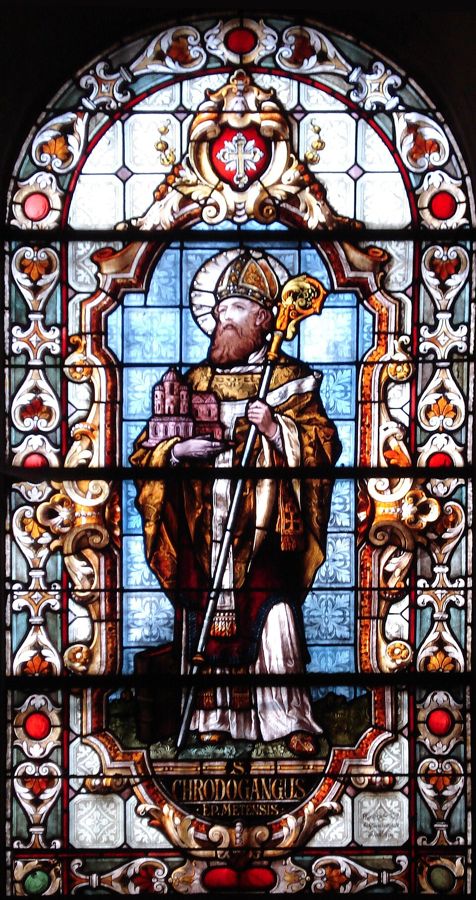
This Saint’s Story
Baring-Gould says he was educated at the abbey of St. Trond, while the Catholic Encyclopedia places his education at the court of Charles Martel. There he became Charles's private secretary, then chancellor, and in 737 his chief minister.
On 1 March 742 he was appointed Bishop of Metz, and at Pepin's request he kept his civil office. The Encyclopedia describes him as working steadily for both Church and State and for close union between their rulers. In his diocese he introduced the Roman liturgy and chant. He founded the Abbey of Gorze near Metz in 748, established St. Peter's on the Moselle, and did much for Gengenbach and Lorsch (a famous Benedictine abbey near Worms, Germany). He is said to have obtained the relics of St. Nazarius for Lorsch and those of St. Gorgonius for Gorze.
In 753 Pepin sent him to Pope Stephen to assure the pope of Frankish support against Aistulf, King of the Lombards, and he went with the pope to Ponthieu. Baring-Gould instead describes an embassy to Aistulf himself in 754 that came to nothing. After the death of St. Boniface, Pope Stephen gave Chrodegang the pallium (754–755). This made him an archbishop personally, but Metz itself was not raised to an archdiocese.
His best-known work is the rule he gave the clergy of his cathedral about 755, so that they lived together in one house. It had thirty-four chapters modelled on the Rule of St. Benedict, and among other things Baring-Gould notes that the canons were to confess to the bishop before Advent and Lent. The rule gave a strong impetus to community life among the secular clergy and was later expanded to eighty-six chapters. In 762, during a dangerous illness, he formed among his priests a confraternity of prayer, the League of Attigny.
The Encyclopedia remembers him as imposing in appearance, mild but firm, generous to the poor, and skilled in Latin and German. He died at Metz on 6 March 766 and was buried at Gorze. Baring-Gould records that his relics disappeared at the Revolution.
