St. Bernard

Bernard of Clairvaux was born in 1090 at Fontaines near Dijon, third of the seven children of Tescelin, lord of Fontaines, and Aleth of Montbard.

Read the essentials →
Feast August 20 · Abbot, Deacon

St. Bernard

Current feast

August 20
Verified · General Roman Calendar

Traditional feast

August 20
1914 / pre-1969 calendar, per Baring-Gould (1897)

Represents

Abbot
Deacon

Feast days

Feast: August 20

This Saint’s Story

Baring-Gould dates the birth 1091. Educated at Châtillon-sur-Seine, he early turned from worldly ambition. In 1113, with about thirty young noblemen of Burgundy, he entered Cîteaux under St. Stephen Harding. Three years later Stephen sent him to found a new house in the Valley of Bitterness in the diocese of Langres; Bernard named it Claire Vallée—Clairvaux—on 25 June 1115, and was blessed as abbot by William of Champeaux.

The beginnings were severe enough to break his health until friends and the General Chapter made him moderate. Disciples flocked in; his father and brothers entered Clairvaux, and his sister Humbeline later took the veil at Jully. He founded, the Encyclopedia says, one hundred and sixty-three monasteries; at his death the houses numbered three hundred and forty-three. At the Council of Troyes in 1128 he helped shape the Rule of the Knights Templars, and he praised the new militia in De Laudibus Novae Militiae.

In the schism of 1130 he judged for Innocent II against Anacletus II, won the great powers to Innocent's side, and helped end the quarrel. About 1140 he opposed Abelard's new errors; the Encyclopedia calls their conflict the great episode of the twelfth century. When Edessa had fallen, Pope Eugenius III—himself taken from Clairvaux's daughter house of Three Fountains—commissioned him to preach a new Crusade. Bernard preached at Vézelay before King Louis VII and again in Germany; Conrad took the cross from his hand. The expedition failed, and he bore the grief of it.

He wrote the sermons on the Canticle of Canticles, the Book of Considerations for Eugenius, and many letters and treatises. He died at Clairvaux on 21 August 1153, in his sixty-third year. Alexander III canonized (officially declared a saint by the pope) him on 18 January 1174—Baring-Gould says 1165—and Pius VIII named him a Doctor of the Church (a title the pope gives to a saint whose teaching is of special value to the whole Church).

What he represents

How he teaches us to live

Drawn from themes in the original account

Share your faith, in words and by example. Preaching and conversion are part of this story.

Build up the community you belong to. Community life is part of this story.

Give to people in need. The account records care for the poor.

The full story

Baring-Gould’s account retold in modern English

Read the full story · 5,811 words · about 25 min

…meant, in the Burgundian dialect, reddish or russet-haired. Tesselin’s wife was Alitha, a devout and God-fearing woman. She bore him seven children: six sons and a daughter. She dedicated her boys to the Lord as soon as they were born. She practiced charity in a very practical way in her neighborhood. Bernard was born in 1091, and when he was old enough, he was sent to school at Cîteaux. He quickly fulfilled his mother’s hopes with his skill and knowledge. He was studious and reserved, preferring to be alone, and he was described as “marvellously cogitative.”

Another account describes him as eager and ambitious for literary fame, engaging in a vigorous rivalry with his peers in poetry and witty exchanges.

Saint Bernard was transitioning from boyhood to youth when his mother died in 1105. After her death, Bernard, with a heavy heart, imagined that he saw her visiting him at night in visions, encouraging him to pursue his good intention of becoming a monk.

However, he faced a struggle before he could finally choose the ascetic life. His mind was expanding and craved greater intellectual growth. The schools of Paris were rapidly becoming centers of intellectual life and activity. Philosophy, after a long period of dormancy, began to captivate people's minds once again. It was not easy for Bernard to suppress the intense desire of his mind for intellectual pursuits and instead commit himself to the spiritual well-being of his soul, which he resolved to nurture. Bernard convinced his uncle and two younger brothers, Bartholomew and Andrew, to leave the world with him. He also persuaded another brother, Guido, to abandon his young wife and join him in the cloister. At the age of twenty-two, in 1113, Bernard and his companions knocked at the gate and entered the walls of Cîteaux. Cîteaux was gaining fame, and soon the small monastery had more residents than it could comfortably accommodate. A group of monks was sent out, led by an older brother named Bertrand, to establish the Abbey of La Ferté. Hugh of Macon soon became the leader of another group from the original monastery and founded a house at Pontigny. By 1115, just two years after Bernard and his companions arrived, it became necessary to seek ways to establish another offshoot of the now thriving Cîteaux.

Twelve monks, led by Bernard, were sent out. Bernard traveled northward, covering nearly ninety miles, following the course of the Seine until he reached La Ferté on the Aube. About four miles beyond La Ferté was a deep valley opening to the east; thick woods gave it a gloomy and wild character, but a clear stream running through it provided relief from its dreariness, promising fresh drinking water and abundant fish ponds for settlers along its banks.

In June, A.D. 1115, Bernard settled in the valley of Wormwood, as it was then called, and began to search for ways to find shelter and food for the coming winter. The simple structure that he and his monks built with their own hands was long honored by the Cistercians. It was a building covered by a single roof, under which the chapel, dormitory, and dining hall were all included. Neither stone nor wood covered the bare earth, which served as the floor. Windows, barely wider than a man's hand, let in a weak light. In this room, the monks had their simple meals of herbs and water.

Directly above the dining hall was the sleeping area. It was accessed by a ladder and was essentially a loft. Here were the monks' beds, which were boxes made of wooden planks, long and wide enough for a man to lie down on. The inside was covered with chaff or dried leaves.

At the top of the stairs was the abbot's cell. It was very small. A framework of boards was placed over the staircase to save space for a bed. Two rough-hewn logs of wood served as the abbot's pillows. The roof was low and slanted so much that it was impossible to sit upright near the wall. Small openings in the roof let in light and air, but too often also snow, rain, and cold winds. The monks had managed to get a roof over their heads, but they had little else. They had left Citeaux in June. Their journey likely took them two weeks, and their clearing and building preparations probably took another two months. Therefore, they would have been nearing September when this part of their work was completed. Autumn and winter were approaching, and they had no food stored except for the beech mast collected in the woods and some edible roots. Their lack of food was made worse by the wear and tear on their shoes and clothes. Their needs increased with the harshness of the season, until they eventually ran out of salt. The kindness of neighbors kept the struggling group alive during the winter. Once this crisis passed, a brighter future opened up for Clairvaux. First, curiosity, and then sympathy from the local community grew, and Clairvaux soon became secure from the challenges that had threatened its early existence.

The hard work, worries, and hardships were too much for Bernard, and he became seriously ill. His friend, Bishop William of Chalons, intervened and insisted that he take complete rest and ease up on his strict fasting. This helped save Bernard's life.

Joseph Meglinger, a monk from Wettingen, visited Clairvaux in 1667 and provided a description of the old monastery, which was well-preserved. It was Bernard’s frequent wish and determination not to leave his monastery unless commanded by his superiors. In 1125, he made two journeys, one to Paris and the other to La Grande Chartreuse, and it is likely that both were related to monastic matters.

The Carthusian Order was founded by Saint Bruno in 1084. The prior whom Saint Bernard visited was named Guigo. He and Bernard had been corresponding before they met in person. Guigo welcomed Bernard at his gates with joy. However, his happiness was overshadowed by the fact that Bernard rode on a saddle that was too comfortably padded and too elegantly decorated to align with his vow of self-denial. Guigo expressed his concerns. Bernard was surprised by this. During his travels, he had not noticed the saddle, which had been lent to him by his uncle, a Cluniac monk. Guigo accepted this explanation with satisfaction and marveled at the depth of contemplation that had kept Bernard unaware of what Guigo noticed immediately.

During Bernard’s visit to Paris, he was encouraged to enter the schools and lecture to the young men gathered there. Instead of appealing to their intellects, he spoke to their consciences and urged his listeners to abandon the empty thoughts of academic pursuits so they could focus all their efforts on the discipline of the soul. He was met with indifference.

That night, he spent time in tears and prayer. His sobs could be heard throughout the house where he stayed. The next day, he preached again and “converted” many scholars, meaning he persuaded them to become monks. However, these extensive travels were quite unusual for Bernard at this time. Later in his life, when he was involved in or led every significant event in the Church, he traveled extensively across much of Europe more than once. But at this moment, and for a few years afterward, he remained a secluded monk of a new and humble Order.

His influence was gradually growing, and the foundation was being laid for the authority and respect that would allow him to play a leading role in resolving a widespread schism and in providing strong support for the Second Crusade.

At this time, the main way Bernard’s power and significance were felt was through his vigorous and persistent correspondence. He was an incredibly tireless letter writer. He wrote to people from all walks of life on various topics, ranging from the most spiritual experiences of an ecstatic soul to the theft of pigs.

Pope Honorius II died in 1130. Because factionalism and party spirit in Rome had often influenced the Sacred College and led to scandalous outcomes, the Cardinals agreed that the election of a new Pope should be entrusted to eight of their members. This was done with the specific aim of avoiding disputes. However, even though William, Bishop of Praeneste, made them commit under the threat of an anathema to uphold this agreement, and even though the ambitious Peter Leonis expressed his support for it, it quickly became clear that neither faction intended to adhere to the terms unless it suited their interests, using it merely as a cover for their schemes.

Peter Leonis led the strongest faction in Rome and had the largest group in the conclave, but in the newly formed committee, his supporters were in the minority. A rumor spread that Honorius was dead. Peter appeared with a group of supporters, and if the dying Pope had not been brought to a window and shown to the people, it is likely that Peter would have outmaneuvered the other faction and claimed the chair of St. Peter through swift action. However, when the Pope did die, the opposing faction hid this fact from Peter Leonis's followers and quickly elected Gregory, Cardinal of St. Angelo, who took the name Innocent II.

Peter's faction immediately protested, elected Peter, and declared him the true Vicar of Christ under the title of Anacletus II. Rome was now filled with two factions of fierce supporters, who soon combined their spiritual threats with violence and bloodshed. Innocent II fled to France, where he was quickly recognized as the rightful Pope by the monks of Cluny. However, the French king and bishops were uncertain about who was the true leader of the Church, and it was decided that St. Bernard should act as an arbitrator between the claims of Innocent and Anacletus. A council was convened at Etampes, where Bernard declared his support for Innocent.

Louis VI and the French bishops accepted his decision and pledged allegiance to Innocent. Bernard, with all his fervor, then advocated for the Pope who had gained recognition through his ruling, urging Henry I of England and the German Emperor to support this Pope. Bernard's strong personality won allegiance for Innocent everywhere. He traveled to Italy with the Pope, declaring that Anacletus was the Antichrist and the Beast of the Apocalypse, and that the only rightful and true Vicar of Christ on Earth was Innocent.

But Bernard began to feel that he could not stay away from home for much longer without causing serious problems for both himself and his community at Clairvaux. During the four years he spent supporting the Pope’s cause, he could only make a few brief visits to Clairvaux. It is believed that he returned there at the beginning of the year 1135. His long-awaited arrival brought immense joy to his friends and the monks. And it was not just them. By this time, his reputation for extraordinary holiness had spread throughout Europe, so that wherever he went, even shepherds came down from the hills and farmers from their fields to ask for his blessing. When he reached Langres, he was greeted by a group from Clairvaux, who, with hugs and tears of joy, led him home. The entire convent gathered to welcome their abbot. Their joy was not chaotic or overly demonstrative, but rather serious, with a profound love shining through. During the abbot’s long absence, there had been no conflicts, troubles, or scandals. There were no discussions or disputes waiting for Bernard’s return; no grudges held in anticipation of his arrival. Old and young, rich and poor, high and low, knights and serfs were all living together in harmony and Christian brotherhood. Bernard, we are told, was deeply humbled by this sign of God’s favor. The fact that his efforts seemed to flourish filled him with a sense of reverent awe, not pride. In fact, his humility often strikes his biographer, Arnold of Bonnevaux, as the most remarkable of his many extraordinary qualities.

“When he was a chosen vessel, and proclaimed the name of Christ before nations and kings; when the princes of this world bowed down to him, and bishops from all lands awaited his commands; when even the Holy See respected his counsel and appointed him a sort of general representative to the world; when, most importantly, his words and actions were confirmed by miracles, he was never arrogant. Instead, he always humbly regarded himself as the servant, not the originator of great works; and while everyone else considered him the greatest, he saw himself as the least. Whatever he accomplished, he attributed to God. He recognized and felt that he could neither desire nor achieve any good thing without God’s inspiration.”

Yet he was the most self-assured of men when it came to following his own opinions, disregarding any claims that contradicted his preconceptions. This was particularly evident in the election of the Bishop of Langres and in the case of Saint William of York.

While Saint Bernard was in Rome in 1137, the Archbishop of Lyons, along with the Dean and a Canon of Langres, came there. The latter two were seeking permission for the Chapter to elect a Bishop for the See of Langres. Bernard immediately desired the see for one of his monks from Clairvaux. He tried to pressure the dean and canon into agreeing to elect only someone he approved of, and he wanted the Archbishop to agree to consecrate the chosen man according to Bernard’s wishes. This outrageous demand surprised the Archbishop and the dean. They gave a superficial agreement, but upon returning to France, the Chapter of Langres elected a Cluniac monk instead of a Clairvaux monk. Bernard's anger was immense. He condemned the bishop-elect as a “man of whom he had bad reports” and labeled the election “a nefarious business.” He hurried to Lyons to either threaten or persuade the Archbishop. The Archbishop quickly gave in, stating he would follow Bernard’s wishes against his own judgment. “No,” said Bernard, who believed his opinion was directly inspired, “not mine, but God’s will be done.”

Meanwhile, the bishop-elect appealed to the king, who, finding that the election had been conducted according to canon law by the chapter, granted him the temporalities of the see. Bernard wrote to the Pope; his first letter was quickly followed by others, as his anger and indignation grew. In fact, throughout his life, he never used more extreme, inappropriate, or unfair language than he did in this situation. Two things are clear: first, that his initial appeal to Rome was ignored, and second, that Bernard would do everything possible to damage the reputation of any bishop-elect who was not a Clairvaux monk. To respect and acknowledge this bishop was to “bow the knee to Baal,” “to make a covenant with death, and with hell to conclude an agreement.”

Peter of Cluny, also known as Peter the Venerable, was one of the most gentle and loving figures of the Middle Ages. He wrote a letter of reprimand to Bernard. In this letter, he stated that the monk who had been elected had been under his guidance for a long time. He described the monk as a good and humble man who had been canonically elected by the chapter. If Bernard had heard rumors about the monk's character, he should not have listened to them, let alone spread them, until he had verified whether there was any truth to them. In reality, these rumors were completely unfounded calumnies. Peter was in a better position than anyone else to know this, as he was the abbot of the monastery where the bishop-elect had lived for many years.

“It was unworthy of you, or of any good man, to believe the obvious enemies of ours and to give credence to declared foes of Cluny. In a private conversation, I could have explained the entire situation to you and shown you how a cloud of falsehood, rising from the depths of darkness, has tried to obscure the clarity of your mind. Do not fear that this monk, as a Cluniac, will not love Cistercians. Discard such a thought. A monk will love other monks. The Bishop of Langres, having been a monk, will love Cistercians and all monks because he understands that love is beneficial and hatred is detrimental. Nor will a monk of mine dare to disagree with me when he sees how much I love you.”

Despite this firm yet kind letter, it had no effect on Bernard. He held onto his preconceived notions, believing that his will was, without a doubt, God’s will. He mocked the gentle Abbot of Cluny, accusing him of “boasting in the multitude of his riches and elevating himself to oppose me, and not just me, but the servants of God—even God Himself, all justice and honor.” The Pope, the cardinals, and the bishops all yielded to Bernard's forceful approach. As a result, Bernard succeeded in having the Cluniac monk removed and replaced by a relative, Godfrey, a monk from Clairvaux.

Another example of Bernard's excessive language and actions involved Saint William of York. William, who was the nephew of King Stephen, had been elected as the Archbishop of York. However, Bernard wanted this important position to be filled by one of his own monks from Clairvaux, named Henry Murdac, whom a minority in the chapter had shown a preference for. Bernard wrote angrily against Saint William, accusing him of ambition—of something worse than ambition—of simony, and condemning him to eternal damnation.

Pope Innocent II ordered the Bishop of Winchester to act as his representative in England and to investigate the case. Those who had accused Saint William did not dare to appear and present their defamatory charges openly before him. The legate immediately consecrated Saint William. At that time, Innocent II, who had long been under Bernard's influence, had become estranged from him. He was unwilling to remove an innocent man from his archbishopric simply so that an unknown, uneducated monk from Clairvaux could take his place.

But Innocent died in 1143, and when, in 1145, Bernard was pleased to see one of his own disciples, a Cistercian monk, on the Papal throne, there was no hesitation in removing Saint William from the coveted position, which had been confirmed to him by Pope Lucius II, and elevating the obscure monk from Clairvaux in his place. The Chapter of York was displeased with this action, and the citizens of the town closed their gates against the newly installed archbishop. Murdac died in the same year as Pope Eugenius III, in 1153, and Saint William then quietly resumed his office, amidst the turmoil caused by Bernard.

rejoicings of an enthusiastic people. He was canonized by Honorius III. These are instances, and sad ones, of how the best and humblest of men may forget the broad principles of justice and charity if carried away by ambition for the advancement of a cause on which he has set his heart. Bernard was almost as unjust in his treatment of Abelard. This distinguished thinker saw that the awakening mind in Europe would no longer rest satisfied with blind acceptance of the doctrines of the Church, without being made to see that there was reason in them. He attempted to show that there was a philosophy in Christian belief. Saint Anselm had done the same. But Bernard, who had resolutely suppressed his desire for intellectual activity, when these hidden thoughts began to emerge, would not tolerate for an hour the idea that Faith required the support of Reason. In Bernard’s eyes, the intellect, if not carefully guided and controlled, was not a friend but a foe to man’s welfare; not a guiding star to lead him, but a misleading light to deceive him. To resist its questions and doubts was part of a good man’s duty. They were carnal and devilish, just like the lusts of the flesh. Truth had been given to man, once and for all, in the teaching of the Church. No conclusions of the mind could add to its certainty; none could diminish it. It was there, accessible and understandable to all, absolute, complete, and final. It had overshadowed man’s life for hundreds of years now, vast and enduring like the great vault of heaven. A conflict between Saint Bernard and Abelard was inevitable. Neither could understand the other, nor did either attempt to do so. The Abbot of Clairvaux spread his fiery appeals across Europe to the Pope, cardinals, princes, and bishops, urging them to help crush this Arius, Pelagius, and Nestorius, all rolled into one. With a cry almost of anguish, Bernard confessed that Abelard had his admirers and followers even among the cardinals of the papal court. The two leaders were watching each other as they prepared for battle. War had begun, but was not yet openly declared. Abelard resolved to anticipate the attack. He sought Henry, Bishop of Soissons, and demanded to be heard publicly before an assembly, confronting his persistent accuser.

It was announced far and wide that a fierce logical combat was going to relieve the monotony of the council summoned to meet at Sens, a contest between the cold philosopher and the fiery mystic. Nothing in modern life can give an adequate idea of the interest and excitement such an announcement would produce.

The original purpose of the meeting at Sens was a ceremony that was of great interest to the public in the Middle Ages — an exhibition of certain highly sacred relics for the eyes and worship of the crowd. King Louis VII was present, along with a gathering of bishops, abbots, and nobles from the northern regions of France. The first day of the council was dedicated to the inspection and veneration of the sacred relics, as well as discussing a vision regarding the rebuilding of the archbishop’s palace, which had been revealed to a young canon.

Abelard arrived on the second day and immediately found himself in a hostile environment. He stopped in the center of the building and faced Bernard, who was standing in a pulpit that remained in existence until the French Revolution, holding Abelard's controversial work in front of him.

A clerk was instructed to read the passages that Bernard had marked as heretical. Berengar of Poitiers describes the scene in an “Apology.”

THE VISION OF BERNARD. The Blessed Virgin appearing to St. Bernard and sharing her story. After a fresco by Filippino Lippi, at Badia, Florence.

“After dinner, Peter (Abelard’s) book was brought in, and someone was told to read it aloud. The man... shouted louder than he was supposed to. Soon, the pontiffs began to insult Abelard by applauding with their feet, laughing, and acting foolishly, praising among themselves the cups and the wine that had wet the episcopal throats. Their hearts were drowned in the sleepy fluid. When anything subtle, divine, or unusual to their ears was heard during the reading, they gnashed their teeth at Peter (Abelard); and the dullards, judging a philosopher, exclaimed, ‘Shall we allow this wretch to live?’ Shaking their heads, they said, like the Jews of old, ‘He destroys the temple.’ The effects of the wine had so clouded their minds that all their eyes were drooping from sleep. Still, the reader continued droning on; the assembly snored. One leaned on his elbow, another found a cushion, and a third rested his head on his knees. So, when the reader reached a difficult passage, he called out to the deaf ears of the bishops, ‘Do you condemn this?’ Hardly awake at the last syllable, in a sleepy voice, and with drooping heads, they muttered ‘We condemn.’ Others, however, roused by the noise of the condemners, cut off the word and said ‘We condemn.’” It was difficult, on a hot day in June, after a heavy meal, to be asked to listen to complex philosophy read for hours. The scene is likely exaggerated, but there is probably some truth to it.

No wonder Abelard refused to argue his case before an assembly that was not capable of understanding his propositions and deductions. His philosophical arguments were unintelligible to most of the audience, and they were not presented in their proper sequence and entirety. Bernard had picked out isolated sentences here and there and, at least in one case, attributed to Abelard words that he had never written, but which the Abbot of Clairvaux thought could be inferred from his words. Abelard rose from his seat, declined to hear more or answer any questions, and appealed to Rome. Bernard’s friends immediately proclaimed that when the heretic should have been at his clearest and strongest, sudden darkness, confusion, and paralysis fell upon him — that Abelard's refusal to plead against Bernard was a miracle. But it is easy to see the reason for this silence. In vain would a deep thinker argue before a slumbering audience — an audience of men who were good and pious enough, no doubt, but utterly incapable due to a lack of mental training for following an intellectual discussion. The votes of his philosophical friends would be completely overwhelmed by the voices of the dull majority, eager to condemn a man on the accusation of heresy, lest their own orthodoxy be called into question. An appeal to Rome caused delay and difficulty for his opponents. And it is quite certain that this maneuver partly succeeded.

The assembly at Sens was in considerable confusion about what course to take. Pope Innocent owed much to Bernard, but he could hardly fail to be impatient with the constant dictation from Clairvaux; and indeed, shortly after these events, he did break off friendly relations with him.

Peter Abelard, on his way to Rome with his appeal, rested at Cluny. The gentle, dove-like Peter the Venerable was still the abbot there. He saw an old man, broken by misfortune, misunderstood by an age that was centuries behind him, hunted down by relentless foes, eager for his condemnation and excommunication. He spread his wing over him and sheltered him at Cluny, and there, not long after, the active and audacious mind entered into its final rest. Abelard died in 1142.

Bernard was now called to preach the second Crusade. At this time, he was fifty-five years old, which was considered old for his age. The last fifteen years had been filled with heavy work and constant worry. He had spent eight years troubled by the schism, made three journeys to Rome, dealt with the controversy involving Abelard, and faced frustrations from political disputes in France, where he was asked to intervene. He had hoped to rest now and spend his later years in peace among the beech woods and by the brook of Clairvaux. But that was not to be.

He was summoned by the Pope and the King of France from his retreat to inspire the waning enthusiasm of Christians for the Crusades. At Easter in 1146, he was at Vezelai to attend a large gathering on this topic. Pale and thin to a degree that seemed almost supernatural, those around him noticed something in the mere glance of his eyes that filled them with wonder and awe. To them, his very existence seemed like a constant miracle; and when the light from his thin, calm face shone on them, when his voice came from those firm lips like sparks of fire, all the listeners were filled with zeal and lost control of their emotions. When Bernard spoke from a wooden platform set up on a hill, a murmur, then a roar, rose from the sea of upturned faces, shouting, “Crosses, Crosses!” Bernard began to distribute the large number of crosses that had been brought for that purpose. They were soon all given out. He had to tear up his monk’s cowl to meet the demand. The summer of 1146 was spent in France. As autumn approached, Bernard began to move into the less familiar territory of Germany. Up to this point, the German nation had been much less involved in the Crusades than the French, and it was believed that Emperor Conrad III was strongly opposed to the current expedition. Therefore, Bernard prepared for a major effort. He visited and preached in Freiburg, Basel, Constance, Spires, Cologne, Frankfurt, Mainz, and many other towns in northwestern Germany. Each day, the same events occurred — the entire population rushed to see and hear him; then, many of the able-bodied men took up the cross. Bernard himself noted that there was scarcely one man for every seven women; castles and towns were left empty. The general excitement erupted along the Rhine and Moselle rivers in the massacre of Jews. Bernard hurried to Mainz to protect the unfortunate Hebrews and redirect the misguided and poorly managed enthusiasm of the Christian zealots.

In 1147, the Crusaders set out, with the Germans going first and the French following. The Germans were led by their Emperor, Conrad, while the French were led by their King, Louis. Byzantine agents tried to count the Crusaders as they crossed a river, but after estimating nine hundred thousand, they gave up on the daunting task. The cavalry of both the Emperor and the King consisted of seventy thousand knights and their immediate attendants. The total number of the entire group is unknown. Odo of Deuil claims there were nine hundred thousand five hundred and fifty-six. The Muslims claim there were two hundred and sixty thousand. These exaggerated numbers only reflect the astonishment of those at the time and indicate that Bernard, through his preaching, likely sent most of the healthy, able-bodied men of Western Europe to the East. However, not even a tenth of that vast horde ever reached the Holy Land. Many died from disease, starvation, or by the swords of the Muslims. In Asia Minor, Louis and Conrad abandoned the unwieldy crowd at Attalia and hurried by boat first to Antioch and then back home in confusion and despair. Among those who survived, many converted to the Muslim faith to save their lives.

When Louis, defeated and disheartened, returned to his kingdom almost secretly, grief and mourning filled the land. Every family was in mourning for a lost relative. Soon, public anger turned against S. Bernard, whom they blamed for this great disaster. They questioned why he preached this Crusade, why he predicted its success, and why he performed miracles to encourage people to join. In response, Bernard wrote an Apology. He placed all the blame on the Crusaders themselves. He argued that their shameful and miserable failure was due to their sins. However, his disappointment and frustration are evident in some of his comments: “Do not the Gentiles say, Where is now their God? And who can wonder? The sons of the Church, the men called Christians, have been overthrown in the desert, slain with the sword, or destroyed by famine. We promised good things, and behold disorder! As if we had acted rashly or carelessly in that undertaking. And yet I did not run that course with uncertainty, but at your command” — he is addressing Pope Eugenius III — “or rather at the command of God through you. The judgments of the Lord are righteous, as each of us knows; this one is an abyss so deep that I dare to say blessed is he who is not ‘scandalized at it.”

The time of Bernard’s end was approaching. In 1153, at the age of sixty-two, he passed away. He did not wish to linger. When, in line with his strong faith, he attributed a slight recovery to the prayers of his grieving monks, he said to them, “Why do you hold back a miserable man? You are stronger, and you are winning against me. Spare me, spare me, and let me go.” The tireless spirit that had previously defined him gradually faded. The restless mind, which had influenced nearly every question and event in Europe for a whole generation, slowly found peace. Public matters no longer interested him. When his cousin, the Bishop of Langres, came to him about some business, he found that he could not capture Bernard’s attention. “Do not marvel,” said the dying saint, “I am already no longer of this world.” The Bishop of Langres was by his dying side! One of his significant mistakes and wrongs was present before his closing eyes. Did he then see the error he had made and regret it? We cannot say. The grieving crowd of his friends, in their overwhelming sorrow, begged him not to leave them, to have compassion on them, and to stay with them. The last earthly struggle he ever experienced began in Bernard’s soul. Temporal matters and eternal matters, his earthly home and his heavenly home, the love of God and the love of man battled within him. But only for a moment. Raising his “dove-like eyes,” he expressed his desire that God’s will might be done. It was, for he was dead.

“After life’s fitful fever, he sleeps well.” Bernard was a man with a single purpose — the glory of God. That he made mistakes — and he made significant ones — that he was driven by his zeal to commit injustices, to speak harshly, and to support a false, disastrous policy, was the fault of his mind, not his heart. What he believed was right, he pursued with all his strength; he did not turn to the right or to the left from what he thought was his duty. That he sometimes erred in his judgment, what does it prove? That he was human. The saints of God are not those who never made mistakes, but those who have a singular aim.

Saint Ronald. The body of Bernard was preserved at Clairvaux until the French Revolution, when the abbot hid the skull and placed his seal on it. The saint's bones were taken away and protected from desecration by the local people, who concealed them at Ville-sous-la-Ferté. There the bones remain to this day, but the skull is in the Cathedral of Troyes.

The few remaining parts of Clairvaux have been turned into a prison. The cellar and the dining hall are the most notable remnants of the ancient abbey that still exist. In the forest, there is a spring called the fountain of St. Bernard, to which a procession is held every year on the Tuesday after Low Sunday. The prisoners have erected a cross at this spot in honor of the saint.

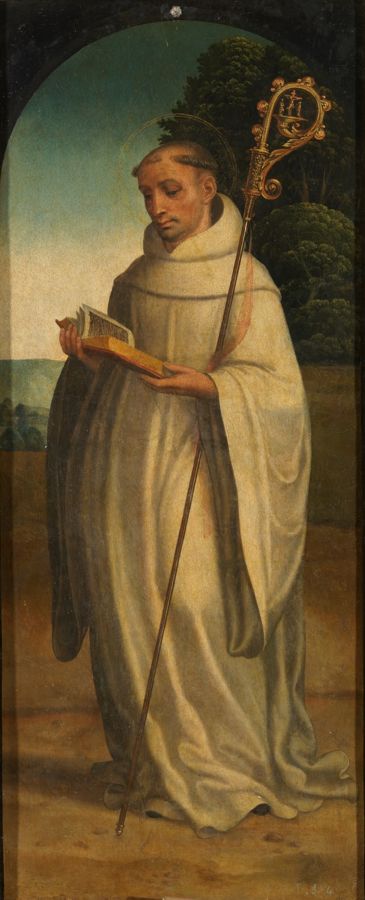
St. Bernard is depicted in art with a hive of bees, partly because he is known as the "Doctor Mellifluus" (Sweet-voiced Doctor), but also because Clairvaux, which he led, was like a hive, where all his monks were busy like bees.

Footnotes

  1. The Cistercians were a religious order founded in 1098.
  2. Guigo was the prior of the Carthusian Order.
  3. Cluniac refers to a monk from the Cluny Abbey in France.
  4. Praeneste: an ancient city in Italy, now known as Palestrina.
  5. St. Bernard: a prominent monk and theologian of the 12th century.
  6. Louis VI: King of France from 1108 to 1137.
  7. Henry I: King of England from 1100 to 1135.
  8. Saint William of York was a bishop in England during the 12th century.
  9. Bernard's first appeal to Rome was disregarded.
  10. Bernard would leave no stone unturned to damage the character of any bishop-elect who was not a Clairvaux monk.
  11. Bernard referred to Peter as boasting in his wealth and power.
  12. Innocent II died in 1143.
  13. Eugenius III died in 1153.
  14. Honorius III was Pope from 1216 to 1227.
  15. Saint Anselm was an Italian Benedictine monk and theologian.
  16. The Abbot of Clairvaux refers to Bernard of Clairvaux, a major figure in the Cistercian order.
  17. Berengar of Poitiers was a theologian and philosopher.
  18. The Blessed Virgin refers to Mary, the mother of Jesus.
  19. St. Bernard was a prominent medieval theologian and abbot.
  20. The words which Bernard cites as the exact words of Abelard are not word for word either in his commentary on the Epistle to the Romans, nor in the copy of the Sentences published by Rheinwald.
  21. Odo of Deuil claims there were nine hundred thousand five hundred and fifty-six.
  22. The Muslims claim there were two hundred and sixty thousand.
  23. Bernard wrote an Apology.
  24. He is addressing Pope Eugenius III.
  25. The abbot concealed the skull and placed on it his seal.
  26. The bones of the saint were carried off and protected from insult by the inhabitants of the neighbourhood.
  27. Doctor Mellifluus: Sweet-voiced Doctor.

Baring-Gould’s own footnotes, in modern English.

Read the original 1870s text

Baring-Gould’s sources: Roman Martyrology, canonized by Alexander III. in 1165. Authorities: —A life, the first book by William, Abbot of S. Thierry; the second by Ernald, Abbot of Bonneval; the third by Ganfrid, secretary of S. Bernard afterwards Abbot of Clairvaux, d. 1180; the fourth and fifth books by the same; the sixth book, on the miracles of S. Bernard, by Philip, monk of Clairvaux, Gaufrid of Clairvaux, and an epistle from the monks of Clairvaux to the clerks of Cologne. Another life of S. Bernard, by Alanus Bishop of Auxerre, d. 1185. Epistola de morte S. Bernardi, by the abovenamed Gaufrid. Another life by Bernard Guntolf, monk, written in metre 13th cent. Another by John the eremite, &e.] S. Bernard was a Burgundian by birth. A mile outside the walls of Dijon, in full view of the range of the Cote d’Or hills, stood a castle, crowning a small height called “ Les Fontaines/' from the limpid springs which gush from its base. This castle belonged to S. Bernard’s father, Tesselin, a brave knight, a friend and vassal of the Duke of Burgundy. Tesselin had the surname of Sorus, which

…meant, in the Burgundian patois, reddish, or russet-haired. Tesselin’s wife was Alitha, a pious, God-fearing woman. She bore him seven children, six sons and a daughter. Her boys she offered to the Lord as soon as they were born. Charity of the most practical kind was exercised by her in her neighbourhood. Bernard was born in 1091, and when he was old enough, was sent to school at CMtillon. He soon fulfilled his mother’s hopes by his proficiency. Studious and retiring, he loved to be alone, and was “ marvellously cogitative,” we are told.

Another account describes him as zealous and ambitious of literary fame, and as carrying on a vigorous rivalry with his fellows in verses and repartees.

S. Bernard was passing from boyhood to youth when his mother died, a.d. 1105, and after her death the aching heart of Bernard led him to imagine he saw her visit him at night in visions, and encourage him to accomplish the good resolve of becoming a monk.

Yet he had a struggle to go through before he could choose finally the ascetic career. His mind was expanding, and craved for greater growth. The schools of Paris were rapidly becoming centres of intellectual life and activity. Philosophy once more, after a long night of sleep, began to exercise a spell on men’s minds. It was not without an effort that Bernard quelled the fervent straining of his mind for intellectual activity, and condemned it to bondage to the soul, whose welfare alone he resolved to cultivate. Bernard persuaded his uncle and two younger brothers, Bartholomew and Andrew, to abandon the world with him. Guido, another brother, he persuaded to desert his young wife, and fly to the cloister. At the age of twenty-two in 1113, Bernard and his companions knocked at the gate, and disappeared within the walls of Citeaux. Citeaux was growing in fame, and soon the small monastery had more inmates than it could conveniently hold. A colony of monks was despatched, under the guidance of an aged brother named Bertrand, to found the Abbey of La Ferte. Hugh of Macon in a short time was the leader of another swarm from the parental hive, and established a house at Pontigny. And already, in in 5, two years after the arrival of Bernard and his companions, it was necessary to look out for the means of founding another offshoot of the now prolific Citeaux.

Twelve monks, under Bernard, were sent forth. Bernard struck northward, and for a distance of nearly ninety miles he kept this course, passing up the source of the Seine, till he arrived at La Ferte on the Aube. About four miles beyond La Fertd was a deep valley opening to the east; thick woods gave it a character of gloom and wildness; but a clear stream which ran through it was sufficient to relieve its dreariness, and promise pure drinking water and full fish ponds to settlers on its banks.

In June, a.d. 1115, Bernard took up his abode in the valley of Wormwood, as it was then called, and began to look about for means of shelter and sustenance against the approaching winter. The rude fabric which he and his monks raised with their own hands, was long preserved by the pious veneration of the Cistercians [strict Benedictine reform begun at Cîteaux in 1098]. It consisted of a building covered by a single roof; under which, chapel, dormitory, and refectory were all included. Neither stone nor wood hid the bare earth, which served for floor. Windows, scarcely wider than a man’s hand, admitted a feeble light. In this room the monks took their frugal meals of herbs and water. Immediately above the refectory was the sleeping apartment. It was reached by a ladder, and was in truth a sort of loft. Here were the monks’ beds, boxes of wooden planks, long and wide enough for a man to lie down on. The inside was strewn with chaff, or dried leaves.

6". Bernard. At the summit of the stair was the abbot’s cell. It was of most scanty dimensions. A framework of boards was placed over the flight of steps, in such a manner that the space might be economized for the purpose of a bed. Two rough-hewn logs of wood were the abbot’s pillows. The roof was low, and slanting to such a degree that it was impossible to sit upright near the wall. Little openings in the roof admitted light and air, and too often also snow, rain, and cold winds.1 The monks had thus got a house over their heads; but they had little else. They had left Citeaux in June. Their journey had probably occupied them a fortnight, their clearing preparations and building perhaps two months; and thus they would be near September when this portion of their labour was accomplished. Autumn and winter were approaching, and they had no store laid by except the beech-masts collected in the woods, and such roots as were fit to be eaten. Their privations caused by insufficient food were heightened by the wearing out of their shoes and clothes. Their necessities grew with the severity of the season, till at last even salt failed them. The charity of neighbours kept the miserable band alive during the winter. This crisis over, a brighter prospect opened on Clairvaux. The curiosity first, then the sympathy of the neighbourhood was attracted, and Clairvaux was soon placed beyond the reach of those trials which had threatened to extinguish its infancy.

The labours, anxieties, and privations had been too much for Bernard, and he fell dangerously ill. His friend, Bishop William of Chalons, interposed and insisted on his taking complete rest and relaxing..his severe fasting. By this means he saved Bernard’s life.

1 Joseph Meglinger, a monk of Wettingen, in 1667, visited Clairvaux, and gives a description of the old monastery, which was carefully preserved. Meglinger's It was Bernard’s often-expressed wish and resolution not to leave his monastery except at the command of his superiors. In 1125 he made two journeys, one to Paris, the other to La Grande Chartreuse, and therefore in all probability both were in some way connected with monastic business.

The Carthusian [a strict order of hermit-monks founded by St. Bruno in 1084] Order had been founded by S. Bruno in 1084. The prior thereof, whom S. Bernard visited, was named Guigo. He and Bernard had been writing to one another before they made personal acquaintance. It was with delight that Guigo received Bernard at his gates. But his delight was clouded by the fact that Bernard rode on a saddle too comfortably padded, and too handsomely adorned, to be consistent with his profession of self-denial. Guigo remonstrated. Bernard expressed his surprise. In his journeys he had not noticed the saddle, which had been lent him by his uncle, a Cluniac. monk. Guigo received this explanation with satisfaction, and wondered at the depth of contemplation which had hidden from Bernard for several days what he saw at the first glance.

On Bernard’s visit to Paris he was exhorted to go into the schools, and lecture to the young men there collected. But instead of addressing their intellects, he appealed to their consciences, and exhorted his hearers to cast away the vain thoughts of mental cultivation, that they might devote all their energies to the discipline of the soul. He was listened to with coldness.

He spent the night in tears and prayer. His sobs were audible throughout the house where he lodged. Next day he preached again, and “converted ” numerous scholars, — that is, persuaded them to become monks. But these wide excursions were quite exceptional with Bernard at this period. At a later epoch of his life, when he shared in, or guided, every important event that occurred 6". Bernard.

in the Church, he overran the greater part of Europe more than once. But at this time, and for a few years after this, he was still a secluded monk of a new and humble Order.

His influence was, however, slowly spreading, and the commencement was being laid of that authority and estimation which enabled him to take the chief part in quelling a widespread schism, and in giving the strongest impulse to the Second Crusade.

The chief means by which, at this time, Bernard’s power and importance were felt, was his vigorous and persevering correspondence. He was the most indefatigable of letterwriters. He writes to persons of all classes, on all subjects, ranging from the most spiritual raptures of an ecstatic soul down to the stealing of pigs.

Pope Honorius II. died in 1130. As the faction and party spirit at Rome had so often penetrated into the Sacred College, and produced the most scandalous results, the Cardinals had agreed that the election of a new Pope should be confided to eight of their number, chosen with the express purpose of avoiding disputes. But although William, Bishop of Praaneste, made them bind themselves under pains of an anathema to respect this convention, although the ambitious Peter Leonis declared his adhesion to it, it became evident that neither party intended to observe the conditions longer than it suited their convenience, as a cloak to their intrigues. Peter Leonis was at the head of the strongest party in Rome, and the largest in the conclave, but in the committee just nominated, his friends were in the minority. A report was spread that Honorius was dead. Peter appeared at the head of a troop of friends, and, if the dying Pontiff had not been dragged to a window, and shown to the people, it is probable that he would have stolen a march on the other party, and gained the chair of S. Peter by the rapidity of his movements. But when the Pope did die, the other party concealed the fact from the adherents of Peter Leonis, and hastily elected Gregory, Cardinal of S. Angelo, under the name of Innocent II. The party of Peter forthwith remonstrated, elected Peter, and declared that he, under the title of Anacletus II., was the true Vicar of Christ. Rome now contained two armies of ferocious partisans, who soon mingled their spiritual threats with devastation and bloodshed. Innocent II. fled to France; he was at once acknowledged as the rightful Pope by the monks of Cluny. But the French king and bishops were undecided which was the true head of the Church; and it was resolved that S. Bernard should stand umpire between the respective claims of Innocent and Anacletus. A council was summoned at Etampes, and Bernard pronounced in favour of Innocent. Louis VI. and the French bishops bowed to his decision, and did homage to Innocent. Bernard now, with all the vehemence of his nature, took up the side of the Pope who owed his recognition to his decision, and proceeded to urge on Henry I. of England, and on the German Emperor, the claims of this Pope. The commanding character of Bernard everywhere gained allegiance to Innocent. Bernard proceeded to Italy with the Pope, proclaiming that Anacletus was Antichrist, and the Beast of the Apocalypse, and that the only rightful, true Vicar of Christ on Earth was Innocent.

But Bernard began to feel that his absence from home could not be prolonged without grave disadvantage both to himself aud his flock at Clairvaux. During the four years spent in furthering the cause of the Pope^ he could only have given Clairvaux a few hasty visits. It is supposed that he returned thither at the beginning of the year 1135. His long-expected advent was the cause of the deepest joy to his friends and monks. And not only to them. Such was the renown for superhuman holiness which by this time had filled all Europe with his name, that wherever he passed, even the shepherds came from the hillSj the rustics from their fields, to implore his blessing. When he reached Langres, he was met by a company from Clairvaux, who, with embraces and tears of gladness, led him home. The whole convent was assembled to receive its abbot. There was no tumult or undisciplined demonstrativeness in their joy, but a great gravity, through which shone the deep glow of intense love. During the abbot’s long absence, no strifes, troubles, scandals, had arisen. There were no discussions or disputes awaiting Bernard’s return; no hatreds nursed up against the day of reckoning. Old and young, rich and poor, the high and the low, the knight and the serf, were all living in amity and Christian brotherhood. Bernard, we are told, was moved to great humbleness by this proof of God’s favour. The fact that the work of his hands seemed to prosper filled him with a certain reverential awe, not with vainglory. In fact, his humility generally strikes his biographer, Arnold of Bonnevaux, as the most remarkable of his many wonderful gifts.

“ When he was a chosen vessel, and announced the name of Christ before nations and kings; when the princes of this world bowed down to him, and the bishops of all lands awaited his bidding; when even the Holy See revered his advice, and made him a sort of general legate [an official representative sent by the pope] to the world; when, greatest of all, his words and acts were confirmed by miracles, he was never puffed up, but in all humility considered himself the minister, not the author of mighty works; and when every one thought him the greatest, in his own judgment he was the least. Whatsoever he did he ascribed to God. He saw, and felt, that he could neither wish nor perform any good thing without the inspiration of God.”

Yet he was the most self-confident of men in following his own opinion, and disregarded whatever claims interfered with his pre-judgment. This was conspicuous enough in the matter of the election of the Bishop of Langres, and in the case of S. William of York.

Whilst S. Bernard was at Rome, in 1137, the Archbishop of Lyons, and the Dean and a Canon of Langres, came thither, the two latter to beg permission for the Chapter to elect a Bishop to the See of Langres. Bernard at once coveted the see for one of his Clairvaux monks, and endeavoured to force the dean and canon to promise only to elect such a man as was approved by himself, and the Archbishop to undertake only to consecrate the man chosen in accordance with Bernard’s wishes. This preposterous demand surprised the prelate and dean; they yielded a seeming assent; but, returning to France, the Chapter of Langres elected a Cluniac, not a Clairvaux, monk. Bernard’s wrath knew no bounds. He denounced the bishop elect as a ‘‘ man of whom he had bad reports designated the election “ a nefarious business " He hastened to Lyons to threaten or convince the Archbishop. That prelate at once yielded, saying, he would follow Bernard’s will against his own judgment. “Nay,” said Bernard, who had no scruple but that his opinion was directly inspired, “not mine, but God’s will be done.”

The bishop-elect in the meantime appealed to the king, who, finding that the election had been conducted canonically by the chapter, invested him with the temporalities [the lands and income attached to a bishopric] of the see. Bernard wrote off to the Pope; his first letter was followed rapidly by others; his wrath and indignation waxing hotter; indeed, during the whole course of his life he never used more unmeasured, more unbecoming, or more unjust language than he did in this matter. Two things are evident; that his first appeal to Rome was disregarded, and secondly, that Bernard would leave no stone S. Bernard.

unturned to damage the character of any bishop-elect who was not a Clairvaux monk. To respect and acknowledge this bishop was to “ bow the knee to Baal,” “ to make a covenant with death, and with hell to conclude an agreement.”

Peter of Cluny, or Peter the Venerable, one of the most gentle, loving characters the Middle Ages present to us, wrote to Bernard a letter of reproof. He says that the monk who was elected had been under him for long, and that he was a good, humble-minded man, and had been canonically elected by the chapter. If Bernard had heard rumours against his character, he ought not to have listened to them, much less have blazoned them abroad, till he had inquired whether there was an atom of truth in them. As it was, they were calumnies, wholly baseless; and Peter was sure to know this better than any one else, for he was abbot of the monastery in which the bishop-elect had long lived. “ It was unworthy of you, or of any good man, to believe manifest foes of ours; to give credence to declared enemies of Cluny. In the freedom of conversation I could have at once explained the whole matter to you, and have shown you what a cloud of falsehood, rising from the pit of darkness, has tried to obscure the bright surface of your mind. Do not fear that, as a Cluniac, this monk will not love Cistercians. Discard such a thought. A monk will love monks. The Bishop of Langres, as he has been a monk, will love Cistercians and all monks, because he knows that love is gain and hatred loss. Nor will a monk of mine dare to differ from me, when he sees how I love you.” This firm yet kindly letter made no impression on Bernard. He had his prepossessions, his will was, he did not doubt it, God’s will. He sneered at the gentle Abbot of Cluny, as “ boasting himself in the multitude of his riches, and lifting himself on high to withstand me, and not me only, but the servants of God — even God himself, all justice and honour.’' The Pope, the cardinals, the bishops, yielded to the violence of Bernard, and Bernard obtained the deposition of the Cluniac monk and the appointment of a kinsman, Godfrey, a monk of Clairvaux, in his room.

Another instance of Bernard’s intemperance of language and action was that of S. William of York. William, nephew of King Stephen, had been elected to the Archbishopric of York; but Bernard was anxious to see this important throne occupied by one of his own Clairvaux monks, named Henry Murdac, whom a minority in the chapter had shown a disposition to favour. Bernard wrote furiously against S. William, charging him with ambition — of worse than ambition — of simony; and condemning him to everlasting perdition. Innocent II. ordered the Bishop of Winchester to act as his legate in England, and try the case. Those who had accused S. William did not venture to appear and state their libellous charges openly before him. The legate at once consecrated S. William. At this time Innocent II., who had for some time writhed under the dictation of Bernard, was estranged from him, and unwilling to depose an innocent man from his archbishopric merely that an unknown, ignorant Clairvaux monk might occupy it. 1 But Innocent died (a. d. 1143), and when, in a.d. 1145, Bernard had the satisfaction of seeing a disciple of his own, a Cistercian monk, on the Papal throne, no difficulty was made in flinging down S. William from the coveted seat, which had been confirmed to him by Lucius II., and exalting the obscure Clairvaux monk in his room. The Chapter of York were ill-pleased at this act, and the citizens of the town shut their gates against the intruded archbishop. Murdac died the same year as Eugenius III., a.d. 1153, and S. William then quietly resumed his office, amidst the S. Bernard.

rejoicings of an enthusiastic people. He was canonized by Honorius III.1 These are instances, and sad ones, of how the best and humblest of men may forget the broad principles of justice and charity if carried away by ambition for the advancement of a cause on which he has set his heart. Bernard was almost as unjust in his treatment of Abelard. This distinguished thinker saw that the awakening mind in Europe would no longer rest satisfied with blind acceptance of the doctrines of the Church, without being made to see that there was reason in them. He attempted to show that there was a philosophy in Christian belief. S. Anselm had done the same. But Bernard, who had resolutely trodden down the cravings of his mind for intellectual activity, when first these secret springs had begun to gush forth, would not tolerate for an hour such a position as that the Faith demanded the support of Reason. In Bernard’s eyes, the intellect, if not carefully guided and controlled, was not a friend, but a foe, to man’s welfare; not a pole-star to lead him, but a jack 0’ lantern to deceive him To resist its questions and doubts was part of a good man’s duty. They were carnal and devilish, even as are the lusts of the flesh. Truth had been given to man, once and for ever, in the teaching of the Church. No conclusions of the mind could add to its certainty; none could diminish it. It was there, accessible and intelligible to all, absolute, complete, and final. It had overarched man’s life for hundreds of years now, capacious and durable as the great vault of heaven. A conflict between S. Bernard and Abelard was inevitable. Neither could understand the other, neither attempted to do so. The Abbot of Clairvaux scattered broad-cast over Europe his fiery appeals to Pope, cardinals, princes, and bishops, to assist in crushing this Arius, Pelagius, and Nestorius [Nestorius (d. c. 451), whose teaching split Christ into two persons; condemned at Ephesus in 431], rolled into one. With a cry almost of anguish Bernard confessed that Abelard had his admirers and followers even among the cardinals of the papal court. The two chiefs were watching each other as they closed for battle. War had begun, but was not yet openly declared. Abelard resolved to anticipate the attack. He sought Henry, Bishop of Soissons, and demanded to be heard publicly before an assembly, on being confronted with his pertinacious accuser.

It was published far and wide that a fierce logical combat was going to relieve the monotony of the council which was summoned to meet at Sens, a contest between the cold philosopher and the fiery mystic. Nothing in modern life can give an adequate idea of the interest and excitement such an announcement would produce.

The original object of the meeting at Sens was a ceremony of unrivalled popular interest in the Middle Ages — an exhibition of certain supremely sacred relics [the bodily remains of a saint, or objects they used, kept with honor] to the eyes and adoration of the multitude. King Louis VII. was present; and a crowd of bishops, abbots, and grandees from the northern parts of France was assembled. The first day of the council was taken up with the inspection and adoration of the sacred relics, and the consideration of a vision respecting the rebuilding of the archbishop’s palace, which had been vouchsafed to a young canon.

Abelard entered on the second day, and found himself at once in the midst of a hostile crowd. He stopped in the centre of the building, and found himself opposite Bernard, who occupied a pulpit, which was in existence up to the time of the French Revolution, holding before him the incriminated work of Abelard.

A clerk was ordered to read the passages Bernard had marked as heretical. Berengar of Poitiers in an “ Apology ” describes the scene.

THE VISION OP'S. BERNARD. The Blessed Virgin appearing to S. Bernard and relating her history. After a Fresco by Filippino Lippi, at Badia, Florence..S'. Bernard.

“ After dinner Peter (Abelard’s) book was brought in, and somebody was told to read it in a loud voice. The fellow.... bellowed out louder than he was asked to do. Presently one saw the pontiffs insult Abelard by applauding with their feet, laughing, and playing the fool, praising among themselves the cups, the wine, that had moistened the episcopal throats. Their hearts were drowned in the sleepy fluid. When, during the reading, anything subtle and divine, and unusual to their ears was heard, they gnashed their teeth at Peter (Abelard); and the moles, judging a philosopher, exclaimed, ‘ Shall we suffer this wretch to live ?’ Wagging their heads, they said, like the Jews of old, ‘He destroyeth the temple.’.... The fumes of wine had so filled their brains, that the eyes of all were drooping from sleep. Still the reader droned on; the assembly snored. One rested on his elbow, another procured a cushion, a third took his map with his head on his knees. So when the reader came on some difficult passage, he called to the deaf ears of the bishops, ‘ Damnatis ? Do ye condemn this ?’ Hardly awake at the last syllable, in a drowsy voice, and with hanging heads they muttered ‘ Damnamus.’ Others, however, roused by the noise of the damners, decapitated the word, and said ‘ Namus.' ” It was hard, on a hot day in June, after a heavy dinner, to be called on to hear abstruse philosophy read hour after hour. The scene, no doubt, is vastly overdrawn, but there is probably a ground of truth in it.

No wonder Abelard refused to argue his case before an assembly which was not Capable of understanding his propositions and deductions. His philosophic arguments were unintelligible to the majority of the hearers; nor were they presented in their sequence and entirety. Bernard had picked out isolated sentences, here and there, and had, at least in one case, given as Abelard’s words what he had never written, but which the Abbot of Clairvaux thought might be gathered out of his words.1 Abelard rose from his seat, declined to hear more, or answer any questions, and appealed to Rome. S. Bernard’s friends at once proclaimed that when the heretic should have found his mind clearest and strongest, sudden darkness, confusion, and paralysis fell upon him — that the refusal of Abelard to plead against Bernard was a miracle. But it is easy to see the reason of this silence. In vain would a deep thinker argue before a slumbering audience’ — an audience of men, good and pious enough, no doubt, but utterly incapacitated by want of mental training for following an intellectual discussion. The votes of his philosophic friends would be completely swamped by the voices of the dull majority, eager in a matter they were unable to understand to condemn a man on the accusation of heresy, lest their own orthodoxy should be called in question. An appeal to Rome caused delay and difficulty to his opponents. And it is quite certain that the manoeuvre partly succeeded.

The assembly at Sens was in no small perplexity as to the course to be pursued. Pope Innocent owed much to Bernard, but he could hardly fail to be impatient at the incessant dictation from Clairvaux; and indeed very shortly after these events, he did break off friendly relations with him.

Peter Abelard, on his way to Rome with his appeal, rested at Cluny. The gentle, dove-like Peter the Venerable, was still abbot there. He saw an old man, broken by misfortune, misunderstood by an age of which he was by centuries in advance, hunted down by implacable foes, eager 1 “ The words which S. Bernard cites as the verba ifisissima of Abelard are not word for word either in his commentary on the Epistle to the Romans, nor in the copy of the Sentences, published by Rheinwald.” — Hefele, Concilien Geschichte, 6'. Bernard.

for his condemnation and excommunication. He spread his wing Over him, and sheltered him at Cluny, and there, not long after, the active and audacious mind entered on its final rest. Abelard died in 1142.

S. Bernard was now summoned to preach the second Crusade. He was at this period fifty-five years of age, and old for his years. The last fifteen years had been full of heavy labour and gnawing care. Eight of worry about the schism, three journeys to Rome, the controversy with Abelard, and vexations arising from'the political quarrels in France, in which he was called to intervene. He had hoped now to rest, and spend his declining days in peace, among the beech woods and by the brook of Clairvaux. But it was not to be so.

He was summoned by the Pope and the King of France from his retreat to stir up the languid zeal of Christian men for the Crusades. At Easter, 1146, he was at Vezelai, to attend a great assembly on this subject. Pale and attenuated to a degree which seemed almost supernatural, his contemporaries discovered something in the mere glance of his eyes which filled them with wonder and awe. That he was kept alive at all appeared to them a perpetual miracle; and when the light from that thin, calm face fell on them, when the voice flew from those firm lips like fire flakes, all the hearers flamed with zeal, and were no longer masters of their feelings. When from a machine of wood, erected on a hill top, Bernard addressed the mighty crowd, a murmur, then a roar, rose from the sea of upturned faces, “ Crosses, Crosses !” and Bernard began to scatter broadcast among the people the large sheaf of them which had been brought for that purpose. They were soon exhausted. He was obliged to tear up his monk’s cowl to satisfy the demand. The summer of tt46 was spent in France. Towards autumn Bernard began to enter on the less known field of Germany. The German nation had, up to this period, taken a much less active part in the Crusades than the French, and it was believed that the Emperor Conrad III. was strongly opposed to the present expedition. S. Bernard therefore prepared for a grand effort. Freiburg, Basle, Constance, Spires, Cologne, Frankfort, Mainz, and numerous other towns of north-western Germany were visited and preached in by him. A daily repetition took place of the same phenomena — the simultaneous rush of the whole population to see and hear him; and then the assumption of the cross by the greater portion of the able-bodied male inhabitants. Bernard himself says that scarcely one man was left to seven women; castles, towns, were deserted. The general excitement broke out along the Rhine and Moselle in the massacre of Jews. Bernard flew to Mainz to protect the unfortunate Hebrews, and direct into another channel the premature and ill-governed zeal of the Christian enthusiasts.

In 1147 the Crusaders started; the Germans first, the French afterwards. The Germans were commanded by their Emperor, Conrad, the French by their King, Louis. Byzantine agents attempted to count the Crusaders at the passage of a river; after a tale of nine hundred thousand, they desisted from the endless and formidable computation. The cavalry of the Emperor and King was each composed of seventy thousand knights and their immediate attendants. What the whole swarm numbered cannot be told. Odo of Deuil says nine hundred thousand five hundred and fiftysix. The Mohammedans say two hundred and sixty thousand. These extravagant reckonings prove only the astonishment of contemporaries, and also, that Bernard by his preaching had sent to the East probably the majority of the hale, able-bodied men of Western Europe. Not one tithe of that. vast horde ever reached the Holy Land. They died either •S'. Bernard.

of disease, starvation, or by the swords of the Moslems, in Asia Minor, Louis and Conrad deserted the unwieldy crowd at Attalia, and hasted by boat first to Antioch, and then home in confusion and despondency. Of those who survived, great numbers, to save their lives, embraced the Mohammedan faith.

When Louis, crestfallen and vanquished, re-entered to his kingdom, as it were by stealth, grief and lamentation possessed the land. There was not a family which did not mourn the loss of a relative. And presently the popular indignation rose against S. Bernard as the author of this vast calamity. Why did he preach this Crusade ? Why prophesy its success? Why work miracles to make people join it ? Bernard wrote an Apology. All the blame he flung upon the Crusaders themselves. The shameful, miserable failure was the result of their sins. But his disappointment and impatience breaks out in some of his remarks: “ Do not the Gentiles say, Where is now their God ? And who can wonder ? The sons of the Church, the men called Christians, have been overthrown in the desert, slain with the sword, or destroyed by famine. We promised good things, and behold disorder ! As though we had been guilty of rashness or levity in that undertaking. And yet with no uncertainty did I run that course, but at your command” — he is addressing the Pope, Eugenius III. — “ or rather at the command of God through you. The judgments of the Lord are righteous, as each of us knows; this one is an abyss so deep, that I dare to pronounce him blessed who is not ‘scandalized at it.”

The time of Bernard’s end drew nigh. In 1153, at the age of sixty-two, he fell asleep. He had no wish to remain. When, in accordance with his beautiful faith, he attributed' a slight recovery to the prayers of his sorrowing monks, he said to them, “ Why do ye thus detain a miserable man ? You are stronger, and you prevail against me. Spare me, spare me, and let me depart” The unwearied activity of spirit which had hitherto distinguished him, gradually faded away; the restless brain, which had influenced more or less every question and event in Europe for a whole generation, fell by degrees into peaceful repose. Public affairs ceased to interest him. When his cousin, the Bishop of Langres, came to him about some business, he found he could not attract Bernard’s attention. I: Marvel not,” said the expiring saint, “ I am already no longer of this world.” The Bishop of Langres by his dying couch ! One of his great mistakes and wrongs present before his closing eyes. Did he see then the error he had committed, and regret it? We cannot say. The weeping multitude of his friends, in the delirium of grief, implored him not to leave them, to have pity on them, and to stay with them. The last earthly struggle he ever knew had commenced in Bernard’s soul. Things temporal and things eternal, his earthly and his heavenly home, the love of God and the love of man contended within him. But for a moment. Raising up his *‘ dove-like eyes,” he said he wished that God’s will might be done. It was, for he was dead.

“ After life’s fitful fever, he sleeps well," S. Bernard was a man of one object — the glory of GodThat he made mistakes — and he made great ones; — that he was carried away by his zeal to commit injustices, to speak intemperately, to advocate a false, disastrous policy, was the fault, not of his heart, but of his head. What he thought was right, he did with all his might; he turned neither to the right hand nor to the left from what he supposed was his duty. That he sometimes erred in his judgment, what does it prove? That he was human. The saints of God are not those who never made mistakes, but are those of singleness of aim.

S. Ronald. The body of S. Bernard was preserved at Clairvaux till the French Revolution, when the abbot concealed the skull, and placed on it his seal. The bones of the saint were carried off and protected from insult by the inhabitants of the neighbourhood, who concealed them at Ville-sous-la-. Ferte. There the bones remain to this day, but the skull is in the Cathedral of Troyes.

The scanty remains of Clairvaux are turned into a prison. The cellar and the refectory are the most remarkable fragments of the ancient abbey that still exist. In the forest is a spring called the fountain of S. Bernard, to which, on Tuesday after Low Sunday, every year a procession is made. A cross has been erected on this spot by the prisoners, in honour of the saint.

S. Bernard is represented in art with a hive of bees, partly because he is the “ Doctor Mellifluus,” but also because Clairvaux, which he presided over, was like a hive, in which all his monks were busy as bees.
In This Saint’s Own Words

One quotation that sums them up, checked word for word against its source.

On Loving God, Bernard of Clairvaux, c. 1128 · See on Wikiquote →

“The reason for loving God is God Himself; and the measure of our love for Him is to love Him without measure.”

— ch. 6

More of their words & lives →

More about St. Bernard

Checked against at least two sources, in our own words

Learn more about this saint →Their full life, teachings, every verified quotation in their own words, legacy, and free public-domain reading.

Help us add to this saint's story

Everything is read by a person before anything appears. Facts are checked against trusted sources first.

Facts are welcome; a source link helps (optional).With your permission we may share it on this page.

Nine days · Free

Pray the novena
with us.

One short email a day for nine days. The day's prayer, a line from St. Bernard's story, and a nudge to keep going.

Also on August 20
O

St. Oswin

August 20 · King, Martyr
R

St. Ronald

August 20 · Martyr
← All 1970 saints in the library
Sources & notes

Feast-day sources

Story sources

Sources

Credits

Image: San Bernardo, de Juan Correa de Vivar (Museo del Prado).jpg · Unknown · Public domain, via Wikimedia Commons

Image: Unknown, Wikimedia Commons (Public domain)

Retold in plain modern English from Baring-Gould’s public-domain text, sentence by sentence, keeping the same facts and order. Short explanations in parentheses are ours.

From Sabine Baring-Gould, The Lives of the Saints, new edition in 16 vols. (London: John C. Nimmo, 1897–98); text from the Internet Archive scan (OCR, lightly cleaned; errors possible). Public domain in the United States. Reproduced unedited, except for short bracketed notes in grey that we added to explain names and terms (“S.” is the old abbreviation for Saint). Some history and judgments reflect 19th-century scholarship.

Notes

Story retold in our own words from the cited sources.