St. Bartholomew

Bartholomew is one of the Twelve Apostles, named sixth in the lists of Matthew, Mark and Luke and seventh in Acts.

Read the essentials →
Feast August 24 · Apostle, Martyr

St. Bartholomew

Current feast

August 24
Verified · General Roman Calendar

Traditional feast

August 24
Traditional date (see Catholic Encyclopedia, 1913)

Represents

Apostle
Martyr

Feast days

Feast: August 24

This Saint’s Story

The Catholic Encyclopedia explains that the name means 'son of Talmai', an old Hebrew name, so it may be a family name rather than his own. Outside the apostle lists the New Testament never mentions him.

Many scholars identify him with Nathanael, whom Philip brought to Jesus and whom Jesus greeted as 'an Israelite indeed, in whom there is no guile' (John 1:47). The reasons are that John never uses the name Bartholomew while the other Gospels never mention Nathanael; that Bartholomew is paired with Philip in the lists; and that Nathanael was a Galilean present with other Apostles when the risen Christ appeared by the Sea of Tiberias. The encyclopedia calls this chain of evidence ingenious and fairly strong, but notes its weak point: Nathanael may simply have been another disciple who interested the fourth evangelist.

Nothing more is known of him for certain. Eusebius (bishop of Caesarea, d. c. 339, the first historian of the Church) records that Pantaenus, the teacher of Origen, found in 'India' that Bartholomew had preached there before him and had left the Gospel of St. Matthew in Hebrew. 'India' then covered a wide area, possibly including southern Arabia. Other traditions have him preaching in Mesopotamia, Persia, Egypt, Armenia, Phrygia and around the Black Sea.

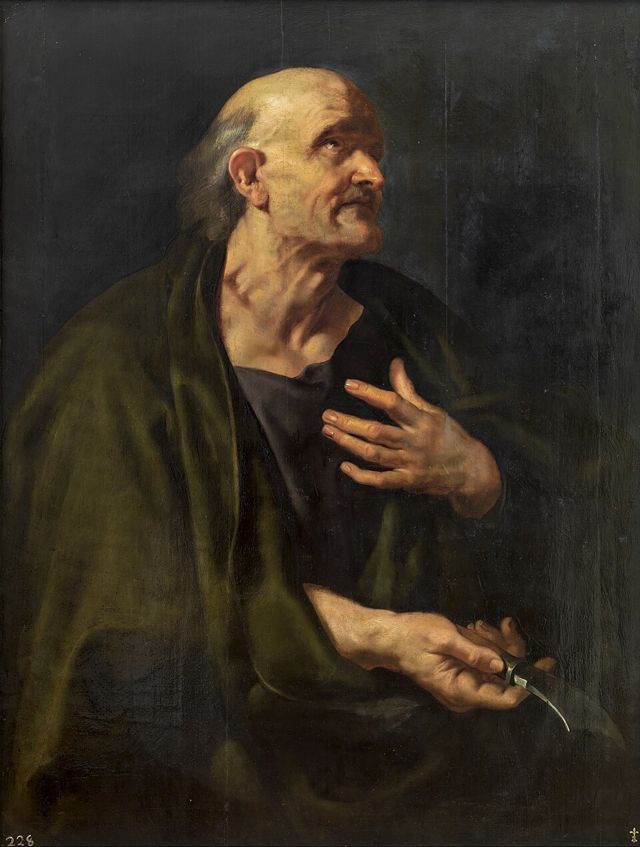
His death, said to have taken place at Albanopolis in Armenia, is just as uncertain. Some accounts say he was beheaded; according to legend, he was flayed alive and crucified head downward on the orders of Astyages for converting his brother Polymius, King of Armenia. That legend is why art, including Michelangelo's Last Judgment, shows him holding his own skin. Some believe his relics rest in the church of St. Bartholomew on the Island in Rome. His feast is 24 August.

What he represents

How he teaches us to live

Drawn from themes in the original account

Share your faith, in words and by example. Preaching and conversion are part of this story.

Celebrate this saint’s feast day. Remember him on August 24 with a short prayer, and ask for his help.

From the homilies

Preached on Scripture

John Henry Newman · Anglican preacher, later Catholic cardinal, 1801–1890
“Guilelessness” (Sermon 27)

What he’s saying: St. Bartholomew is believed to be the same person as Nathanael, who was one of Christ's first followers, and he is mentioned again in the Gospel after Christ's resurrection.

“St. Bartholomew, whose Festival we celebrate today, has been supposed to be the same as the Nathanael mentioned in the text. Nathanael was one of Christ's first converts, yet his name does not occur again till the last chapter of St. John's Gospel, where he is mentioned in company with certain of the Apostles, to whom Christ appeared after His resurrection.”

Text: “Jesus saw Nathanael coming to Him, and saith of him, Behold an Israelite indeed, in whom is no guile!”

Read more

The full original · 602 words

Read the full Catholic Encyclopedia article

One of the Twelve Apostles, mentioned sixth in the three Gospel lists (Matthew 10:3; Mark 3:18; Luke 6:14), and seventh in the list of Acts (1:13).

The name (Bartholomaios) means "son of Talmai" (or Tholmai) which was an ancient Hebrew name, borne, e.g. by the King of Gessur whose daughter was a wife of David (II Kings 3:3). It shows, at least, that Bartholomew was of Hebrew descent; it may have been his genuine proper name or simply added to distinguish him as the son of Talmai. Outside the instances referred to, no other mention of the name occurs in the New Testament.

Nothing further is known of him for certain. Many scholars, however, identify him with Nathaniel (John 1:45-51; 21:2). The reasons for this are that Bartholomew is not the proper name of the Apostle; that the name never occurs in the Fourth Gospel, while Nathaniel is not mentioned in the synoptics; that Bartholomew's name is coupled with Philip's in the lists of Matthew and Luke, and found next to it in Mark, which agrees well with the fact shown by St. John that Philip was an old friend of Nathaniel's and brought him to Jesus; that the call of Nathaniel, mentioned with the call of several Apostles, seems to mark him for the apostolate, especially since the rather full and beautiful narrative leads one to expect some important development; that Nathaniel was of Galilee where Jesus found most, if not all, of the Twelve; finally, that on the occasion of the appearance of the risen Savior on the shore of the Sea of Tiberias, Nathaniel is found present, together with several Apostles who are named and two unnamed Disciples who were, almost certainly, likewise Apostles (the word "apostle" not occurring in the Fourth Gospel and "disciple" of Jesus ordinarily meaning Apostle) and so, presumably, was one of the Twelve. This chain of circumstantial evidence is ingenious and pretty strong; the weak link is that, after all, Nathaniel may have been another personage in whom, for some reason, the author of the Fourth Gospel may have been particularly interested, as he was in Nicodemus, who is likewise not named in the synoptics.

No mention of St. Bartholomew occurs in ecclesiastical literature before Eusebius, who mentions that Pantaenus, the master of Origen, while evangelizing India, was told that the Apostle had preached there before him and had given to his converts the Gospel of St. Matthew written in Hebrew, which was still treasured by the Church. "India" was a name covering a very wide area, including even Arabia Felix. Other traditions represent St. Bartholomew as preaching in Mesopotamia, Persia, Egypt, Armenia, Lycaonia, Phrygia, and on the shores of the Black Sea; one legend, it is interesting to note, identifies him with Nathaniel. The manner of his death, said to have occurred at Albanopolis in Armenia, is equally uncertain; according to some, he was beheaded, according to others, flayed alive and crucified, head downward, by order of Astyages, for having converted his brother, Polymius, King of Armenia. On account of this latter legend, he is often represented in art (e.g. in Michelangelo's Last Judgment) as flayed and holding in his hand his own skin. His relics [the bodily remains of a saint, or objects they used, kept with honor] are thought by some to be preserved in the church of St. Bartholomew-in-the-Island, at Rome. His feast is celebrated on 24 August. An apocryphal gospel of Bartholomew existed in the early ages.

LE CAMUS, Vie de Notre Seigneur (tr. New York, 1906), I; IDEM in VIG., Dict. de la Bible, where references are given for the sources of the traditions, FOUARD, Life of Christ (New York, 1891).
More about St. Bartholomew

Checked against at least two sources, in our own words

Help us add to this saint's story

Everything is read by a person before anything appears. Facts are checked against trusted sources first.

Facts are welcome; a source link helps (optional).With your permission we may share it on this page.

Nine days · Free

Pray the novena
with us.

One short email a day for nine days. The day's prayer, a line from St. Bartholomew's story, and a nudge to keep going.

Also on August 24
E

St. Eutyches

August 24 · Feast
Y

St. Yarcard

August 24 · Bishop
O

St. Ouen of Rouen

August 24 · Bishop
← All 1970 saints in the library
Sources & notes

Feast-day sources

Story sources

Sources

Credits

Image: Rubens apostel bartolomeus grt.jpg · Peter Paul Rubens · Public domain, via Wikimedia Commons

Image: Peter Paul Rubens, Wikimedia Commons (Public domain)

Scripture: John i. 47; Acts x. 41; Matt. x. 3
John Henry Newman, Parochial and Plain Sermons, vol. 2 (London: Rivington, 1835). Written in English; public domain. Published 1835 (before 1931): public domain in the U.S. Read the full text →

From The Catholic Encyclopedia (New York: Robert Appleton Company, 1907–1914), via Wikisource. Public domain in the United States. Reproduced unedited, except for short bracketed notes in grey that we added to explain names and terms (“S.” is the old abbreviation for Saint). Some history and judgments reflect 19th-century scholarship.

Notes

Story retold in our own words from the cited sources.