After a while he returned to Sora, saw that all was well there, and then went off to Limne, at the most extreme corner of Asia Minor, on the Euxine, where there wfas least chance o
Read the essentials →After a while he returned to Sora, saw that all was well there, and then went off to Limne, at the most extreme corner of Asia Minor, on the Euxine, where there wfas least chance o
Read the essentials →September 12
September 12
Martyr
Short entry · the summary here is 96 words; Baring-Gould’s fuller original text and its sources are below. We have not filled any gap with invented detail.
Share your faith, in words and by example. Preaching and conversion are part of this story.
Celebrate this saint’s feast day. Remember this saint on September 12 with a short prayer, and ask for this saint’s help.
After a while, he returned to Sora and saw that everything was well there. Then he went off to Limne, which is at the farthest corner of Asia Minor, on the Black Sea, where there was the least chance of Christians being disturbed. Alternatively, it was a place where greater missionary work could be done. One day, when Autonomus had come to Sora, the local people burst into his chapel, destroyed it, and killed him while he was standing at the altar.
(The Acts say Sorei: I presume it was Sora on the Partheneus, in Paphlagonia. S. Macedonius and Others.)
After a while he returned to Sora, saw that all was well there, and then went off to Limne, at the most extreme corner of Asia Minor, on the Euxine, where there wfas least chance of Christians being molested, or, to put it in another light, a greater missionary work might be accomplished. One day, when Autonomus had come to Sora, the inhabitants burst into his chapel, wrecked it and killed him whilst standing at the altar.
1 The Acts say Sorei: I presume it was Sora on the Partheneus, in Paphlagonia. •S-S. Mctcedonius and Others.
Feast: September 12
One short email a day for nine days. The day's prayer, a line from St. Autonomus's story, and a nudge to keep going.
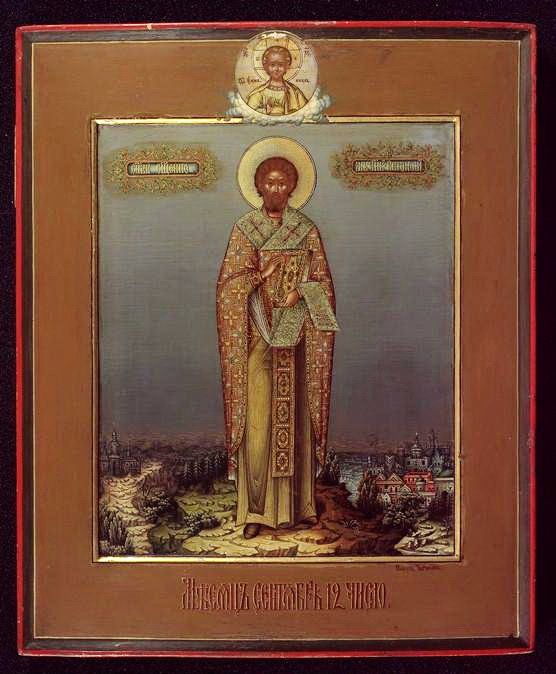
Image: Autonomus of Italy by O.Chirikov (Muz.ist.rel).jpg · Osip Semenovich Chirikov · Public domain, via Wikimedia Commons
Image: Osip Semenovich Chirikov, Wikimedia Commons (Public domain)
Retold in plain modern English from Baring-Gould’s public-domain text, sentence by sentence, keeping the same facts and order. Short explanations in parentheses are ours.
From Sabine Baring-Gould, The Lives of the Saints, new edition in 16 vols. (London: John C. Nimmo, 1897–98); text from the Internet Archive scan (OCR, lightly cleaned; errors possible). Public domain in the United States. Reproduced unedited, except for short bracketed notes in grey that we added to explain names and terms (“S.” is the old abbreviation for Saint). Some history and judgments reflect 19th-century scholarship.
