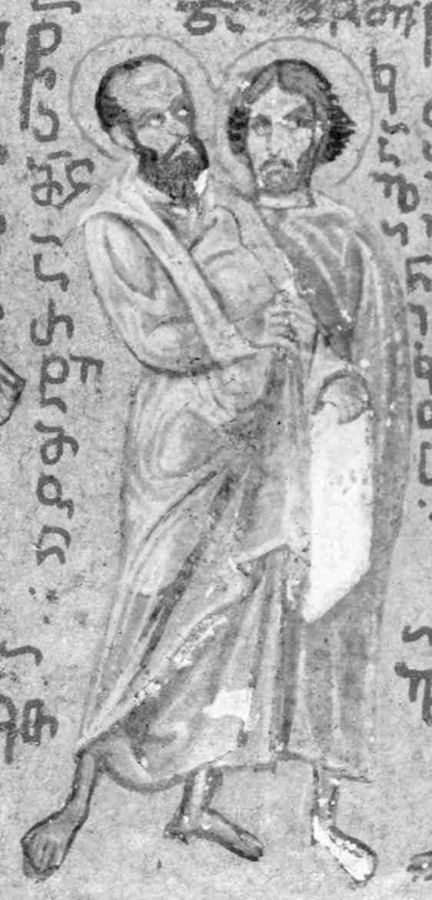
St. Artemas

Artemas was a devout Christian boy in Puteoli in southern Italy.

Read the essentials →
Feast October 30 · Martyr

St. Artemas

Current feast

October 30
Secondary source · Wikipedia infobox

Traditional feast

January 25
1914 / pre-1969 calendar, per Baring-Gould (1914)

Represents

Martyr

Feast days

Feast: October 30
Traditional: January 25

This Saint’s Story

Adapted in modern English from Baring-Gould (1914) · original text below

He was sent to school to a heathen master named Cathageta. Full of faith, the boy talked about what he believed with some of his schoolmates, and it soon got around that Artemas was a Christian. When it reached the master, Cathageta lectured and bullied the boy and threatened him with the rod.

'You may whip,' said the brave boy, 'but you will only whip my faith deeper into me.' In a rage the master shouted to the other boys to punish him. Hardened by the cruelties of the arena, they fell on him with the iron pens they used for writing on wax tablets and stabbed him to death.

Thin entry · the 1914 book gives only 141 words. We have not filled the gap with invented detail.

What he represents

How he teaches us to live

Drawn from themes in the original account

Stay faithful when it costs you. Holding firm under pressure is part of this story.

Celebrate this saint’s feast day. Remember him on October 30 with a short prayer, and ask for his help.

The full story

Baring-Gould’s account retold in modern English

Read the full story · 137 words · about 1 min

Artemas was a devout Christian boy living in Puteoli, in southern Italy. He was sent to school with a teacher named Cathageta, who was a pagan. Out of the abundance of the heart, the mouth speaks, and the boy, filled with faith, shared his beliefs with some of his classmates. It soon became known among the boys that Artemas was a Christian, and this reached the master's ears. Cathageta scolded and intimidated the young scholar, threatening him with punishment. "You may whip me," said the brave boy, "but you will only drive my faith deeper into me." Enraged, the master shouted to the boys to punish him, and the cruel boys, trained to violence by the horrors of the arena, attacked him with their iron pens, which were used for writing on wax tablets, and killed him.

Read the original 1870s text

Baring-Gould’s sources: Commemorated at Puteoli and Naples under the name of Artemas, but in the ancient Martyrology attributed to S. Jerome, he is called Antimasius, a mistake of copyists for Artimasius or Artemas. The Acts are those preserved by the Church of Puteoli, and seem to be founded on others of great antiquity; they exist only in a fragmentary condition, and give no clue to the date of the martyrdom.

Artemas was a pious Christian boy in Puteoli, in the south of Italy. He was sent to school to one Cathageta, a heathen. Out of the abundance of the heart the mouth speaketh, and the boy, filled with faith, spoke of his belief to some of his fellow-scholars. It was soon known among the boys that Artemas was a Christian, and it came to the master's ears. Cathageta lectured and browbeat the little scholar, and threatened him with the rod. "You may whip," said the brave boy; "but you will only whip my faith deeper into me." Then the master, in a rage, shouted to the boys to punish him, and the cruel tiger-cubs, educated to bloodshed by the atrocities of the arena, fell upon him with their iron pens, used for scratching on wax tablets, and stabbed him to death.

Help us add to this saint's story

Everything is read by a person before anything appears. Facts are checked against trusted sources first.

Facts are welcome; a source link helps (optional).With your permission we may share it on this page.

Nine days · Free

Pray the novena
with us.

One short email a day for nine days. The day's prayer, a line from St. Artemas's story, and a nudge to keep going.

Also on January 25
J

Sts. Juventine and…

January 25 · Martyrs
A

St. Apollo in the Thebaid

January 25 · Abbot
M

St. Mares in Syria

January 25 · Abbot
← All 1970 saints in the library
Sources & notes

Feast-day sources

Story sources

Sources

Credits

Image: Arphema kalinnik.jpg · Афонські майстри · Public domain, via Wikimedia Commons

Image: Афонські майстри, Wikimedia Commons (Public domain)

Retold in plain modern English from Baring-Gould’s public-domain text, sentence by sentence, keeping the same facts and order. Short explanations in parentheses are ours.

From Sabine Baring-Gould, The Lives of the Saints, new and revised edition (Edinburgh: John Grant, 1914; first edition 1872). Public domain in the United States. Reproduced unedited, except for short bracketed notes in grey that we added to explain names and terms (“S.” is the old abbreviation for Saint). Some history and judgments reflect 19th-century scholarship.