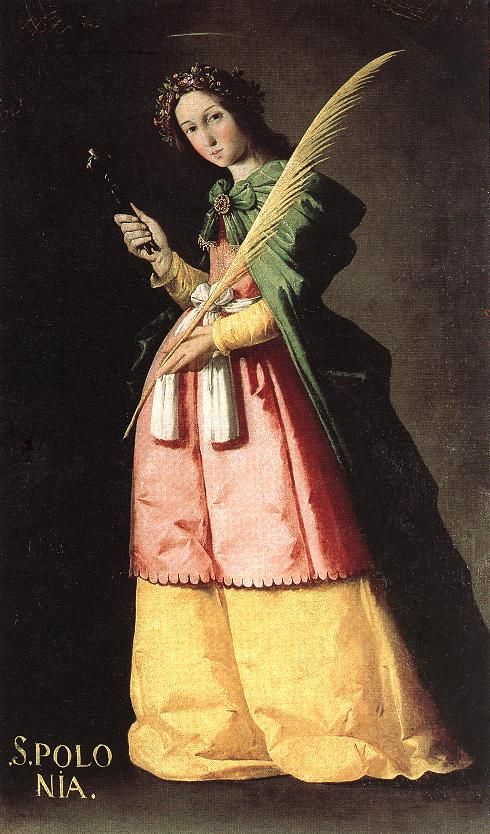
The following is the account of the martyrdom of Saint Apollonia, written by Dionysius, the bishop of Alexandria, who was also a confessor during the persecution. "The persecution against us did not begin with the imperial edict, but started a whole year before it. A certain prophet and poet incited the masses of the heathen against us, stirring them up to their native superstition. Encouraged by him, and feeling free to commit any kind of wickedness, they believed that the only way to show their piety was to kill us.
First, they seized an elderly man named Metras and demanded that he utter blasphemous words. When he refused, they beat him with clubs and pricked his face and eyes. After that, they took him to the outskirts of the city, where they stoned him to death. Next, they brought a woman named Quinta, who was a believer, to the temple of an idol and tried to force her to worship. When she turned away in disgust, they tied her by the feet and dragged her through the entire city over the rough stones of the paved streets, throwing her against millstones and scourging her at the same time, until they brought her to the same place where they stoned her.
Then, in unison, they rushed into the homes of the faithful. They quickly drove out anyone they knew lived nearby, plundering their belongings and keeping the more valuable items for themselves. They tossed the more common wooden furniture around and burned it in the streets, creating a scene like a city under siege. They also captured the admirable virgin Apollonia, who was then advanced in age. They beat her jaws and broke all her teeth, and when they lit a fire in front of the city, they threatened to burn her alive unless she repeated their blasphemous words. At first, she seemed to hesitate, but when she was allowed to go, she suddenly jumped into the fire and was consumed."
Relics of Saint Apollonia are found in the Church of Saint Apollonia in Rome; her head is in Saint Maria Transtiberina; her arms are in Saint Laurence, outside the city walls; part of her jaw is in Saint Basil's; and other relics are located in Naples, Volterra, Bologna, Antwerp in the Jesuit Church, Saint Augustine's in Brussels, the Jesuit Church in Mechlin, Saint Cross in Liège, Cologne in the Jesuit Church, and in the churches of Saint Gereon, Saint Maurice, Saint Alban, Saint Cunibert, and others; as well as in other places. These relics sometimes consist of just a single tooth or a small piece of bone.
Saint Apollonia is invoked, and her relics are sought for relief from toothache and other pains in the jaw.
In art, she is always recognized by her depiction holding a tooth, and sometimes with pincers grasping a tooth in her hand.
Footnotes
- Relics of Saint Apollonia are found in various locations, including churches in Rome and Antwerp.
- She is invoked for relief from dental pain.
- In art, she is depicted with a tooth or pincers.
Baring-Gould’s own footnotes, in modern English.
Read the original 1870s text
Baring-Gould’s sources: This saint is named in the Roman and all Western Martyrologies. There is, however, another Apollonia, martyr under Julian the Apostate, 114 years her junior, commemorated in some churches on this day, and some apocryphal Acts of this latter saint are extant. There is much doubt whether this Roman Apollonia ever really existed, and whether the Martyrologists have not fallen into an inaccuracy in writing S. Apollonia "of Rome," instead of "of Alexandria," because her relics were brought to Rome. The account of the martyrdom of S. Apollonia of Alexandria is perfectly authentic, it occurs in a letter from S. Dionysius B. of Alexandria, during the persecution, to Fabius, B. of Antioch, giving him an account of the sufferings of his church. This letter is preserved by Eusebius, in his Ecclesiastical History, lib. vi. c. 41.
THE following is the account of the martyrdom of S. Apollonia, by Dionysius, the bishop of Alexandria, himself a confessor [in old usage, a saint who was not martyred, or who suffered for the faith without being killed] at the time, in the persecution. "The persecution with us did not begin with the imperial edict, but preceded it a whole year. And a certain prophet and poet excited the mass of the heathen against us, stirring them up to their native superstition. Stimulated by him, and taking full liberty to exercise any kind of wickedness, they considered this the only way of showing their piety—to slay us. First, then, seizing a certain aged man, named Metras, they called on him to utter impious expressions, and as he did not obey, they beat his body with clubs, and pricked his face and eyes; after which they led him away to the suburbs, where they stoned him. Next, they led a woman called Quinta, who was a believer, to the temple of an idol, and attempted to force her to worship; but when she turned away in disgust, they tied her by the feet, and dragged her through the whole city, over the rough stones of the paved streets, dashing her against the millstones, and scourging her at the same time, until they brought her to the same place, where they stoned her. Then, with one accord, all rushed upon the houses of the pious, and whomsoever of their neighbours they knew, they drove thither in all haste, and despoiled and plundered them, setting apart the more valuable of the articles for themselves; but the more common and wooden furniture they threw about and burnt in the roads, presenting a sight like a city taken by the enemy. They also seized that admirable virgin Apollonia, then in advanced age, and beating her jaws, they broke out all her teeth, and kindling a fire before the city, threatened to burn her alive, unless she would repeat their impious expressions. She appeared at first to shrink a little, but when suffered to go, she suddenly sprang into the fire, and was consumed."
Relics in the Church of S. Apollonia, at Rome; her head in S. Maria Transtiberina; her arms in S. Laurence, outside the walls; part of her jaw in S. Basil's; other relics [the bodily remains of a saint, or objects they used, kept with honor] at Naples, Volaterra, Bonona, at Antwerp in the Jesuit Church; in S. Augustine's, at Brussels; in the Jesuit Church at Mechlin; in S. Cross at Liége; at Cologne, in the Jesuit Church; and in those of S. Gereon, S. Maurice, S. Alban, S. Cunibert, and others; and elsewhere. These relics consist in some cases of a tooth only, or a splinter of bone.
S. Apollonia is invoked, and the application of her relics is sought against toothache, and other pains in the jaw.
In Art, she is always to be recognized by her being represented holding a tooth, sometimes pincers grasping a tooth, in her hand.