This Saint’s Story
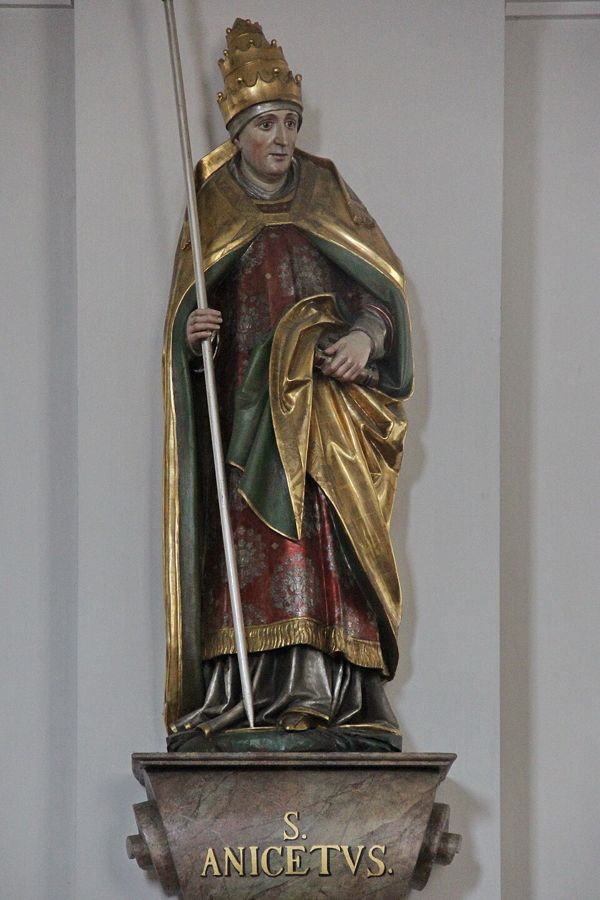
The Catholic Encyclopedia, following Duchesne, warns that the dates of this period are so confused that exact verification is impossible. Birth and early life are unknown. In his time the Roman Church had to answer teachers of strange doctrines; Baring-Gould, citing Eusebius and Irenaeus (bishop of Lyon, d. c. 202, who listed the early popes), stresses that Anicetus opposed the schools of Valentine and Marcion. The early Christian writer Hegesippus also came to Rome then. Later authors mark the visit as noteworthy because many distinguished Christians already looked to the Roman see, and because the same years saw heretical teachers—Marcion, Valentine, Cerdo, and others—disturbing the city.
The aged Polycarp of Smyrna, disciple of the apostle John, came to Rome about 160–162 to confer with Anicetus on the date of Easter. The churches of Asia kept the feast on the fourteenth of Nisan, the Jewish Passover date, whatever weekday it fell on; Rome always kept Easter on Sunday and remembered the Lord’s death on Friday. Neither persuaded the other. Eusebius (bishop of Caesarea, d. c. 339, the first historian of the Church) records that the controversy was not ended, yet the bonds of charity were not broken, and that Anicetus allowed Polycarp to celebrate the Eucharist in his place as a sign of communion. Baring-Gould adds, from Irenaeus, that Polycarp also brought many of those heretics back to the Church’s faith as he had received it from the apostles. Rome claimed the practice of Peter; Smyrna claimed the practice of John; they parted in peace.
Anicetus is traditionally counted a martyr, though the Encyclopedia gives no account of how he died and itself shows the period’s uncertainty—one notice places a martyrdom in 161 while the reign is carried to about 168. Feast dates vary among 16, 17, and 20 April; this page keeps 17 April. No patronage is clearly assigned to him in the Catholic Encyclopedia.