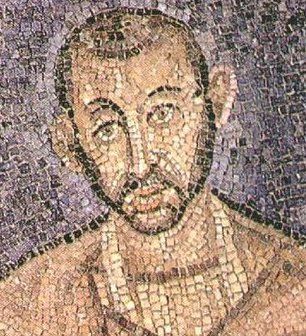
The Neapolitan Calendar from the 9th century also mentions this on November 3.
Authorities include a Life written by Paulinus the Priest (active around 422) at the request of Saint Augustine, which is found in most editions of the works of Saint Augustine and in Surius, Lives of the Saints, dated April 4; Saint Isidore of Seville in "On Illustrious Men," chapter 4; Ruffinus in his Ecclesiastical History, book II; Saint Basil in Letter 55; Sozomen in his Ecclesiastical History, book IV; Socrates in his Ecclesiastical History, book VI; Theodoret in his Ecclesiastical History, books IV and V; and the Epistles and other writings of Saint Ambrose.
Uxentius of Cappadocia, an Arian, held the position of bishop in Milan for twenty years (from 355 to 374). He had been imposed on the see by Constantius after the council held in Milan in 355, which resulted in the condemnation of Saint Athanasius and the expulsion of Saint Dionysius.
It was at the end of 374 that Auxentius died. Valentinian wanted the people to choose a successor. The governor of Liguria was in the process of encouraging the people to maintain order when a child suddenly shouted, “Ambrose Bishop.” The people echoed this cry; they believed it was a special case where Divine intervention indicated the chosen bishop. It did not matter to them that Ambrose had not yet been baptized. The principle stated in a Sardican canon, which required a period of probation before becoming a bishop, was considered not applicable in such an extraordinary situation.
Ambrose tried various ways to escape from a responsibility he genuinely feared, duties for which he perhaps felt no particular calling. He attempted to undermine the high opinion people had of him through a curious tactic. He rushed to his courtroom and had some criminals brought before him and tortured. He hoped the screams of the victims would convince the voters that he was a merciless judge. But the people responded, "We take on ourselves the responsibility."
Next, he went home and had some prostitutes brought into his house. The people said, “We will bear your sin.” Then he tried to flee and actually hid for a time, but the owner of the place where he was hiding turned him over to the authorities who were searching for him. Realizing that resistance was futile, he requested that only a Catholic could baptize him. This request was quickly granted. Seven days after his baptism, he was consecrated on December 7, 374, at the age of thirty-four.
There has been some doubt about whether the Sardican canon was partially followed by conferring on him, during that week, the lower orders of the clergy. From the Greek historians, we might conclude that it was not followed; however, Paulinus, his secretary and biographer, is a much more reliable source, and he states, “It is said that after his baptism he discharged all ecclesiastical offices” before his consecration. In any case, Ambrose could rightly say of himself that he was “snatched from the tribunals to the episcopate, and had to begin to teach before he had.”
He began to learn. He dedicated himself to studying theology under Simplicianus, a Roman priest. Ambrose was the son of a prefect of the praetorium in Gaul, who also had the same name, Ambrose. He had a brother named Satyrus, whom he loved dearly, and a sister named Marcellina, who was significantly older than him. Both of them are recognized as saints.
It seems that Ambrose was born in Gaul, but it is impossible to determine if the claim made by Trèves (a city in France) to be his birthplace is accurate, although it is not unlikely. Saint Ambrose was born around the year 340. Later in life, after he had gained fame for his eloquence, a legend emerged that a swarm of bees had settled on his cradle while he was sleeping as an infant. This story, originally told about Plato, was transferred to Ambrose, similar to how legends associated with a Norse king reappear as historical anecdotes about William the Conqueror and later about Napoleon Bonaparte.
The father of Saint Ambrose died when the saint was very young, and his mother returned with him to Rome. He was raised carefully by her and by his sister Marcellina. Amicius Probus, the praetorian prefect of Italy in 368, chose Ambrose to be his assistant after noticing his integrity and clear intelligence, as he served for a time as an advocate in his court. Later, Ambrose was appointed governor of Liguria and Emilia. When Amicius Probus gave him this position, he did so with words that would later be considered prophetic: “Go your way, govern not as a judge but as a bishop.”
As soon as Saint Ambrose was consecrated, he freed himself from all the ties that could distract him from focusing solely on his new responsibilities. He made a commitment to his duties.
He sold much of the portion of the family estates that had fallen to his share and gave a lot to the Church. He devoted himself diligently to his theological studies and responsibilities as a bishop. Soon after his ordination, he wrote to Emperor Valentinian to complain about injustices committed by some magistrates. The emperor replied, “I have long been aware of your frankness, yet that did not prevent me from agreeing to your consecration. Continue applying the remedies prescribed by the Law of God to our sins.”
Basil wrote to Ambrose to congratulate him, or rather the entire Church, on his promotion. He urged Ambrose to oppose the Arians and to fight the good fight of faith. After the death of Valens in 378, the empire passed to his nephews Gratian and Valentinian II. The latter was an infant, while Gratian was a young man of great energy and abilities. The weak Valens had been mocked by his people in the circus, which led him to confront the invading Goths personally. Flattered by his eunuchs into underestimating his barbarous opponents, he did not wait for Gratian, who was rushing to help him, but attacked the Goths near the walls of Hadrianople. He suffered a crushing defeat and died.
Gratian, on his way to the East, knew he was heading into a situation with formidable barbarian adversaries as well as theological disputes. He relied on the shields of his legions to protect him from the former. He asked Ambrose to provide him with a theological treatise that could shield him from the arguments of heretics. Ambrose immediately complied with the young emperor's request and wrote a two-book treatise on the Faith, which he sent to him in 379. He had been a bishop for only three years, yet his reputation had spread widely. Many virgins came to Milan and placed themselves under his guidance. He preached a series of sermons to them, which, at the request of his sister, he collected into a book. Shortly after, he wrote a book on Widowhood, prompted by a woman who had lost her husband and was relatively advanced in age marrying again.
The destruction caused by the Goths in Thrace and Illyria stirred his deep compassion for the victims. He melted down gold and silver vessels from the churches and sold them to redeem captives, keeping only as many chalices and patens as were necessary. The Arians criticized him and condemned his actions as sacrilegious, but Ambrose strongly defended his conduct. He stated that the Church has gold not to hoard, but to use for the needs of her children.
After the death of Valens, Gratian, guided by a liberal mindset, passed a law that allowed all heretics, except for Manichaeans, Photinians, and Eunomians, to practice their religion without interference. However, in August of the following year, Gratian was in Milan, and it is likely that Ambrose influenced the emperor to revoke this law and to issue one that had the opposite effect. It is certain that Gratian sent a letter to Hesperius, the prefect of Italy, from Milan on August 3rd, revoking the freedoms granted to heretics and prohibiting everyone, without exception, from practicing their religion or gathering in churches or private homes.
When Gratian was in Sirmium in 378, Palladius and Secundianus, two bishops from Illyria, complained to him that they were being accused and condemned as Arians. They asked him to call a council to judge their case. The Catholic bishops urged Gratian to hear their case and determine whether they were orthodox or not, but the young emperor, still a teenager, was too modest and likely recognized his own ignorance regarding complex theological issues. Saint Ambrose wrote to Gratian, suggesting that it was not worth troubling the entire episcopate over a couple of heretics—essentially prejudging their case—and that he and the Western Catholic bishops would quickly refute them. A council was called to meet at Aquileia. Ambrose then added three more books to his work on the Faith, where he addressed the arguments of the Arians and explained in a Catholic context the passages of Scripture they used to support their doctrine.
Emperor Valentinian I had been married twice; if we can trust the ecclesiastical historian, he had taken the beautiful Justina as his wife while still having a legitimate wife, Severa. Socrates indeed claims that he boldly asserted the right to have two wives and extended this same domestic privilege to all his subjects by law. However, it is more likely that he married Justina after he had divorced Severa. His first wife was the mother of Gratian, while Justina gave birth to Valentinian II.
After her husband's death, Justina moved to Sirmium. The bishopric of the capital of Illyria was then vacant due to the death of the Arian bishop Germinus. Justina was determined to replace him with another Arian. It was crucial to secure an orthodox bishop for this significant see. Although Ambrose had no authority in Illyria, he hurried to Sirmium, and Justina was dismayed to learn that he was in the cathedral, enthroned, had summoned the people, and was about to proceed with the election and consecration of a bishop.
She sent orders for him to be removed from his position. Ambrose sat still on his platform and would not move. An Arian consecrated virgin approached him, grabbed his clothing, and tried to pull him out of his seat. Ambrose paid her no more attention than to say, “It is not appropriate for a woman or someone of your profession to lay hands on a priest. Be careful, lest the judgment of God come upon you.” The woman was so frightened that she became ill and died that night, which caused such fear among the Arians that they no longer tried to interfere with Ambrose's actions. The Catholic party elected Anemius, and Ambrose returned to Milan, having earned Justina's hatred.
The Western Council, called by Gratian at Aquileja, to address the case of the Illyrian bishops Palladius and Secundianus, met in 381. Only about thirty bishops attended. Palladius protested; he had appealed to the whole Church and demanded to be heard by a general council. He had hoped for support from some of the Eastern bishops. The bishops urged Palladius to condemn the statements in the letter of Arius to S. Alexander. Like the Eusebians at Nicaea, he resorted to pitiful evasions: he would call Christ “very Son,” “good and powerful,” but would not say whether He was created or uncreated. When asked, “Is Christ very God?” he replied, “He is the power of our God.” He cited the texts John 17:3, 1 Timothy 6:15, and John 14:28. Since he refused to condemn Arius, he was deposed; he mocked the proceedings, saying, “Have you begun to play? Play on.” His companion, Secundianus, who rejected the proposition “the Son is very God” as unscriptural, was condemned alongside him. The debate lasted from daybreak until one o’clock in the afternoon. The bishops wrote to Gratian and to Valentinian II, announcing the decision of the council.
In 382, a council was held at Rome, which S. Ambrose attended. While there, he was invited by a lady of high rank to offer the Holy Sacrifice in her house beyond the Tiber River; he visited her for this purpose and is reported to have cured a paralyzed woman on that occasion. While in Rome, he fell ill and was cared for by his sister Marcellina, and visited by S. Ascholius of Thessalonica. In the same year, he began his treatise on the Incarnation, which he was prompted to undertake by the following circumstances. Two chamberlains of Gratian, who were Arians, posed a difficulty to him while he was preaching one day and demanded his answer. He promised to provide it the next day in the Portian basilica. Accordingly, he attended, along with those in the congregation who enjoyed theological discussions. However, the two chamberlains were not serious in their challenge—they had merely voiced a difficulty as it came to their minds and were too indifferent to go to the Portian church to hear it thoroughly and carefully refuted. They had, in fact, gone out for a drive in the country. Ambrose and the people waited, but as the chamberlains did not show up, he ascended the ambone (a raised platform for reading scripture) and began to explain the struggle between Cain and Abel. In this explanation, he made it abundantly clear that Arians, Apollinarians, and heretics in general were like that wicked one who killed his brother, and that Christ was the true Abel whom they put to death again by denying His divinity. This led to Gratian proposing a difficulty to him, which Ambrose resolved; and from these circumstances, his treatise on the Incarnation emerged. Popular imagination, of course, has made the two chamberlains tumble out of their chariot and break their necks, but since Ambrose says nothing about this judgment in his treatise when referring to them, it is almost certain that nothing of the sort occurred.
Maximus revolted in 383, and Gratian was murdered in Lyons. The entire region of Gaul, along with the army that Gratian had led against Maximus, had switched allegiance to the usurper. Justina was fearful for her son Valentinian, and in her distress, she turned to Ambrose and sent him to Trier to negotiate with Maximus. Ambrose stayed there the entire winter, waiting for the outcome of a delegation sent by the usurper to Valentinian. Maximus was satisfied with ruling over Gaul, Spain, and Britain, and he left the child-emperor of Italy to be dealt with at a later and more convenient time. During his time in Trier, Ambrose refused to communicate with Maximus, the murderer of his sovereign. The interests of his earthly monarch or of the empire would not lead him to sacrifice, even for a moment, those of his Heavenly Master; he would have no association with a man of blood. Ambrose, who had cared for Gratian, guided his studies, and protected his virtue, mourned for the young sovereign with tears, as if he were a son.
In the senate-house at Rome, there stood, during the reign of Gratian, an altar of Victory, which Constantius had removed when he visited Rome, and which Julian had restored. Gratian, who demonstrated his Christian zeal by refusing the robe of the Pontifex Maximus, which emperors had typically worn, again ordered the removal of the altar. The "great city," which had been "drunken with the blood of the saints," remained at that time, despite the energy and grandeur of its church, a stronghold of idolatry. Among its pagan nobles were the virtuous and high-minded Praetextatus, known for his sarcasm about the Roman episcopate; Flavian, one of the praetorian prefects; and Symmachus, the great orator of the party, who now went to advocate for the restoration of the altar. However, Damasus, the Pope, sent a memorial from Christian senators, rejecting any involvement in the pagan petition and declaring that they would not enter the senate-house if it were granted.
Gratian refused to admit Symmachus or to hear his eloquent appeal. This appeal still exists. Written in a weak and apologetic tone, it is clear that it is a clever defense of a nearly hopeless cause. It is cautious to the point of timidity, skillfully and elaborately conciliatory, and moderate out of fear of offending rather than from calm dignity.
Ambrose, on the other hand, in the memorial he presented and authored, writes with all the passionate and carefree energy of someone confident in his cause, who knows he is appealing to an audience already sympathetic to him. He does not need to address objections, reconcile difficulties, or seek favor; his contemptuous and accusatory language is meant to inflame zeal and provoke resentment and scorn.
However, it was not just for the statue of Victory that the pagan orator appealed. Gratian had confiscated all the property of the temples and eliminated the privileges and immunities of the priesthood, including those of the vestal virgins. Symmachus pleaded for tolerance in the name of Rome. “Most excellent princes, fathers of your country, respect my years, and allow me to continue practicing the religion of my ancestors, in which I have grown old. Grant me the freedom to live according to my ancient customs. This religion has subdued the world to my dominion; these rites drove Hannibal from my walls and the Gauls from the Capitol. Have I lived this long only to be rebuked in my old age for my religion? It is too late; it would be shameful to change in my old age. I only ask for peace for the gods of Rome, the protective gods of our country. Heaven is above us all; we cannot all follow the same path; there are many ways to reach the great secret.”
The end of the third century had seen the persecution of Diocletian, and by the fourth century, paganism was pleading for tolerance in its stronghold. Symmachus argues against the miserable practice of saving on the maintenance of the vestal virgins, calling it disgraceful to enrich the imperial treasury with such meager gains. He protests against the confiscation of all legacies left to them by the piety of individuals. “Slaves may inherit; only the vestal virgins and the ministers of religion are denied this common privilege.”
The orator concludes by appealing to the deified father of the emperor, who looks down with sorrow from the starry citadel, to see that the tolerance he maintained with willing justice is being violated.
Ambrose's tone and manner are very different as he appeals to the young and narrow-minded Gratian to prohibit this dangerous concession. He plainly asserts the undeniable obligation of a Christian sovereign to ensure that no part of the public revenue is used to support idolatry. “The emperor who grants such a concession as is demanded will find that the bishops will neither tolerate nor overlook his sin. If he enters a church, he will either find no priest or one who will defy his authority. The Church will indignantly reject the gifts of one who has shared them with pagan temples. The altar disdains the offerings of one who has made offerings to images.”
Symmachus, thwarted in his attempt, waited until the death of Gratian and then made a second request on behalf of the altar of Victory, this time to the young Valentinian. But Ambrose was once again ready to oppose him. He reminded Valentinian that no pagan was required by a Christian ruler to participate in Christian worship, and that his youthful age would not excuse a weak betrayal of Christianity. He emphasized the moral emptiness and powerlessness of paganism. “How long did Hannibal mock the gods of Rome? It was the goose and not the deity that saved the Capitol. Did S. Ambrose.
Did Jupiter speak through the goose? Where were the gods during all the defeats, some of which were recent, of the pagan emperors? Was not the altar of Victory still standing?” He ridiculed the number, the weaknesses, and the marriages of the vestal virgins when they grew old. “If the same generosity were shown to Christian virgins, the depleted treasury would be emptied by their claims.” “Are not the baths, the porticoes, and the streets still filled with statues? Must they still hold their place in the great council of the empire? You force worship if you restore the altar. And who is this deity? Victory is a gift, not a power. She relies on the bravery of the legions, not on the influence of religion—a mighty deity, who is granted by the size of an army or the uncertain outcome of a battle!” Valentinian refused to restore the altar.
The Empress Justina was ungrateful to Saint Ambrose for his intercession with Maximus. During Lent in 384, she demanded, in her son's name, the Portian basilica outside the walls of Milan for Arian worship. Then, in its place, she requested the new and larger church of the Apostles within the city. Since the former had been a basilica, or hall of justice, given to the Church by the State, Justina believed the State had the right to reclaim it for the emperor's religious worship. The Arians had lost their churches under the Catholic emperor, Gratian. Under the Arian Valentinian, they claimed at least the right to one church for their devotions.
On the Friday before Palm Sunday, officers of the state approached Ambrose. He responded, “The priest cannot give up the temple.” On Saturday, the prefect tried in vain to obtain at least the Portian church. The people urged Ambrose to resist, and he did so. On Palm Sunday, Ambrose was in the baptistery, explaining the Creed, as was customary on that day, to the competentes, or candidates for Easter baptism, while the ordinary catechumens had left the church. A message informed him that curtains were being put up in the Portian, which was the usual sign of the emperor claiming any place. “However,” Ambrose wrote to his sister, “I remained at my duty, and began to perform Mass.”
While he was “making the oblation,” he heard with grief that Castulus, an Arian priest, was in the hands of the Catholic population, who were likely to tear him apart. He immediately sent clergy to rescue him and prayed during the sacrifice that no blood might be shed in the conflict. The court, very angry about the riot and the mistreatment of Castulus, demanded a fine from the city for the disturbance and imprisoned several Catholic tradesmen. Counts and tribunes urged Ambrose to submit. “If,” he firmly answered, “I were asked to yield what was mine, I would not refuse, although what is mine belongs to the poor. But what is God’s I cannot surrender. Put me in irons, lead me to death; you cannot better gratify me.”
“At all events,” said the officer coldly, “control the passions of the excited rabble.” He replied, “It is in my power to refrain from exciting them. The hand of God can alone calm them.” It was impossible, as they all knew, to use force without causing a massacre. Ambrose spent the entire night in the old basilica. Before daybreak, he went out and found the church surrounded by soldiers. He returned to the Portian to prevent it from falling into the hands of the Arians. This was on Wednesday. The soldiers quietly followed and surrounded the basilica. Ambrose forbade communion with them, but since the guard was mostly made up of Catholic soldiers, their religious fears were stirred, and they began to enter the church. The women screamed and fainted, but the soldiers insisted they had come there to pray.
not to use violence against anyone. The lessons were from the Book of Job. Ambrose began to preach on Job’s trials. He himself, along with the Catholic flock, were like Job on his dunghill. The devil had robbed them of their children, possessions, and good name. Ambrose did not think it inappropriate or disrespectful to compare the empress-mother to Job’s wife, who urged him to blaspheme God, to Eve, who tempted Adam, to Jezebel, who encouraged the prophets of Baal and persecuted Elijah, and to Herodias, the incestuous woman, who sought the life of John the Baptist.
News arrived that the people were tearing down the hangings of the church that displayed the sacred image of the sovereign, which had been hung in the Portian basilica as a sign that the church had been taken over by the emperor. Ambrose sent some of his priests to calm the unrest, but he did not go himself. He looked triumphantly at the soldiers who had entered the church and listened without drawing their swords to the insults directed at the name and character of the empress-regent. “See!” he said, “the Gentiles have entered into the inheritance of the Lord; but the armed Gentiles have become Christians and co-heirs of God. My enemies are now my defenders.”
A confidential secretary of the emperor appeared, not to expel or degrade the rebellious prelate, but to criticize his tyranny and complain about his domineering behavior. “Why do you hesitate to strike down the tyrant?” replied Ambrose. He added, “Yes, the priest has his dominion — it is in his weakness. When I am weak, then I am strong.” Ambrose spent the night with his priests chanting psalms in the “little basilica.” The next day was Maundy Thursday, the solemn day for absolving penitents.
While Ambrose was preaching on the lesson from the Book of Jonah, word came that the soldiers were recalled from their post, and the tradesmen were restored to their homes. A scene of tumultuous joy followed; disregarding the sanctity of the place where they were gathered, the people clapped their hands, and the soldiers rushed to the altar and kissed it.
The imperial authority was intimidated by the determined bishop. The court did not dare to engage in a conflict that could have endangered the life of the emperor. The Catholic rioters, who were supported, as was proven, by the soldiers ready to violently attack an Arian priest, might not hesitate to kill an emperor who was already in his minority and unpopular. When Valentinian was urged to confront Ambrose in the church, the cautious and timid young man replied, “His eloquence would compel you yourselves to lay me bound hand and foot before his throne.” Ambrose celebrated the defeat of the old dragon, struck down by God and expelled. However, some court officials were very angry about how Ambrose had spoken of the emperor and his mother.
“While I live, do you treat Valentinian with such contempt?” said the eunuch, Calligone. “Truly, I shall strike off your head.” Ambrose responded, “God grant that you may fulfill your threat; I shall suffer as a bishop, and you will do the work of an eunuch.” But it was unacceptable that the free practice of Arian worship should remain illegal while the emperor and his mother professed that faith. Justina convinced Valentinian to repeal the law of Gratian, as it affected the Arians, and to allow them full freedom of worship. Benevolus, the Prefect of the Memorials (or Secretary of State), refused to draft this law. He had not yet been baptized, but he was a passionate debater and supporter of the Catholic side. He was removed from his position and returned to Brescia, his hometown, where he became friends with S. Gaudentius. Meanwhile, Justina found a more agreeable secretary, and the law was enacted in January 386. It granted complete and equal tolerance to both Catholics and Arians and mandated that anyone who incited riots or opposed the enforcement of this law through overt or covert actions would be punished with death. An Arian bishop, who took the name Auxentius, claimed the bishopric of Milan. Ambrose was called to argue against him in the imperial consistory. He submitted a written refusal to accept the principle of lay judges in matters of faith and quoted the words of Valentinian I, “It is not for me to judge between bishops.” He boldly pointed out that the current sovereign was young and unbaptized; one day he would realize the absurdity of asking a bishop to “place his rights at the feet of laymen.”
He took up residence within the church, which was once again filled with a passionate congregation, and was guarded, as before, by soldiers who prevented anyone from leaving. To inspire enthusiasm, he encouraged the people to sing hymns that he had written, which were full of concise and powerful energy, and to chant the Psalms in alternation, “after the manner of the East.” He understood “how mighty a strain” the doxology to the Father, Son, and Spirit was, which “made all who sang it teachers.”
After spending some days in this manner, Ambrose preached, apparently on Palm Sunday, assuring his congregation that he would never abandon them. He referred to Elisha in Dothan and Peter in prison, denounced Auxentius, and used the lessons of the day—Naboth's story and the entry into Jerusalem—as relevant and striking illustrations. He quoted the passage about “tribute to Caesar” and stated that in the Church there was only one image, Christ, the image of the Father. There was no question about paying taxes; they were, of course, levied on Church lands. He did not deny that the Church had gold to give; Christ’s poor were her beneficiaries. He summarized his principles with the words, “The emperor is of the Church, is in the Church, but is not above it.”
It seems that the soldiers were withdrawn. After a new struggle, Ambrose had achieved a new victory, and the imperial power had suffered a new defeat. He was left free to dedicate a church—the Ambrosian; after which the people asked him to place some relics of martyrs in the new church, as was customary. “I will,” he said, “if I can find any.” He admitted that the church of Milan was lacking in relics; thus, it was even more necessary to find some now. He instructed the people to dig in the earth before the chancel screen of Saints Felix and Nabor. As they approached the site, a madman went into a fit, and it was thought that the devil within him was disturbed by the holy remains.
The bones of two men of great stature were found, along with a lot of blood. The bodies were disinterred and solemnly transported to the Ambrosian church. There was great joy. It was concluded that these were the relics of Saints Gervasius and Protasius, martyrs of Milan. A blind butcher named Severus recovered, or claimed to have recovered, his eyesight by using a handkerchief that had touched the relics. Other miraculous cures were mentioned in a sermon preached that day by Ambrose; but this was the main case. The Arians mockingly claimed that the entire event was a fraud; however, we do not have an account of their reasons for doubting the authenticity of the bones and the miraculous healing of the butcher. The public excitement caused by the discovery and the reported miracles was so intense that it halted Justina's attempts to regain control of a church for the Arians in Milan.
It was not long after this that Augustine and Ambrose met. Augustine was struggling against the Manichaean errors that had darkened his soul, and he was preparing in a house near Milan for baptism at the upcoming Easter. Ambrose recommended that he read Isaiah. Augustine attended the sermons of the bishop, but due to the crowds who sought interviews with Ambrose, he did not have the opportunities he desired to hold long conversations with him and fully open his heart. On Easter eve, April 25, 387, Augustine, along with his friend Alypius and his son Adeodatus, was baptized together by Ambrose in the baptistery at Milan.
Justina, having failed to defeat Ambrose, employed him again in her service. He visited Trèves to ask Maximus for a ratification of the peace and for the delivery of the remains of Gratian. Maximus treated the archbishop with disrespect by refusing to see him except in a public audience. When Ambrose entered the consistory, he declined the offered kiss of peace, citing this affront to his dignity. After some conversation, Maximus promised to consider Valentinian’s request. Ambrose kept his distance from the communion of the prince who had slain his master. He also refused to communicate with Ithadus and the other bishops who had denounced and obtained the execution of Priscillian and those who agreed with him. Martin had also refused communion with bishops whose hands were stained with the blood of heretics. As a result, Maximus ordered Ambrose to leave the city. His main regret was that an old and dying bishop, Hyginus, who had also refused communion with these prelates, was ruthlessly sent into exile. “When I begged that the old man might not be sent away without a cloak and a feather cushion, I was sent away myself.” He made his way back to Rome and wrote on his way a letter to Valentinian, warning him to be cautious and on guard against a man who, under a guise of peace, concealed a hostile intent.
The way Ambrose treated the Ithacian bishops aligned with his beliefs about the sanctity of human life. However, it was contrary to the intolerance that denied heretics the right to publicly practice their religion, which logically led to persecution with violence. A judge named Studius asked Ambrose for guidance regarding his religious beliefs if he were to condemn criminals to death. Ambrose told him that it was necessary to issue capital sentences, and there was no sin in doing so. However, he noted that most Christian judges who passed such sentences refrained from taking communion, and he admired the sentiment behind this practice. “You are excusable,” he said, “if you communicate, but you are not praiseworthy.”
Some pagan magistrates took pride in never having stained their axes with human blood, and Christian judges should strive to be equally careful when handing down death sentences. In another letter, Ambrose mentioned that he had become passionate about this topic because certain bishops—referring to the Ithacians—had brought criminals before the courts and secured their executions. “When the guilty is made to die,” he said, “the person of the criminal is destroyed, but not the crime. But when the criminal turns from the error of his ways, then the crime is blotted out, and the person of the criminal is saved.” He advised, however, that bishops should be very cautious when interceding for the lives of criminals. Vanity, rather than charity, could motivate them to act as intercessors, and being too generous in granting pardons to wrongdoers might encourage crime and undermine justice.
Saint Ambrose. Justina, fearing an invasion of Italy by Maximus, fled with her son to Thessalonica to seek protection from Theodosius. Maximus crossed the Alps, and Italy accepted him as emperor without resistance. Meanwhile, Valentinian was learning about orthodoxy from Theodosius, and Theodosius was receiving love from Valentinian's sister.
In his genuine zeal for the faith, even if “not according to knowledge,” and inspired by his recent baptism, Theodosius issued an edict. This edict authorized the followers of the doctrines held by Damasus of Rome and Peter of Alexandria to call themselves Catholics. “As we judge that all others are extravagant madmen,” he declared, “we brand them with the infamous name of heretics, and declare that their gatherings shall no longer use the respectable title of churches.”
Demophilus, the bishop of Constantinople, was given the choice to either subscribe to the creed of Nicaea or face banishment. The Arians were stripped of the hundred churches they had filled to capacity, which were then handed over to the small number of orthodox believers. However, this number was sure to grow significantly under the supportive influence of imperial patronage.
About six weeks later, Theodosius announced his decision to expel from all churches in his territories the bishops and their clergy who stubbornly refused to accept or at least profess the doctrine of the Council of Nicaea. On March 10, 388, he prohibited heretics living in cities from ordaining clergy, holding assemblies, and even appearing to plead their case or grievances in his presence. He then waged war against Maximus, who was defeated in Pannonia and executed at Aquileja in the summer of 388. Theodosius stayed in Milan for several months. It was likely during the early part of his stay that, after approaching the altar to make his offering, he did not return to the nave like other laypeople but continued to stand in the sanctuary. Ambrose asked him what he wanted; he replied that he intended to receive Communion. Ambrose, through his archdeacon, instructed the emperor to withdraw from a part of the church reserved for the clergy. Theodosius immediately complied, explaining that he had been accustomed to remain in the sanctuary at Constantinople, but he thanked Ambrose for providing him with better guidance.
In another instance, the prelate's admonition was less reasonable and less readily followed. The Christians of Callinicum, in Osroene, had burned the synagogue of the Jews—reportedly at the instigation, if not with the actual approval, of the bishop. The church of the Valentinian Gnostics had also been destroyed and looted by the zeal of some monks. Theodosius ordered the synagogue to be restored at the expense of the Christians and fair compensation to be given to the heretical Valentinians for their losses. Ambrose's righteous anger was not diminished by the distance of these events from his own work or by the undeniable violence of the Christian group. He stepped forward, seemingly designated by his position and character as the recognized defender of all Christendom, to assert the right and the honor to sack, burn, and desecrate the sacred buildings of those who did not worship God according to the most perfect way of the Catholic Church. In a letter to the emperor, he boldly defended the bishop; he declared himself, as far as his approval could make him so, an accomplice in the glorious and holy crime. If martyrdom were the result, he claimed the honor of that martyrdom; he stated that it was completely incompatible with Christianity to contribute in any way to the restoration of Jewish or heretical worship. If the bishop complied with the order, he would be an apostate, and the emperor would be responsible for that.
be answerable for his apostasy. The act was only a slight and insufficient retaliation for the acts of plunder and destruction committed by the Jews and heretics against orthodox Christians. He argued that since Julian had not punished pagans for disrespecting churches, Theodosius should not punish Christians for the lawless violence done to a synagogue. He followed up the letter with a sermon addressed to the emperor while he was in the church. When he came down from the pulpit, Theodosius said, “You have been preaching at me.” Ambrose did not deny it. “Well,” said the emperor, “I certainly did give rather a severe order, but I have softened it. Those monks commit many outrages!” Ambrose flatly refused to continue with the eucharistic service until the emperor promised to cancel the offensive orders. Theodosius eventually relented, at least in part; the law-breakers would not be punished. He was not so lost to the basic principles of justice in his fanatical obedience to a demanding bishop that he would revoke the command to rebuild the synagogue and restore the stolen treasures of the Valentinian “temple.” Ambrose persistently repeated, “I depend upon you — I depend upon you.” “Yes, depend upon me.” Then Ambrose went up to the altar. “I would not have done so,” he triumphantly adds, “if he had not given me a full promise.”
A third request on behalf of the altar of Victory was not refused by Theodosius as quickly as Ambrose probably expected; but after some days, his bold and persistent exhortations had their effect.
But if these actions of Ambrose might seem to some to reflect the narrowest bigotry and unwarranted aggression on the dignity of the civil magistrate, the Roman world could not withhold its admiration from another act of the Milanese bishop. It could not help but celebrate the emergence of a new moral power, aligned with humanity and justice; a power that could bring both the highest and the lowest under its influence. For the first time since the establishment of imperial despotism, the voice of a subject was heard in deliberate, public, and authoritative condemnation of an act of atrocious tyranny and bloody vengeance; for the first time, an emperor of Rome trembled before public opinion and humbled himself to a sincere confession of guilt and cruelty.
The people of Thessalonica had a disgraceful conflict with Botheric, the commander-in-chief of the forces in Illyricum. They rose up in a riot and murdered him along with several other officers. At first, Theodosius was filled with rage. However, Ambrose seemed to calm him down. Yet, the high officials at his court, especially Ruffinus, his chancellor, persuaded him to order a general massacre. The circus, filled with the entire population of the city, was surrounded by troops, and an indiscriminate massacre of people of all ages and sexes, both guilty and innocent, avenged the insult to the imperial dignity. Seven thousand lives were lost in this ruthless slaughter. The massacre lasted three hours.
The most tragic case was that of a father who offered himself as a substitute for his sons. The soldiers replied that they could only spare one of the boys because they needed to meet their quota of victims. The unfortunate man, looking at both of his sons, could not decide whom to choose. In their impatience, the soldiers killed both. This was the tragedy that Ambrose learned about. Wanting to give Theodosius time to reflect, he temporarily left Milan and wrote to the emperor.
In the letter, Ambrose expressed the horror he and his fellow bishops felt about this inhumane act. He stated that Theodosius would be complicit in this crime if he did not express his disgust at its guilt. If he did not refuse to communicate with someone stained with the innocent blood of not just one, but thousands, he would share in the guilt. The act that had been committed was unparalleled. The emperor must repent like David. “You are a man, and temptation has come upon you; conquer it. Only repentance can remove sin. No angel or archangel can do it; even the Lord Himself forgives no sinners except those who repent. I would persuade you, I entreat, exhort, admonish.” He continued, saying that the devil had been envious of the kindness of heart, which was the greatest grace of the emperor’s character. “I am attached to you, I love you, I pray for you; but I love God more.”
Theodosius tried to enter the church as he usually did, but Ambrose, who had returned to Milan, met him at the gate. He grabbed hold of Theodosius's purple robe and asked, “How can you presume to receive the most holy Body of the Lord and carry His precious Blood to lips that ordered so much bloodshed?”
Theodosius replied, “David himself committed crimes.” Ambrose was quick with his response: “You followed him in sin; follow him also in amendment.” The emperor, feeling ashamed, did not push forward but withdrew from the church and remained excommunicated for eight months.
When the feast of the Nativity of Our Lord arrived, he stayed shut up in his palace and wept. Ruffinus, the master of the offices, asked him why he was crying. The emperor answered, “I weep because today the temple of God is open to slaves and beggars, and I am alone excluded.”
Ruffinus offered to go and plead with Ambrose for his restoration to communion. Theodosius replied, “You will not succeed; his sentence was just, and respect for the imperial power will not lead him to break the law of God.” Nevertheless, Ruffinus persisted. “Then run fast,” said Theodosius. Unable to contain his impatience, he followed his master of the offices at a distance.
S. Ambrose saw Ruffinus coming and said, “You, the adviser of this massacre, have come to excuse it.” As Ruffinus made his case, Ambrose, filled with zeal, declared, “I tell you, Ruffinus, that I will stand and block his entrance. If he tries to enter, it will be over my body.”
Ruffinus returned to Theodosius, who was in the middle of the square, and told him what Ambrose had said. The emperor replied, “Nevertheless, I will go on; I will accept the affront I have deserved.”
He proceeded to the church, but instead of entering, he turned into the audience hall where Ambrose was seated and begged him for absolution.
“What penance have you done for this great crime?” asked the bishop. The emperor responded, “It is for you to teach me what to perform.” Ambrose imposed two obligations on him: first, to make public penance, and second, to pass a law that would suspend the death sentence for thirty days. This would allow time for a reconsideration of the sentence if it had been given in anger or based on incomplete information. Then Ambrose lifted the excommunication, and Theodosius entered the church.
The emperor took off his imperial ornaments and lay prostrate on the pavement, weeping and saying, “My soul cleaveth unto the dust; quicken Thou me according to Thy word.” The people wept and prayed with him.
It was probably in reference to this memorable deed of Ambrose that Chrysostom said, addressing the clergy: “If the unworthy person who comes to communion is a general or a prefect, or even someone who wears a crown, deny him; your authority is greater than his. But if you are afraid, refer him to me; I will shed my own blood rather than administer such awful Blood, contrary to what is right.”
A fourth appeal regarding the Altar of Victory took place at the beginning of 392. The delegation could not extract anything from Valentinian, who gave his response without any communication with S. Ambrose. The young western emperor was now in Gaul. He promised to be a noble ruler, being just and fair, compassionate, pure in life, and diligent in his imperial duties. He was only twenty years old and still unbaptized. He looked forward to receiving the sacrament of regeneration from Ambrose at Vienne, to which he summoned him, partly for this purpose, but mainly to obtain from him release from the gilded bondage in which he was held by Arbogastes. Valentinian eagerly awaited Ambrose's arrival. “Do you think I will see my father?” he asked.
However, in May 392, he foolishly risked a confrontation with his powerful general and master. He received Arbogastes on the throne, and as the count approached with some semblance of respect, he handed him a paper that dismissed him from all his positions. “My authority,” replied Arbogastes, contemptuously, “does not depend on the smiles or frowns of a monarch,” and he threw the paper on the ground. Three days later, on Whitsun Eve, May 15, Valentinian was strangled by Arbogastes in his palace. His body was taken with proper ceremony to the tomb in Milan, and the archbishop delivered a funeral oration to honor his virtues and mourn his misfortunes. He spoke of the murdered prince as one who had longed for baptism, and therefore received its benefits. He represented him as baptized by Christ Himself, because human actions were lacking.
The loving saint reasoned that catechumens dying for Christ could not be true martyrs; “but if they were baptized in their own blood, Valentinian was baptized by his piety and desire.” He continued, in words that allude to Virgil's lament for Marcellus, to speak of offering the Eucharist for Valentinian’s soul. “Give the holy Mysteries to my hands, give the heavenly sacraments. Not with flowers will I strew his tomb, but will bedew his spirit with the fragrance of Christ.”
After the murder of Valentinian, Arbogastes, a Gaul who had uncontested authority over the troops, hesitated to take the imperial purple, which had never been tainted by a barbarian. Instead, he placed Eugenius, a rhetorician, on the throne. Eugenius's rise to power was an act of military force; however, the Pagans of the West welcomed his accession with great enthusiasm and high hopes. Throughout Italy, the temples were reopened, the smoke of sacrifices rose from all directions, and the entrails of victims were examined for signs of victory. The frontiers were protected by all the fears associated with the old religion. The statue of Jupiter the Thunderer, positioned on the fortifications in the Julian Alps, defiantly faced the advances of the Christian emperor. The images of the gods were displayed on the banners, and Hercules was carried in triumph at the front of the army. Eugenius restored the Altar of Victory in the Senate, but he hesitated about the temple estates that had been given away, fearing that financial loss might incite Christian zeal into plotting against his throne and life.
Ambrose fled from Milan because the soldiers boasted that they would stable their horses in the churches and pressure the clergy to fill their ranks. Eugenius, the renegade, was coming in state to Milan. From Bologna, where Ambrose had taken refuge, the saint wrote a letter to Eugenius. “How,” he asked, “can you make offerings to Christ? How can priests distribute your offerings? Everything that is done by the Pagans will be attributed to you.” In Milan, Eugenius made gifts to the clergy, but they were indignantly rejected. When he sought entry to the churches, he was turned away.
Meanwhile, during his exile, Ambrose was attending a ceremony that he greatly favored—the translation of relics. The bodies of Vitaiis and Agricola, martyrs from Bologna, were “discovered” and then translated. The bodies had been buried among the bones of Jews, but were found thanks to the nails that had pierced S. Agricola, some decaying pieces of wood that the discoverers believed to be part of the saint's cross, and some bottles of blood that were miraculously, or suspiciously, preserved with the relics. However, S. Ambrose was not the one who discovered these remains—the bishop of Bologna was responsible for that—but he participated in the translation and took some of the wood and nails, which were generously given to him. At that time, the bodies themselves were not divided up, so that a martyr could be spread in pieces across the globe. The battle of Aquileia resulted in the defeat of Arbogastes and the downfall of Paganism, which would never rise again. Eugenius was executed, and his children were raised to despise his memory.
Ambrose received the news in a handwritten letter from Theodosius. He took it to the church, placed it on the altar, and held it in his hand while offering the sacrifice. In his response, he advised the emperor to show mercy to the conquered, especially to those who had fled for sanctuary in Christian churches. Then Ambrose went to Aquileia. A law of Theodosius, enacted in 386, forbids the carrying of bodies from one place to another and the sale of relics of martyrs. Saint Augustine speaks of monks trafficking in relics (in "On the Operations of Monks," chapter 28), and Paulinus, in "The Life of Ambrose," chapter 27, pleaded for the prisoners in person and obtained their pardon. Theodosius, with courtly politeness, assured Ambrose that he attributed his victory not to his own superior generalship, but to the effectiveness of the saint's prayers. Upon reaching Milan, Theodosius abstained from communion because of the blood he had shed in battle, until the arrival of his children, whom he had sent for. These were Honorius and, probably, his sister Placidia, since Arcadius did not leave Constantinople. Theodosius presented them to Ambrose to receive his blessing. Knowing that he did not have long to live, as his imminent death had been announced to him by Saint John of Egypt, but also more certainly by his dropsical condition, Theodosius divided his empire between Arcadius and Honorius. He gave the West to Honorius, with Ambrose as a guide.
When Rome heard of Theodosius's triumph, the senate met in solemn debate to consider the rival claims of Jupiter and Christ to the adoration of the Roman people. We have two accounts of this debate—one from the Christian poet Prudentius and the other from the pagan historian Zosimus. According to Prudentius, Jupiter was outvoted by a large number of votes. This decision led to a general abandonment of their ancestral deities by the submissive minority. However, according to Zosimus, the senate firmly but respectfully declared to Theodosius that they remained loyal to their ancient deities. Theodosius refused to continue assigning funds from the public revenue to support the idolatrous worship. The senate protested, arguing that if it ceased to be funded by the national treasury, it would no longer be the national rite. This argument was more likely to strengthen than weaken the determination of the Christian emperor. From that time on, the temples were deserted, and the priests and priestesses, deprived of their support, were scattered abroad.
Theodosius died the year after the defeat of Eugenius in 395, and Saint Ambrose delivered his funeral oration. The following year, Ambrose had the satisfaction of exhuming and moving the bodies of Saints Nazarius and Celsus. The blood was still fresh, "as if shed yesterday," and the bodies were intact. The blood was soaked up with rags and plaster, and was then distributed. No one had known about Saints Nazarius and Celsus until these bodies were discovered. The story of their discovery has a suspiciously unpleasant odor. Saint Ambrose was probably deceived by someone who had committed a murder and wanted to cover it up by appealing to the gullibility of his time.
In 396, the emperor Honorius held games for the people of Milan. The wild beasts roamed around the amphitheater, roaring and charging at each other. However, this was not exciting enough for those who wanted to see human blood spilled; the crowd shouted for a criminal named Cresconius to be thrown to the beasts. Cresconius had taken refuge in a church. Stilicho, who governed on behalf of Honorius, sent soldiers to remove the criminal, and he was brought to the amphitheater amidst the cheers of the bloodthirsty crowd. But when two leopards were released onto the man, they attacked the soldiers who had brought him into the arena and injured them. Stilicho pretended to think that this was a punishment for taking the man from sanctuary, and he sent Cresconius away.
Ambrose was very angry about this violation of the Church's privileges. In Verona, there was a virgin named Indicia, whom Zeno, the bishop, had dedicated to God. She had spent some time in Rome with Saint Marcellina, but then returned to Verona, where she hid for several months. Rumors spread that she had given birth to a baby, which she had killed and hidden. Her brother-in-law, Maximus, who was living in the same house, believed this rumor and complained to Bishop Syagrius about the scandal affecting his household and the Church. The bishop asked for witnesses. Three women had spread the rumor, and two men claimed they had heard it from these women. The men appeared before the bishop, but the women refused to explain why they believed Indicia had given birth.
Syagrius ordered that the nun be examined by some matrons. However, Indicia refused to submit to this. She appealed to Saint Ambrose against this indignity. He gathered a council of bishops to discuss this sensitive issue. They declared the two men from Verona excommunicated for listening to the gossip about the nun. Maximus, her brother-in-law, was also expelled from the Church's communion. Ambrose wrote an angry letter to Syagrius, harshly rebuking him for suggesting that a committee of matrons should visit a nun. He also noted that signs of a recent childbirth can often be misleading, and that the matrons, misled by appearances, might have given an incorrect judgment.
Saint Ambrose was then involved in resolving the disputes in the Church of Vercellae, which had left that see vacant for a long time. He wrote a lengthy letter on the matter, urging the people of Vercellae to approach the election of a bishop with the right spirit. He referred to Saint Eusebius of Vercellae as the first Western bishop who had combined the clerical and monastic life, stating that he “preferred exile to ease” and “raised the standard of confession.” He also warned them about two monks who had left the monastery near Milan and were spreading the views of Jovinian, claiming that the rise of asceticism in the Church was actually an invasion of Manichaean error. Later, he himself visited Vercellae and facilitated the election of the devout Honoratus.
Fara. His noble life was coming to an end. Stilicho, upon hearing that he was ill, sent high-ranking messengers to ask him to pray that he might still live for Italy. Ambrose made the memorable reply: “I have not lived among you in such a way that I should be ashamed to live; yet I do not fear to die, for we have a good Lord.” From 5 p.m. on Good Friday until shortly after midnight, his lips moved continuously in silent prayer. After receiving "the Lord's Body as a good Viaticum" from Honoratus, he breathed his last on the 4th of April, 397.
His body rests in the basilica of San Ambrogio in Milan. He is depicted in art with a beehive and as one of the four Doctors of the Early Church.
Footnotes
- A Life written by Paulinus the Priest (active around 422) at the request of Saint Augustine.
- Saint Isidore of Seville in "On Illustrious Men," chapter 4.
- Ruffinus in his Ecclesiastical History, book II.
- Saint Basil in Letter 55.
- Sozomen in his Ecclesiastical History, book IV.
- Socrates in his Ecclesiastical History, book VI.
- Theodoret in his Ecclesiastical History, books IV and V.
- The council held in Milan in 355, which resulted in the condemnation of Saint Athanasius.
- It is said that after his baptism he discharged all ecclesiastical offices.
- S. Satyrus, on September 17; S. Marcellina, on July 17.
- Ambrose wrote a treatise in two books on the Faith, which he sent to Gratian in 379.
- Justina was the wife of Valentinian I and mother of Valentinian II.
- Palladius and Secundianus were bishops from Illyria.
- Aquileja is a historical city in northeastern Italy.
- Ambone: a raised platform in a church for reading scripture.
- Doleo in te, fili Gratiane, suavis mihi valde.— De Ob. Val. 80.
- Damasus Dec. S. Ambrose.
- “Most excellent princes, fathers of your country, respect my years, and allow me to continue practicing the religion of my ancestors, in which I have grown old. Grant me the freedom to live according to my ancient customs. This religion has subdued the world to my dominion; these rites drove Hannibal from my walls and the Gauls from the Capitol. Have I lived this long only to be rebuked in my old age for my religion? It is too late; it would be shameful to change in my old age. I only ask for peace for the gods of Rome, the protective gods of our country. Heaven is above us all; we cannot all follow the same path; there are many ways to reach the great secret.”
- “Missam facere ccepi.” The earliest instance, apparently, of this term.
- “Referebam in meo jure esse, ut non exdtarem, in Deo manu, ud mitigaret.” Saint Ambrose.
- An oratory apparently in connection with the great basilica. The old churches were supplied with numerous buildings connected with them — baths, halls, galleries, sleeping-rooms, and rooms for eating in; so that people often spent nights and days in the churches.
- "Tu fades, quod spadones." S. Ambrose.
- The bones of two men of great stature were found, with much blood.
- The popular excitement caused by the discovery had been bribed and educated to play the part.
- Hyginus: an old bishop who refused communion with certain prelates.
- Ambrose's views on the sanctity of life and capital punishment.
- Theodosius' edict on the title of Catholics and heretics.
- Demophilus' choice regarding the creed of Nicaea.
- Theodosius declared his resolution of expelling from all churches of his dominions the bishops and their clergy.
- The Christians of Callinicum, in Osroene, had burned the synagogue of the Jews.
- The church of the Valentinian Gnostics had likewise been destroyed and plundered by the zeal of some monks.
- Ambrose stood forward, designated, it might seem, by his situation and character as the acknowledged champion of the whole of Christendom.
- He boldly vindicated the bishop; he declared himself, so far as his approbation could make him so, an accomplice in the glorious and holy crime.
- If martyrdom were the consequence, he claimed the honour of that martyrdom.
- He declared it utterly irreconcilable with Christianity that it should in any way contribute to the restoration of Jewish or heretical worship.
- If the bishop should comply with the mandate, he would be an apostate.
- Ambrose was a bishop of Milan known for his strong stance on church authority.
- Theodosius was the Roman emperor from 379 to 395.
- David refers to the biblical King David, known for his repentance.
- Ambrose laid on him two obligations: one, to make public penance; the other, to pass a law by which sentence of death was suspended for thirty days, so as to allow time for a remission of the sentence should it have been delivered in a moment of anger, or on imperfect information.
- This is told by Ruffinus, H. E. lib. xviii., and by Theodoret, lib. r. c. 18. But the law in the Theodosian Code bears the name of Gratian as well as of Theodosius, and is dated Aug. 18, 388.
- In Matth. Horn. 8a.
- The bodies of Vitaiis and Agricola were discovered and then translated.
- The discovery was due to the bishop of Bologna.
- The bodies themselves were not divided up.
- A law of Theodosius, enacted in 386, forbids the carrying of bodies from one place to another and the sale of relics of martyrs.
- Saint Augustine speaks of monks trafficking in relics (in "On the Operations of Monks," chapter 28).
- Paulinus, in "The Life of Ambrose," chapter 27, pleaded for the prisoners in person and obtained their pardon.
- The blood was still fresh, “as if shed yesterday,” and the bodies entire.
- The blood was sopped up in rags and in plaster, and was thus distributed.
- No one had heard of SS. Nazarius and Celsus till these bodies were found.
- The story of their invention has an unpleasantly suspicious odour.
- S. Ambrose was probably imposed upon by some one who had committed a murder.
- The account has been already given, July 28, p. 593.
- "the Lord's Body as a good Viaticum" refers to the Eucharist given to someone near death.
Baring-Gould’s own footnotes, in modern English.
Read the original 1870s text
…the Neapolitan Kalendar of the 9th cent, also on Nov. 3. Authorities:— A Life written by Paulinus the Priest (fl. 422), at the request of S. Augustine, in most editions of the works of S. Augustine, and in Surius, Vit. SS. 4th April; S. Isidore of Seville, “ De Viris Illustribus,” c. 4; Ruffinus, H. E. lib. ii.; S. Basil, Ep. 55; Sozomen, H. E. iv.; Socrates, H. E. vi.; Theodoret, H. E. iv. v.; the Epistles and other writings of S. Ambrose [bishop of Milan (d. 397)].] UXENTIUS of Cappadocia [a region of central Turkey], an Arian [followers of Arius, who taught that the Son is a created being, not fully God], had occupied the see of Milan [a bishop’s “see” is his diocese, named from his seat (Latin sedes)] for twenty years (355 — 374); he had been forced on the see by Constantius, after the council held at Milan in 355, which had ended in the condemnation of S. Athanasius [bishop of Alexandria (d. 373), great defender of the Nicene faith] and the expulsion of S. Dionysius.
It was at the close of 374 that Auxentius died. Valentinian desired the people to choose a successor. The governor of Liguria was in the act of exhorting the people to observe order, when a child suddenly uttered the words, “ Ambrose Bishop.” The people took up the cry; it was deemed a special case, in which Divine intervention pointed out the predestined bishop. It mattered not in their view that Ambrose was not yet baptized. The principle em' bodied in a Sardican canon, which required a time of probation before the episcopate, was held not to apply to an occasion so extraordinary. Ambrose tried various means of escaping from a burden which he unfeignedly dreaded, duties for which he, perhaps, felt no particular call. He attempted to destroy the high opinion which had been formed of him by a curious expedient. He hastened to his judgmenthall, and had some criminals brought before him and put on the rack. The shrieks of the victims he hoped would convince the electors that he was a judge without mercy. But the people cried, " We take on ourselves the responsibility.” Next he went home and ordered some prostitutes to be introduced into his house. “ We,” said the people, “ will bear your sin.” Then he attempted flight, and did actually hide himself for a time, but was given up by the owner of his place of refuge to the authorities who were busy searching for him. Finding resistance hopeless, he asked that none but a Catholic might baptize him. This was readily granted. Seven days after his baptism he was consecrated, December 7, 374, being thirty-four years old. Whether the form of the Sardican canon was to some extent complied with by conferring on him, during the week, the inferior orders, has been doubted. From the Greek historians we should infer the negative; but Paulinus, his secretary and biographer, is a much higher authority, and his words are: “ It is said that after his baptism he discharged all ecclesiastical offices,” before his consecration. In any case, Ambrose might well say of himself, that he was “ snatched from the tribunals to the episcopate, and had to begin to teach before he had 76 Zezw of the Saints. 7.
begun to learn.” He set himself to study theology under Simplicianus, a Roman priest. Ambrose was the son of a prefect of the praetorium in Gauly also named Ambrose. He had a brother named Satyrus whom he dearly loved, and a sister named Marcellina, considerably his senior. Both are numbered with the saints.1 Apparently Ambrose was born in Gaul [roughly modern France and Belgium], but it is impossible to say whether the claim made by Trèves to have been his birthplace is well founded, though it is not improbably just. S. Ambrose was born about the year 340. In after years, when he had made himself famous by his eloquence, the legend that a swarm of bees had settled on his cradle as he lay asleep in infancy, told originally of Plato, was transferred to Ambrose, much as legends related of a Norse king reappear as historical anecdotes told of William the Conqueror, and again of Napoleon Bonaparte.3 The father of S. Ambrose died whilst the saint was very young, and his mother returned with him to Rome. He was brought up carefully by her and by his sister Marcellina. Amicius Probus, praetorian prefect of Italy in 368, chose Ambrose to be his assessor, having noticed his probity and clear intelligence, as he acted for awhile in the capacity of advocate in his court. Afterwards Ambrose was made governor of Liguria and ^Emilia, and when Amicius Probus gave him the governorship, it was with words which were afterwards deemed prophetic, “ Go thy way, govern not as a judge but as a bishop.” S. Ambrose was no sooner consecrated than he disembarrassed himself from all the ties which could distract his mind from exclusive attention to his new duties. He made 1 S. Satyrus, on Sept, 17; S. Marcellina, on July rj. explaining it as stooping to kiss the land he has come to claim, is told of S. Olaf Haraldson, and of William the Conqueror. The story of Abram conveying his wife through the dcuan* into Egypt in a box, reappears in the story told by Sanders of Archbishop Cranmer bringing 44 Black Joan '* through the Custom-house at Dover. S. Ambrose.
over the portion of the family estates which had fallen to his share to his brother Satyrus, sold much, gave much to the Church, and devoted himself with conscientious diligence to his theological studies and episcopal obligations. Soon after his ordination, he wrote to the Emperor Valentinian to complain of injustices committed by some of the magistrates. The emperor replied: “I have long been aware of the freedom of your speech, yet that did not hinder me from consenting to your consecration. Continue applying to our sins the remedies prescribed by the Law of God.” S. Basil wrote to Ambrose to congratulate him, or rather the whole Church, on his promotion, and urged him to oppose the Arians, and to fight the good fight of faith. On the death of Valens in 378, the empire fell to his nephews Gratian and Valentinian II. The latter was an infant, Gratian a youth of great energy and abilities. The feeble Valens had been goaded by the jeers of his people in the circus to going in person against the invading Goths [Germanic peoples who invaded the Roman Empire, many of them Arian Christians]. Flattered by his eunuchs into contempt for his barbarous opponents, he did not wait for the arrival of Gratian, who was hastening to his assistance, but attacked the Goths under the walls of Hadrianople, and met with a crushing defeat, and with death. Gratian, on his way to the East, knew that he was rushing not only against barbarian adversaries of redoubtable power, but also into the midst of theological polemics. He trusted to the shields of his legions to guard him against the missiles of the former. He appealed to Ambrose to furnish him with a theological magazine which might protect his own bosom from the barbs of heretical argument. Ambrose at once complied with the request of the youthful emperor, and wrote a treatise in two books on the Faith, which he forwarded to him in 379. He had not been bishop for three years, and yet his reputation had spread far and wide. Many virgins came to Milan, and placed themselves under his direction. To them he preached a course of sermons which, at the request of his sister, he collected into a book. Not long after, he wrote a book on Widowhood, on the occasion of a woman who had lost her husband and was tolerably advanced in life marrying again.
The ravages of the Goths in Thrace and Illyria excited his most lively compassion for the sufferers. He melted down the vessels of gold and silver in the churches, and disposed of them for the redemption of the captives, keeping only as many chalices and patens as were necessary. The Arians reproached him, and denounced his conduct as sacrilegious, but Ambrose indignantly vindicated his conduct. The Church, he said, has gold, not to store up, but to use for the necessities of her children.
After the death of Valens, Gratian, following the dictates of a liberal mind, passed a law which accorded permission to all heretics, with the exception of Manichaeans, Photinians, and Eunomians, to follow their religion without molestation. But in the month of August next year Gratian was in Milan, and it is much to be feared that Ambrose used his influence with the emperor to obtain a repeal of this rescript, and to exact one to the contrary effect. It is certain that Gratian addressed a letter to Hesperius, prefect of Italy, from Milan on the 3rd of August revoking the liberties accorded to the heretics, and forbidding all, without exception, the exercise of their religion, and the assembling of themselves either in churches or in private houses.
When Gratian was at Sirmium in 378, Palladius and Secundianus, two Illyrian bishops, complained to him that they were denounced and decried as Arians, and entreated him to summon a council to judge their case. The Catholic bishops requested Gratian to hear them and decide whether they were orthodox or not, but the youthful emperor, still in Doc.70 S. Ambrose.
his teens, was too modest, and probably knew himself to be too ignorant, to judge subtle questions of theology. S. Ambrose wrote to Gratian to tell him that it was not worth troubling the whole episcopate about a couple of heretics — prejudging their case — and that he and the Western Catholic bishops would speedily confound them. A council was summoned to meet at Aquileja. Ambrose now added three more books to his work on the Faith, in which he dealt with the arguments of the Arians, and explained in a Catholic sense those passages of Scripture which they quoted to sustain their doctrine.
The Emperor Valentinian I. had been twice married; if we might trust the ecclesiastical historian, he had taken to his arms the lovely Justina at the same time that he had a legitimate wife, Severa. Socrates indeed asserts that he boldly assumed the right of having two wives, and that he extended by law to all his subjects the same domestic privilege which he had assumed for himself. But it is more probable that he married Justina after having repudiated Severa. His first wife was the mother of Gratian. Justina bore him Valentinian II.
After the death of her husband, Justina retired to Sirmium. The bishopric of the capital of Illyria was then vacant, through the death of the Arian Germinus. Justina was bent on replacing him by another Arian. It was most important to obtain an orthodox bishop for this influential see. Although Ambrose had no jurisdiction whatever in Illyria, he hastened to Sirmium, and Justina heard to her dismay that he was in the cathedral enthroned, had summoned the people, and was about to proceed with the election and consecration of a bishop.
She sent orders that he should be removed from his place. Ambrose sat immovable on his tribune, and would not stir. An Arian consecrated virgin went up to him, caught hold of his garments, and tried to drag him out of his seat. Ambrose took no more notice of her than to say, “ It befits neither a woman nor one of your profession to lay hands on a priest. Beware, lest the judgment of God fall on you.” The woman was so frightened that she fell ill and died in the night, and this caused such a scare among the Arians, that they no longer attempted to interfere with the proceedings of Ambrose. The Catholic party elected Anemius, and Ambrose returned to Milan, having earned the hatred of Justina.
The Western Council summoned by Gratian at Aquileja, to hear the case of the Illyrian bishops Palladius and Secundianus, met in 381. It was attended by only about thirty bishops. Palladius remonstrated; he had appealed to the whole Church, had demanded to be heard by a general council; he had calculated on support from some of the Eastern bishops. The bishops called on Palladius to condemn the statements in the letter of Arius to S. Alexander. Like the Eusebians at Nicaea, he had recourse to pitiable evasions: he would call Christ “ very Son,” “ good and powerful,” but would not say whether He were created or uncreate. When asked, “Is Christ very God?” he answered, “ He is the power of our God.” He adduced the texts John xvii. 3, 1 Tim. vi. 15, John xiv. 28. As he would not condemn Arius, he was deposed; he sneered at the proceedings, “ Have you begun to play ? play on.” His companion, Secundianus, who rejected as un scriptural the proposition “ the Son is very God,” was condemned with him. The debate lasted from daybreak till one o’clock in the afternoon. The bishops wrote to Gratian and to Valentinian II., announcing the decision of the council. In 382 a council was held at Rome, which S. Ambrose attended. Whilst there, he was invited by a lady of exalted rank to offer the Holy Sacrifice in her house beyond the S. Ambrose. 81 Tiber; he visited her for the purpose, and is reported to have cured a paralysed woman on that occasion. Whilst in Rome he fell ill, and was attended by his sister Marcellina, and visited by S. Ascholius of Thessalonica. In the same year he began his treatise on the Incarnation, which he was induced to undertake by the following circumstances. Two chamberlains -of Gratian, who were Arians, while Ambrose was preaching one day, proposed to him a difficulty, and demanded his answer. He promised to give it next day in the Portian basilica. Accordingly he attended, along with such of the people as were fond of theological discussions. But the two chamberlains had not been serious in their challenge — they had spoken out a difficulty as it rose in their minds, and were too indifferent to go to the Portian church to hear it elaborately and ponderously refuted. They had, in fact, gone out for a drive in the country. Ambrose and the people waited, but as the chamberlains did not appear, he mounted the ambone* and began an explanation of the struggle between Cain and Abel, in which he made it abundantly clear that Arians, Apollinarians, and heretics in general were that wicked one who slew his brother, and that Christ was the true Abel whom they put to death afresh by denying His divinity. This led to Gratian proposing to him a difficulty, which Ambrose resolved; and out of these circumstances grew his treatise on the Incarnation. Popular imagination, of course, has made the two chamberlains tumble out of their chariot and break their necks, but as Ambrose says nothing about this judgment in his treatise when alluding to them, it is almost certain that nothing of the sort took place.
Maximus revolted in 383, and Gratian was murdered at Lyons. The whole of Gaul, and the army which Gratian had led against Maximus, had gone over to the usurper. Justina trembled for her son Valentinian, and in her distress VOL. xv. 6 had recourse to Ambrose, and sent him to Trèves to negotiate with Maximus. Ambrose remained there the whole of the winter, awaiting the result of a deputation sent by the usurper to Valentmian. Maximus contented himself with the sovereignty of Gaul, Spain, and Britain, and left the childemperor of Italy to be crushed on a future and more convenient occasion. During his stay at Trèves, Ambrose refused to communicate with Maximus, the murderer of his sovereign. The interests of his earthly monarch or of the empire would not induce him to sacrifice for an instant those of his Heavenly Master; he would have no fellowship with the man of blood. Ambrose, who had loved Gratian, and directed his studies, and guarded his virtue, mourned for the young sovereign with tears, as for a son.1 * In the senate-house at Rome stood, in the reign of Gratian, an altar of Victory, which Constantius had removed when he visited Rome,- and Julian had restored. Gratian, who showed his Christian zeal by refusing the robe of the Pontifex Maximus, which emperors had usually worn, again ordered the removal of the altar. The “ great city,” which had been “ drunken with the blood of the saints,” remained at this time, in spite of the energy and stateliness of its church, a stronghold of idolatry. Among its pagan nobles were the virtuous and high-minded Praetextatus, famous for his sarcasm about the Roman episcopate;3 Flavian, one of the praetorian prefects; and Symmachus, the great orator of the party, who now went to plead for the restoration of the altar. But Damasus the Pope sent a memorial from (Christian senators, repudiating all share in the pagan petition, and declaring that they would not come into the senatehouse if it were granted. Ambrose took charge of this 1 ** Doleo in te, fili Gratiane, suavis mihi valde.”— De Ob. Val. 80. number of the best statues * See S Damasus Dec. S. Ambrose.
memorial; Gratian refused to admit Symmachus, or to hear his eloquent appeal. This appeal is still extant. Couched in a feeble and apologetic tone, we perceive at once that it is the artful defence of an almost hopeless cause; it is cautious to timidity; dexterous, elaborately conciliatory; moderate, from fear of offending, rather than from tranquil dignity. Ambrose, on the other hand, in the memorial he bore, and of which he was the author, writes with all the fervid and careless energy of one confident in his cause, and who knows that he is appealing to an audience already pledged by their own feelings to his side. He has not to obviate objections, to reconcile difficulties, to sue or propitiate; his contemptuous and criminating language has only to inflame zeal, to quicken resentment and scorn. But it was not for the. statue of Victory alone that the heathen orator appealed. Gratian had confiscated all the property of the temples, and swept away the privileges and immunities of the priesthood, even of the vestal virgins. Symmachus pleaded for toleration in the name of Rome. “ Most excellent princes, fathers of your country, respect my years, and permit me still to practise the religion of my ancestors, in which I have grown old. Grant me but the liberty of living according to my ancient usage. This religion has subdued the world to my dominion; these rites repelled Hannibal from my walls, the Gauls from the Capitol Have I lived thus long, to be rebuked in my old age for my religion ? It is too late; it would be discreditable to change in my old age. I entreat but peace for the gods of Rome, the tutelary gods of our country Heaven is above us all: we cannot all follow the same path: there are many ways by which we arrive at the great secret/’ 1 The end of the third century had witnessed the persecution of Diocletian [Roman emperor 284–305, who began the ‘Great Persecution’ of Christians in 303]; the fourth had not elapsed before 1 “ Uno itinera non potest perveniri ad tam grande secretum.” paganism was pleading for toleration in her stronghold. Symmachus remonstrates against the miserable economy of saving the maintenance of the vestal viigins; the disgrace of enriching the imperial treasury by such paltry gains; he protests against the confiscation of all legacies bequeathed to them by the piety of individuals. “ Slaves may inherit; the vestal virgins alone, and the ministers of religion, are precluded from this common privilege.” The orator concludes by appealing to the deified father of the emperor, who looks down with sorrow from the starry citadel, to see that toleration violated which he had maintained with willing justice. Far different is the tone and manner of Ambrose as he appeals to the young and contracted mind of Gratian to prohibit the fatal concession. He asserts, in plain terms, the unquestionable obligation of a Christian sovereign to permit no part of the public revenue to be devoted to the maintenance of idolatry. “ The emperor who shall be guilty of granting such a concession as is demanded will find that the bishops will neither endure nor connive at his sin. If he enter a church, he will either find no priest, or else one who will defy his authority. The Church will indignantly reject the gifts of him who has shared them with Gentile temples. The altar disdains the offerings of him who has made offerings to images.”
Symmachus, foiled in his attempt, waited till the death of Gratian, and then made a second application in behalf of the altar of Victory, now to the childish Valentinian. But Ambrose was again prepared to resist him. He reminded Valentinian that no pagan was obliged by a Christian sovereign to join in Christian worship, and that boyish years would not excuse a weak betrayal of Christianity. He dwelt on the moral deadness and impotence of paganism. “ How long did Hannibal insult the gods of Rome ? It was the goose and not the deity that saved the Capitol. Did S. Ambrose.
Jupiter speak in the goose ? Where were the gods in all the defeats, some of them but recent, of the pagan emperors? Was not the altar of Victory then standing ?” He insults the number, the weaknesses, the marriages of the vestal virgins when grown old. “ If the same munificence were shown to Christian virgins, the beggared treasury would be exhausted by the claims.” “ Are not the baths, the porticoes, the streets still crowded with statues? Must they still keep their place in the great council of the empire? You compel to worship if you restore the altar. And who is this deity ? Victory is a gift, and not a power. She depends on the courage of the legions, not on the influence of the religion — a mighty deity, who is bestowed by the numbers of an army, or the doubtful issue of a battle !” Valentinian refused to restore the altar.
The Empress Justina was ungrateful to S. Ambrose for his intercession with Maximus. In Lent [the forty days of fasting before Easter] of 384 she demanded in her son's name, for Arian worship, first the Portian basilica 1 outside the walls of Milan, and then, in its stead, the new and larger church of the Apostles within the city. As the former had been a basilica, or hall of justice, made over by the State to the Church, Justina thought the State had a right to reclaim the gift, to use it for the religious worship of the emperor. The Arians had been deprived of their churches under the Catholic emperor, Gratian. Under the Arian Valentinian they claimed at least a right to one church in which to perform their devotions. Officers of state came to Ambrose on Friday before Palm Sunday; he answered, “The priest cannot give up the temple.” On Saturday the prefect in vain endeavoured to obtain at any rate the Portian church. The people clamoured to Ambrose to resist, and he did so. On Palm Sunday, Ambrose was in the baptistery, explaining the Creed, as was usual on that day, to the competentes, or 1 Now San Vittoro candidates for the Easter baptism, the ordinary catechumens having left the church. A message informed him that curtains were being put up in the Portian, the ordinary sign of the emperor’s claiming any place. “ However,” Ambrose wrote to his sister, “ I remained at my duty, and began to perform Mass.” 1 While he was “ making the oblation,” he heard with grief that Castulus, an Arian priest, was in the grasp of the Catholic population, who were likely to tear him to pieces. He forthwith sent clergy to his rescue, and prayed at the sacrifice that no blood might be shed in the contest. The court, highly incensed at the riot and the illtreatment of Castulus, demanded a fine of the city for the disturbance, and imprisoned several Catholic tradesmen. Ambrose was urged by counts and tribunes to submit “ If,” he firmly answered, * I were asked to yield what was mine, I would not refuse, although what is mine belongs to the poor. But what is God’s I cannot surrender. Put me in irons, lead me to death; you cannot better gratify me.” “At all events,” said the officer, coldly, “control the passions of the excited rabble.” He replied, “It is in my power to refrain from exciting them. The hand of God can alone allay them.”2 It was impossible, as they and he knew, to employ force, without a massacre ensuing. Ambrose spent the whole night in the old basilica. Before daybreak he went out, and found the church surrounded by soldiers. He returned to the Portian to save its falling into the hands of the Arians. This was on Wednesday. The soldiers quietly followed, and surrounded the basilica. Ambrose forbade communion with them; but as the guard was made up mostly of Catholic soldiers, the men’s religious fears were thus appealed to, and they began to steal into the church. The women screamed and fainted; but the soldiers declared they had come there to pray, and 1 “ Missam facere ccepi." The earliest instance, apparently, of this term. 1 “ Referebam in meo jure esse, ut non exdtarem, in Deo manu, ud mitigaret”
not to use violence against anyone. The lessons were from the Book of Job. Ambrose began to preach on Job’s trials. He himself, the Catholic flock indiscriminately, were Job on his dunghill. The devil had robbed them of children, and goods, and good name. Ambrose thought it not indecent and disrespectful to the empress-mother to liken her to Job’s wife urging him to blaspheme God, to Eve tempting Adam, to Jezebel encouraging the prophets of Baal and persecuting Elijah, to Herodias, the incestuous, seeking the life of the Baptist. Intelligence arrived that the populace were tearing down the hangings of the church on which was the sacred image of the sovereign, which had been suspended in the Portian basilica, as a sign that the church had been taken possession of by the emperor. Ambrose sent some of his priests to allay the tumult, but went not himself. He looked triumphantly around on the soldiers who had entered the church, and had listened without drawing their swords to the insults heaped on the name and character of the empressregent. “See!” he said, “the Gentiles have entered into the inheritance of the Lord; but the armed Gentiles have become Christians and co-heirs of God. My enemies are now my defenders.”
A confidential secretary of the emperor appeared, not to expel or degrade the refractory prelate, but to deprecate his tyranny and complain of his domineering. “Why do ye hesitate to strike down the tyrant?” replied Ambrose; and he added, “Yes, the priest has his dominion — it is in his weakness. When I am weak, then am I strong.” Ambrose spent the night with his priests in chanting psalms in the “little basilica.”1 Next day was Maundy Thursday, the solemn day for absolving penitents. While 1 An oratory apparently in connection with the great basilica. The old churches were supplied with numerous buildings connected with them — baths, halls, galleries, sleeping-rooms, and rooms for eating in; so that people often spent nights and days in the churches.
[Dec* y. Ambrose was preaching on the lesson, which consisted of the Book of Jonah, word came that the soldiers were recalled from their post, and the tradesmen restored to their homes. A scene of tumultuous joy followed; regardless of the sanctity of the spot where they were assembled, the people clapped their hands, and the soldiers rushed to the altar and kissed it.
The imperial authority quailed before the resolute prelate. The court dared not prosecute a struggle which might have jeopardized the life of the emperor. The Catholic rioters, abetted, as was proved, by the soldiers, who were ready to tear an Arian priest to pieces, might not shrink from putting an obnoxious emperor in his minority to death. When Valentinian was urged to confront Ambrose in the church, the timid and prudent youth replied, “ His eloquence would compel you yourselves to lay me bound hand and foot before his throne.” Ambrose triumphed in the destruction of the old dragon, smitten by God and cast out. But some of the officers of the court were highly incensed at the way in which Ambrose had allowed himself to speak of the emperor and his mother.
“ While I live, dost thou thus treat Valentinian with contempt ?” said the eunuch, Calligone. “Verily, I shall strike off thy head.” Ambrose replied, “ God grant that thou mayest fulfil thy menace; I shall suffer as a bishop, and thou do the job of an eunuch.” 1 But it was intolerable that the free exercise of Arian worship should remain illegal whilst the emperor and his mother professed that form of faith. Justina persuaded Valentinian to repeal the law of Gratian, so far as it affected the Arians, and to allow them full liberty of worship. Benevolus, Prefect of the Memorials, or Secretary of State, refused to draft this law. He was not yet baptized, but he was an ardent 1 “ Tu fades, quod spadones.** S. Ambrose.
controversialist and partisan on the Catholic side. He was degraded, and retired to Brescia, his native place, where he made the friendship of S. Gaudentius, while Justina found a secretary more complaisant, and the law was promulgated in January, 386. It granted complete and equal toleration to Catholics and Arians alike, and ordered that such as excited riots, or opposed the execution of this law by overt or covert measures, should be punished with death. An Arian bishop, who took the name of Auxentius, claimed the throne of Milan. Ambrose was called on to plead against him in the imperial consistory. He gave in a written refusal to admit the principle of lay judges in matters of faith, and cited the words of Valentinian I., " It is not for me to judge between bishops.” The present sovereign, he boldly observed, was young and unbaptized; one day he would see the absurdity of asking a bishop to “ place his rights at the feet of laymen.”
He took up his abode within the church, which was again filled with a zealous congregation, and guarded, as before, by soldiers who prevented all egress. To enkindle enthusiasm, he set the people to sing hymns which he had written, full of terse and condensed energy, and to chant the Psalms antiphonally, “ after the manner of the East.” He knew “ how mighty a strain” was the doxology to Father, Son, and Spirit, which “ made all who sang it teachers.” After some days had been thus spent, Ambrose preached, apparently on Palm Sunday, assuring his flock that he would never abandon them; referring to Elisha in Dothan, and Peter in prison, denouncing Auxentius, and using the lessons of the day — Naboth's history and the entry into Jerusalem — for apposite and telling illustrations. He quoted the passage about “ tribute to Caesar,” and said that in the Church there was but one image, Christ the image of the Father. There was no question about paying taxes; they were levied, as of course, on Church lands. That the Church had gold to bestow he denied not; Christ’s poor were her stipendiaries. He summed up his principles in the words, “ The emperor is of the Church, is in the Church, but is not above it.” It appears that the soldiers were withdrawn. After a new struggle, Ambrose had won a new triumph, the imperial power had sustained a new defeat. He was left free to dedicate a church — the Ambrosian; after which the people asked him to place some relics [the bodily remains of a saint, or objects they used, kept with honor] of martyrs in the new church, according to custom. “ I will,” he said, “ if I can find any.” The church of Milan, he admitted, was barren of relics; more the need for finding some now. He ordered the people to dig in the earth before the chancel screen of SS. Felix and Nabor. As they approached the place, a madman went into a paroxysm, and it was thought that the devil within him was disturbed by the holy remains. The bones of two men of great stature were found, with much blood.1 The bodies were disinterred, and conveyed in solemn pomp to the Ambrosian church. There was great exultation. It was concluded that these were the relics of SS. Gervasius and Protasius, martyrs of Milan. A blind butcher, named Severus, recovered, or pretended that he had recovered, his eyesight by the application of a handkerchief which had touched the relics. Other wondrous cures were spoken of in a sermon preached that day by Ambrose; but this was the chief case. The Arians laughingly declared that the whole thing from beginning to end was a fraud; but we have not an account of their reasons for doubting the genuineness of the bones and the miraculous illumination of the butcher.* The popular excitement caused by the discovery, 1 ** Inrenimu* mine magnitudinis viros duos, ut prise* etas ferebaL** presence of the relics hfcd been bribed and educated to play the part They drowned one of these wretches, but whether from anger at his testimony, or comriction that be was an impostor, we hare no means of judg and by the reputed miracles, was so great as to stop Justina's attempts to recover the use of a church for the Arians in Milan.
It was not long after this that Augustine and Ambrose met. Augustine was engaged in the struggle against the Manichaean errors which had darkened his soul, and was preparing in a house near Milan for baptism at the ensuing Easter. Ambrose recommended him to read Isaiah. Augustine attended the sermons of the bishop, but, on account of the crowds who sought interviews with Ambrose, he had not the opportunities he desired of holding long conversations with him, and opening to him fully his heart. On Easter eve, April 25, 387, Augustine, with his frtend Alypius and his son Adeodatus, were baptized together by S. Ambrose in the baptistery at Milan.
Justina, having failed to crush S. Ambrose, employed him again in her service. He visited Trèves to ask Maximus for a ratification of the peace, and for the delivery of the remains of Gratian. Maximus treated the archbishop with disrespect, by refusing to see him except in public audience; and Ambrose, on entering the consistory, declined the proffered kiss of peace, on the ground of this affront to his dignity. After some conversation, Maximus promised to consider Valentinian’s request. Ambrose held aloof from the communion of the prince who had slain his master; he refused also to communicate with Ithadus and the other bishops who had denounced and obtained the execution of Priscillian and those who agreed with him. S. Martin [St. Martin of Tours (d. 397), soldier turned bishop] had also refused communion with bishops whose hands were red with the blood of heretics. In consequence of this, Maximus bade Ambrose leave the city. His chief regret was that an old and dying bishop, Hyginus, who had also refused communion with these prelates, was ruthlessly hurried into exile. “When I begged that the old man might not be thrust forth without a cloak and a feather-cushion, I was thrust forth myself.” He made his way back to Rome, and wrote on his road a letter to Valentinian to be wary, and on his guard against a man who, under a semblance of peace, disguised a hostile purpose.
The conduct of Ambrose towards the Ithacian bishops was quite in accordance with his views of the sacredness of human life, though opposed to that intolerance which denied heretics the public profession of their religion, the logical sequence of which was persecution with fire and sword. A judge named Studius consulted Ambrose about his religious situation should he be called onto condemn criminals to death. Ambrose told him that it was necessary that capital sentences should be given, and there was no sin in pronouncing them. But he said that most Christian judges when they passed such sentences abstained from communion, and he praised the feeling which dictated this conduct. “ You are excusable,” he said, “if you communicate, but you are not praiseworthy.” Several heathen magistrates were proud never to have stained their axes with human blood, and Christian judges should endeavour to be equally sparing in dealing forth sentence of death. In another letter Ambrose says that he had waxed warm on this subject, since certain bishops — he is alluding to the Ithacians — had dragged criminals before the courts and had obtained their execution. “When the guilty is made to die,” he says, “the person of the criminal is destroyed, but not the crime. But when the criminal turns from the error of his ways, then the crime is blotted out, and the person of the criminal is saved.” He recommends, however, great caution in bishops interceding for the lives of criminals; vanity and not charity may make them intercessors, and too liberal an extension of pardons to malefactors may encourage crime, and defeat the ends of justice.
S. Ambrose. Justina, fearing an invasion of Italy by Maximus, fled with her son to Thessalonica, to place herself and him under the protection of Theodosius [name of Roman emperors; Theodosius I (379–395) made Christianity the state religion]. Maximus crossed the Alps, and Italy without opposition accepted him as emperor. In the meantime Valentinian was learning orthodoxy from the lips of Theodosius, and Theodosius love from the lips of the sister of Valentinian.
In his zeal for the faith, which was altogether genuine, if “ not according to knowledge,” glowing from his recent baptism, Theodosius dictated an edict, authorizing the followers of the doctrines held by Damasus of Rome and Peter of Alexandria, to assume the title of Catholics, and “ as we judge that all others are extravagant madmen, we brand them with the infamous name of heretics, and declare that their conventicles shall no longer usurp the respectable appel lation of churches.”
Demophilus, bishop of Constantinople, was offered the alternative of subscription to the creed of Nicaea or banishment. The Arians were deprived of the hundred churches they had filled to overflowing, which were given over to the inconsiderable number of orthodox believers, a number, however, certain to multiply enormously under the quickening sunshine of imperial patronage.
About six weeks afterwards, Theodosius declared his resolution of expelling from all churches of his dominions the bishops and their clergy, who should obstinately refuse to believe, or at least to profess, the doctrine of the Council of Nicaea. On March io, 388, he forbade heretics inhabiting cities, ordaining clergy, holding assemblies, and even appearing to plead their cause or their wrongs in his presence. He now made war on Maximus, who was defeated in Pannonia [a Roman province roughly covering western Hungary and parts of Austria and Croatia] and put to death at Aquileja in the summer of 388. Theodosius remained at Milan several months. It was probably in the early part of his stay that, after approaching the altar to present his offering, he did not return, like other laymen, to the nave, but continued standing in the sanctuary. Ambrose asked what he wanted; he replied that he intended to communicate. Ambrose, by his archdeacon, bade the emperor withdraw from a part of the church reserved for the clergy. Theodosius at once acquiesced, explaining that he had been accustomed at Constantinople to remain in the sanctuary, but thanking Ambrose for giving him better instruction. In another case the prelate's admonition was less reasonable and less readily obeyed. The Christians of Callinicum, in Osroene, had burned the synagogue of the Jews — it was said, at the instigation, if not under the actual sanction of the bishop. The church of the Valentinian Gnostics had likewise been destroyed and plundered by the zeal of some monks. Theodosius commanded the restoration of the synagogue at the expense of the Christians, and fair compensation to the heretical Valentinians for their losses. The pious indignation of Ambrose was not restrained by the remoteness of these transactions from the scene of his own labours or by the undeniable violence of the Christian party. He stood forward, designated, it might seem, by his situation and character as the acknowledged champion of the whole of Christendom, to claim the right and the honour to sack, and burn, and defile the sacred edifices of such as did not adore God after the most perfect way of the Catholic Church. In a letter to the emperor, he boldly vindicated the bishop; he declared himself, so far as his approbation could make him so, an accomplice in the glorious and holy crime. If martyrdom were the consequence, he claimed the honour of that martyrdom; he declared it utterly irreconcilable with Christianity that it should in any way contribute to the restoration of Jewish or heretical worship. If the bishop should comply with the mandate, he would be an apostate, and the emperor would S. Ambrose.
be answerable for his apostacy. The act was but a slight and insufficient retaliation for the deeds of plunder and destruction perpetrated by the Jews and heretics against orthodox Christians. He argued that as Julian had not punished heathens for outraging churches, Theodosius ought not to punish Christians for lawless violence done to a synagogue. He followed up the letter with a sermon addressed to the emperor, when he was in the church. When he came down from the pulpit, Theodosius said, “ You have been preaching at me.” Ambrose did not deny it. “Well,” said the emperor, “ I certainly did give rather a severe order, but I have softened it Those monks commit many outrages ! ” Ambrose flatly refused to proceed with the eucharistic service until the emperor promised to cancel the obnoxious orders. Theodosius at last gave way, at least in part; the law-breakers should not be punished. He was not so lost to the elementary principles of justice in his fanatical obedience to an imperious bishop as to remit the command that the synagogue should be rebuilt, and that the stolen treasures of the Valentinian “ temple ” should be restored. Ambrose pertinaciously repeated, “ I depend upon you — I depend upon you.” “ Yes, depend upon me.” Then Ambrose went up to the altar. “ I would not have done so,” he triumphantly adds, “ if he had not given me a full promise.”
A third application on behalf of the altar of Victory was not so promptly refused by Theodosius as Ambrose probably expected; but after some days his bold and pertinacious exhortations had their effect.
But if these acts of Ambrose might to some appear to savour of the narrowest bigotry, and unwarrantable aggressions on the dignity of the civil magistrate, the Roman world could not withhold its admiration from another act of the Milanese prelate. It could not but hail the appearance Lives of t lie Saints.
[Dec. y. of a new moral power, enlisted on the side of humanity and jusrice; a power which could bow the loftiest, as well as the meanest, under its dominion. For the first time since the establishment of the imperial despotism, the voice of a subject was heard in deliberate, public, and authoritative condemnation of a deed of atrocious tyranny and sanguinary vengeance; for the first time, an emperor of Rome trembled before public opinion, and humbled himself to a contrite confession of guilt and cruelty.
The people of Thessalonica had quarrelled in a disgraceful cause with Botheric, the commander-in-chief of the forces in Illyricum; and having risen in tumult, had murdered him and several other officers. At first, Theodosius had been kindled into fury; Ambrose, apparently, had calmed him; but the high officials of his court, particularly Ruffinus, his chancellor, or “ master of the offices,” had persuaded him to order a general massacre. The circus, filled with the entire population of the city, was surrounded by troops, and an indiscriminate massacre of all ages and sexes, the guilty and the innocent, revenged the insult on the imperial dignity. Seven thousand lives were sacrificed in this remorseless carnage. The massacre lasted three hours. The most piteous case was that of a father, who offered himself as a substitute for his sons; the soldiers answered that they could only spare one of the youths, because they had to make up their tale of victims. The unhappy man, gazing on both, could not make up his mind to choose one before the other; and the impatient soldiers cut down both. Such was the tragedy of which Ambrose now heard. Wishing to give Theodosius time to bethink himself, he withdrew for a while from Milan, and wrote to the emperor. The letter expressed the horror of Ambrose and his brother bishops at this inhuman deed, in which he should consider himself an accomplice if he could refrain from expressing his detestation of its guilt; if he should not refuse to communicate with a man stained with the innocent blood, not of one, but of thousands. The deed which had been done had no parallel. The emperor must repent like David. “ You are a man, and temptation has come upon you; conquer it. Only penitence can take away sin. No angel or archangel can do it; even the Lord Himself forgives no sinners, save those who repent. I would persuade you, I entreat, exhort, admonish.” The devil, he proceeded, had been envious of that kindness of heart, which was the crowning grace of the emperor’s character. “ I am attached to you, I love you, I pray for you; but I love God better.”
Theodosius attempted to enter the church as usual; but Ambrose, who had returned to Milan, met him at the gate, took hold of his purple robe, and asked, “ How can you presume to receive the most holy Body of the Lord, and to carry His precious Blood to lips which ordered so much bloodshed?” “David himself committed crimes,” said Theodosius. The answer was ready: “ You followed him in sin, follow him also in amendment.” The emperor, abashed, did not press forward, but retired from the church, and remained excommunicate for eight months. The feast of the Nativity of Our Lord arrived, and he remained shut up in his palace, and wept Ruffinus, master of the offices, asked the cause of these tears. “I weep,” the emperor answered, “ because this day the temple of God is open to slaves and beggars, and I am alone excluded.” Ruffinus offered to run and plead with Ambrose for restoration to communion. “ You will not succeed,” said Theodosius; “ his sentence was just, and respect for the imperial power will not lead him to transgress the law of God.” Ruffinus persevered. “ Then run fast,” said Theodosius. And, no longer master of his impatience, he followed his master of the offices at a distance. S. Ambrose saw Ruffinus VOL. xv. 7 coming. “ You, the adviser of this massacre, are come to excuse it,” he said. As Ruffinus urged the case, Ambrose, inflamed with zeal, said, “ I tell you, Ruffinus, that I shall stand and withstay his entrance. If he will press in, it shall be over my body.”
Ruffinus returned to Theodosius, who was in the middle of the square, and told him what Ambrose had said. “ Nevertheless I will go on,” said the emperor, “ I will receive the affront I have deserved.”
He went on to the church, but instead of entering it, he turned into the audience hall where Ambrose was enthroned, and besought of him absolution.
“What penance have you done for this great crime?” asked the bishop. “ It is for you to teach me what to perform,” answered the emperor. Ambrose laid on him two obligations: one, to make public penance; the other, to pass a law by which sentence of death was suspended for thirty days, so as to allow time for a remission of the sentence should it have been delivered in a moment of anger, or on imperfect information.1 Then Ambrose raised the excommunication, and Theodosius entered the church. The emperor removed his imperial ornaments, and remained prostrate on the pavement, weeping and saying, “ My soul cleaveth unto the dust, quicken Thou me according to Thy word.” The people wept and prayed with him.
It was probably in allusion to this memorable deed of Ambrose that Chrysostom said, addressing the clergy: “ If the unworthy person who comes to communion be a general or a prefect, or even he that wears the diadem, debar him; your commission is greater than his. But if you are afraid, 1 This is told by Ruffinus, H. E. lib. xviii., and by Theodoret, lib. r. c. 18. But the law in the Theodoaian Code bears the name of Gratian as well as of Theodosius, and is dated Aug. 18, 38a.
Dec 7.j S- Ambrose. 99 refer him to me; I will shed my own blood, sooner than administer Blood so awful, contrary to what is meet.”1 A fourth application about the Altar of Victory took place in the beginning of 392. The deputation could wring nothing from Valentinian, who gave his answer without any communication with S. Ambrose. The young western emperor was now in Gaul. He gave promise of a noble reign, being just and equitable, tender-hearted, pure in life,® and sedulous in imperial duties. He was but twenty years old, and he was still unbaptized. He looked forward to receiving the sacrament of regeneration from Ambrose at Vienne, to which place he summoned him, partly for this purpose, chiefly to obtain from him release from the gilded bondage in which he was held by Arbogastes. Valentinian anxiously awaited the coming of Ambrose. “ Think you that I shall see my father?” he asked. But in May, 392, he rashly risked a contest with his powerful general and master. He received Arbogastes on the throne, and, as the count approached with some appearance of respect, delivered to him a paper, which dismissed him from all his employments. “ My authority,” replied Arbogastes, contemptuously, “does not depend on the smiles or frowns of a monarch,” and he cast the paper on the ground. Three days after, on Whitsun Eve, May 15, Valentinian was strangled by Arbogastes in his palace. His body was conveyed with decent pomp to the sepulchre in Milan; and the archbishop pronounced a funeral oration to commemorate his virtues and deplore his misfortunes. He spoke of the murdered prince as one who had longed for baptism, and therefore received its benefits. He represented him as baptized by Christ Himself, because human offices were wanting. Otherwise, 1 In Matth. Horn. 8a.
actress. reasoned the loving saint, catechumens dying for Christ could be no true martyrs; “ but if they were baptized in their own blood, Valentinian was baptized by his piety and desire.” He proceeded, in words which allude to Virgil's lament for Marcellus, to speak of offering the Eucharist for Valentinian’s soul. “ Give the holy Mysteries to my hands, give the heavenly sacraments Not with flowers will I strew his tomb, but will bedew his spirit with the odour of Christ.”
On the murder of Valentinian, Arbogastes the Gaul, whose authority over the troops was without competitor, hesitated to assume the purple, which had never yet been polluted by a barbarian. He placed Eugenius, a rhetorician, on the throne. The elevation of Eugenius was an act of military violence; but the Pagans of the West hailed his accession with the most eager joy and the fondest hopes. Throughout Italy the temples were reopened, the smoke of sacrifice ascended from all quarters, the entrails of victims were explored for signs of victory. The frontiers were guarded by all the terrors of the old religion. The statue of Jupiter the Thunderer, placed on the fortifications amid the Julian Alps, looked defiance on the advances of the Christian emperor. The images of the gods were unrolled on the banners, and Hercules was borne in triumph at the head of the army. Eugenius restored the Altar of Victory in the senate, but hesitated about the temple estates which had been granted away, lest pecuniary loss should stimulate Christian zeal into conspiracy against his throne and life.
Ambrose fled from Milan, for the soldiery boasted that they would stable their horses in the churches, and press the clergy to fill their legions; and Eugenius, the renegade, was coming in state to Milan. From Bologna, whither Ambrose had betaken himself, the saint addressed a letter to Eugenius. “ How,” he asked, “can you make offerings to Christ? How S. Ambrose.
can priests distribute your offerings? Everything that is done by the Pagans will be imputed to you.” At Milan Eugenius made presents to the clergy, but they were indignantly rejected. When he sought admission to the churches he was repulsed.
In the meantime Ambrose in his exile was attending a ceremony for which he exhibited great partiality — the translation [the solemn moving of a saint’s relics to a new shrine] of relics. The bodies of Vitaiis and Agricola, martyrs of Bologna, were “invented,” and then translated. The bodies had been laid among the bones of Jews, but were discovered by means of the nails which transfixed S. Agricola, some crumbling remains of wood which the inventors were pleased to regard as part of the cross of the saint, and some bottles of blood which were miraculously, or suspiciously, preserved with the relics. S. Ambrose was not, however, the inventor of these remains — the discovery was due to the bishop of Bologna — but he assisted at the translation, and carried off some of the wood and nails, which were liberally given to him. At that time the bodies themselves were not parcelled out, so that a martyr might be distributed in particles over the globe.1 The battle of Aquileja saw the rout of Arbogastes, and the fall of Paganism, never again to raise its head. Eugenius was put to death, and his children brought up to abhor his memory.
Ambrose received the news in an autograph letter from Theodosius. He carried it to the church, placed it on the altar, and held it in his hand whilst offering the sacrifice. In his answer he advised the emperor to show mercy to the conquered, and especially to such as had fled for sanctuary to Christian churches. Then Ambrose went to Aquileja, 1 A law of Theodosius, in 386, forbids the carrying of bodies from one place to another, and the sale of relics of martyrs. S. Augustine speaks of monks trafficking in relics (De Oper. Monach. c. 28), Paulin us, Vit Amb. c. 27. pleaded for the prisoners in person, and obtained their pardon. Theodosius, with courtly politeness, assured Ambrose that he attributed his victory, not to his own superior generalship, but to the efficacy of the prayers of the saint On reaching Milan, Theodosius abstained from communion, on account of the blood he had shed in battle, till the arrival of his children, whom he had sent for. These were Honorius and, probably, his sister Placidia, for Arcadius did not leave Constantinople. Theodosius presented them to Ambrose to receive his blessing. As he knew that he had not long to live, his speedy death having been announced to him by S. John of Egypt, but also, more certainly, by a dropsical habit, Theodosius divided his empire between Arcadius and Honorius. To the latter he gave the West, and Ambrose for a guide.
When Rome heard of the triumph of Theodosius, the senate met in solemn debate to consider the rival claims of Jupiter and Christ to the adoration of the Roman people. We have two accounts of this debate — one from the pen of the Christian poet, Prudentius, the other from that of the heathen Zosimus. According to the former, Jupiter was outvoted by a large number of suffrages. The decision was followed by a general desertion of their ancestral deities by the obsequious minority; but according to Zosimus, the senate firmly, but respectfully, declared to Theodosius that they adhered to their ancient deities. Theodosius refused any longer to assign funds from the public revenue to maintain the charge of the idolatrous worship. The senate remonstrated, saying that if it ceased to be supported at the national cost, it would cease to be the national rite. This argument was more likely to confirm than to shake the determination of the Christian emperor. From this time the temples were deserted; the priests and priestesses, deprived of their maintenance, were scattered abroad. S. Ambrose.
Theodosius died the year after the defeat of Eugenius (395), and S. Ambrose made his funeral oration. Next year Ambrose had the gratification of exhuming and translating the bodies of SS. Nazarius and Celsus.1 The blood was still fresh, “ as if shed yesterday,” and the bodies entire. The blood was sopped up in rags and in plaster, and was thus distributed. No one had heard of SS. Nazarius and Celsus till these bodies were found. The story of their invention has an unpleasantly suspicious odour. S. Ambrose was pro* bably imposed upon by some one who had committed a murder, and wished to disguise it by an appeal to the credulity of his times.
In 396 the emperor Honorius gave shows to the people of Milan. The wild beasts ranged round the amphitheatre, and roared and rushed on one another. But this was poor sport to those who desired to see human blood shed; and the people clamoured to have a criminal named Cresconius flung to the beasts. Cresconius had taken refuge in a church. Stilicho, who governed Honorius, sent soldiers to remove the criminal, and he was brought to the amphitheatre amidst the exultant shouts of the bloodthirsty mob. But two leopards let loose on the man, flew at the soldiers who introduced him to the arena, and injured them. Stilicho pretended to believe that this was a punishment for removing the man from sanctuary, and sent Cresconius away. Ambrose was highly incensed at this violation of the privileges of the Church. There was at Verona a virgin named Indicia, whom Zeno, the bishop, had dedicated to God. She had been some time at Rome with S. Marcellina, but then went back to Verona, where she kept herself in hiding for some months, and the report spread that she had given birth to a baby, which she had killed and hidden. Her brother-in-law, Maximus, in whose house she was living at the time, and who ought to 1 The account has been already given, July a8, p. 593. have known what went on in it, believed that this was true, and complained to the bishop Syagrius of the scandal to his house and to the Church. The bishop asked for witnesses. Three women had spread the report, and two men said that they had heard it from these women. The men appeared before the bishop, but the women refused to state the grounds for their belief that Indicia had been delivered of a child. Syagrius ordered that the nun should be examined by some matrons. But to this Indicia would not submit She appealed to S. Ambrose against the indignity. He assembled a council of bishops to discuss this delicate matter. They pronounced the two men of Verona excommunicate for having given ear to the tittle-tattle of the women about the nun. And Maximus, her brother-in-law, was also cast out of the communion of the Church. Ambrose wrote an angry letter to Syagrius, rebuking him severely for having dared to propose such a proceeding as a committee of matrons to visit a nun, and remarked, moreover, that indications of a recent confinement were often deceptive, and that the matrons, misled by appearances, might have given a wrong verdict. S. Ambrose was next engaged in abating the dissensions of the Church of Vercellae, which kept that see long vacant. He wrote a long letter on the subject, exhorting the people of Vercellae to proceed in a right spirit to the election of a bishop. He referred to S. Eusebius of Vercellae as the first Western prelate who had combined the clerical with the monastic life, and as having “ preferred exile to ease,” and “ raised the standard of confession.” He also warned them against two monks who had quitted the monastery near Milan, and were propagating the views of Jovinian that the influx of asceticism, which was deluging the Church, was, in reality, an invasion of Manichaean error. Afterwards he himself visited Vercellae, and procured the election of the pious Honoratus.
Fara. His own noble life was drawing to a close. Stilicho, on hearing that he was taken ill, begged him, by messengers of high rank, to pray that he might yet live for Italy. Ambrose made the memorable reply: “ I have not so lived among you as that I should be ashamed to live; yet I fear not to die, for we have a good Lord.” From 5 p.m. on Good Friday until shortly after midnight his lips incessantly moved in silent prayer; and after receiving from Honoratus " the Lord's Body as a good Viaticum,” he breathed his last on the 4th of April, 397.
His body reposes iq the basilica of San Ambrogio at Milan. He is represented in art with a beehive, and as one of the four Doctors of the Early Church.