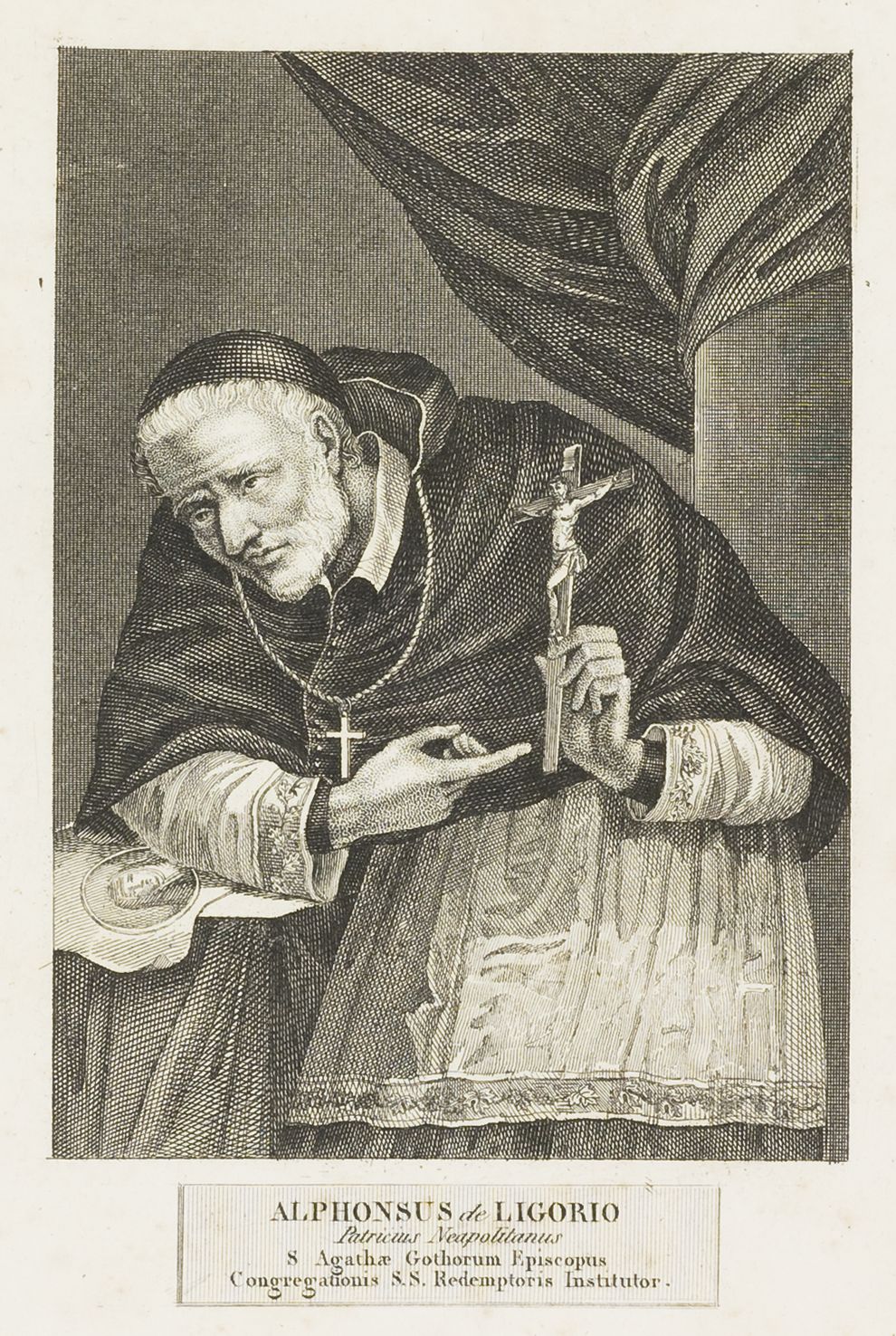
This Saint’s Story
He was the firstborn of seven siblings in a noble family that had experienced financial decline. His father, a naval officer, ensured that Alphonsus received a comprehensive education, which led him to graduate with a law degree at the remarkably young age of 16. Despite his success in the legal field, he grew increasingly disillusioned with the profession, especially after suffering a significant loss in court. This defeat prompted him to seek a more meaningful path in life.
In 1723, after a profound inner calling, Alphonsus chose to pursue the priesthood. Initially, he faced resistance from his father, but they eventually reached a compromise that allowed him to study for the priesthood while living at home. He was ordained on December 21, 1726, and began his ministry by serving the marginalized youth of Naples. His straightforward preaching style resonated with the poor, leading him to establish Evening Chapels, which became vibrant centers of faith and community engagement.
In 1732 Alphonsus established a new religious community dedicated to serving the poor and preaching the Gospel. This group focused on addressing the spiritual needs of people in rural areas and emphasized a compassionate approach to confession, countering the strict moralism of Jansenism. His musical talents also flourished during this time, as he composed hymns that enriched the spiritual life of his communities.
In 1762, Alphonsus reluctantly accepted the role of Bishop of Sant'Agata de' Goti, despite his age and health issues. He undertook significant reforms in his diocese, addressing clerical abuses and promoting devotion to the Eucharist and the Virgin Mary. Even as his health declined, he continued to write and preach until his resignation was accepted in 1775. He faced numerous physical ailments in his later years but remained devoted to his mission until his death on August 1, 1787.
Alphonsus was beatified (declared 'Blessed', the step before sainthood) by Pope Pius VII on September 15, 1816, and canonized (officially declared a saint by the pope) by Pope Gregory XVI on May 26, 1839. His legacy endures through his extensive writings on moral theology, which have influenced generations of theologians. He was declared a Doctor of the Church (a title the pope gives to a saint whose teaching is of special value to the whole Church) in 1871, recognizing his significant contributions to Catholic thought.
