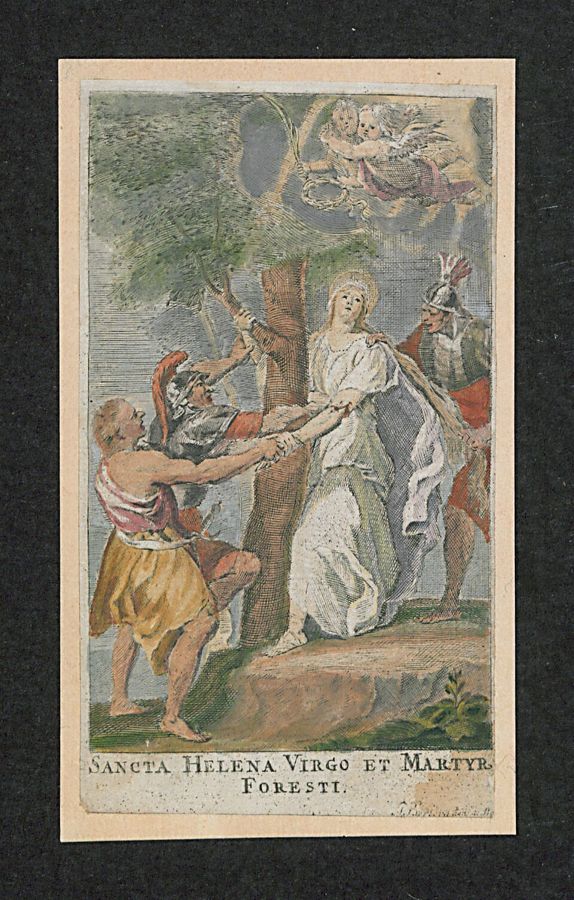
St. Alena

Saint Alena, who is sometimes called Alène or Alina, was born in the 7th century in Dilbeek, a town near Brussels. Alena, the daughter of the lord of Dilbeck in the 7th century, was converted to Christianity by hearing her father’s account of Christian ceremonies which he had witnessed.

Read the essentials →
Feast June 17 · Virgin, Martyr

St. Alena

Current feast

June 17 (also listed: June 16, June 18, June 19, June 24, July 28, December 16)
Secondary source · Wikipedia infobox

Traditional feast

June 17
1914 / pre-1969 calendar, per Baring-Gould (1897)

Represents

Virgin
Martyr

Feast days

Feast: June 17

This Saint’s Story

Written for this site from Wikipedia and Sabine Baring-Gould, The Lives of the Saints (source note)

Her parents, Levold and Hildegaart, were noble pagans. Alena made the courageous decision to embrace Christianity, choosing to be baptized without informing her family. To practice her faith, she would sneak out at night to attend Mass at a nearby chapel.

When her father discovered her secret, he was furious and believed that she had been enchanted into converting. He sent guards to bring her back home. During the struggle to detain her, Alena lost her arm, and the injuries she sustained ultimately led to her death while imprisoned. According to tradition, her burial site became known for miraculous events, including the healing of a Duke who prayed for her intercession.

In the late 12th century, her remains were officially honored and enshrined in the Priory of Forest, which marked the beginning of her veneration as a saint. This site soon became a popular destination for pilgrims seeking her intercession. Over the years, her relics were preserved in various ornate containers, although modern studies suggest that the bones housed in Forest may not belong to her.

Alena is often depicted in religious art as a princess with one arm missing or as a healer of the blind. She is especially honored in Brussels, where she is called upon for help with eye ailments and dental issues.

What she represents

How she teaches us to live

Drawn from themes in the original account

Share your faith, in words and by example. Preaching and conversion are part of this story.

Celebrate this saint’s feast day. Remember her on June 17 with a short prayer, and ask for her help.

Read more

The full original · 308 words

Read Baring-Gould’s full account

Baring-Gould’s sources: B-'lgian and Galilean Manyrologies. The festival of S. Alena is celebrated on the Sunday be! ore Midsummer-day; it is entered in Martyrologkt variously on June 17th, i8th, and 19th. Authority:— A Latin life founded on popular tradition.

Alena, the daughter of the lord of Dilbeck in the 7th century, was converted to Christianity by hearing her father’s account of Christian ceremonies which he had witnessed. A priest having built an oratory in a neighbouring forest, at the spot now called Vorst or La Fordt, near Brussels, she went to him to receive instruction, but secretly, for fear of her father. She was baptized, and afterwards went at midnight through the wilderness of trees, to the little chapel to hear matins and assist at mass, returning to her father’s castle before daybreak.

When her father discovered her proceedings he was furious, and sent servants to prevent her from going to the chapel. She evaded the watch placed on her in her home, and escaped into the forest, where she S. Botulph* fell into the hands of some rough men, who, in their violent efforts to detain her, broke her arm, and so injured her in the struggle that she died. Then frightened at what they had done, in having gone beyond their orders, the men escaped. The priest, perhaps hearing the cries, came to the spot and found the unfortunate girl.

He was unable to restore life, and she was buried near his chapel.1 At the close of the 12th century, the place where her body lay is said to have been discovered by revelation, and her bones were dug up and placed in the crypt of the church of S. Denis at For6t. They are exhibited to the faithful on her festival. A filbert tree is also shown in a walled enclosure adjoining the church, and the story about it is that Alena one day thrust her staff into the ground at the chapel door, and left it there.

On the morrow it had budded and rooted itself, and it grew up a stately filbert.

More about St. Alena

Checked against at least two sources, in our own words

Help us add to this saint's story

Everything is read by a person before anything appears. Facts are checked against trusted sources first.

Facts are welcome; a source link helps (optional).With your permission we may share it on this page.

Nine days · Free

Pray the novena
with us.

One short email a day for nine days. The day's prayer, a line from St. Alena's story, and a nudge to keep going.

Also on June 17
N

Sts. Nicander and Marcian

June 17 · Martyrs
M

Sts. Manuel

June 17 · Martyrs
P

St. Pior

June 17 · Hermit
← All 1970 saints in the library
Sources & notes

Feast-day sources

Story sources

Sources

Credits

Image: Alena van Dilbeek (tg-uact-793).jpg · Unknown · CC0, via Wikimedia Commons

Image: Unknown, Wikimedia Commons (CC0)

From Sabine Baring-Gould, The Lives of the Saints, new edition in 16 vols. (London: John C. Nimmo, 1897–98); text from the Internet Archive scan (OCR, lightly cleaned; errors possible). Public domain in the United States. Reproduced unedited, except for short bracketed notes in grey that we added to explain names and terms (“S.” is the old abbreviation for Saint). Some history and judgments reflect 19th-century scholarship.