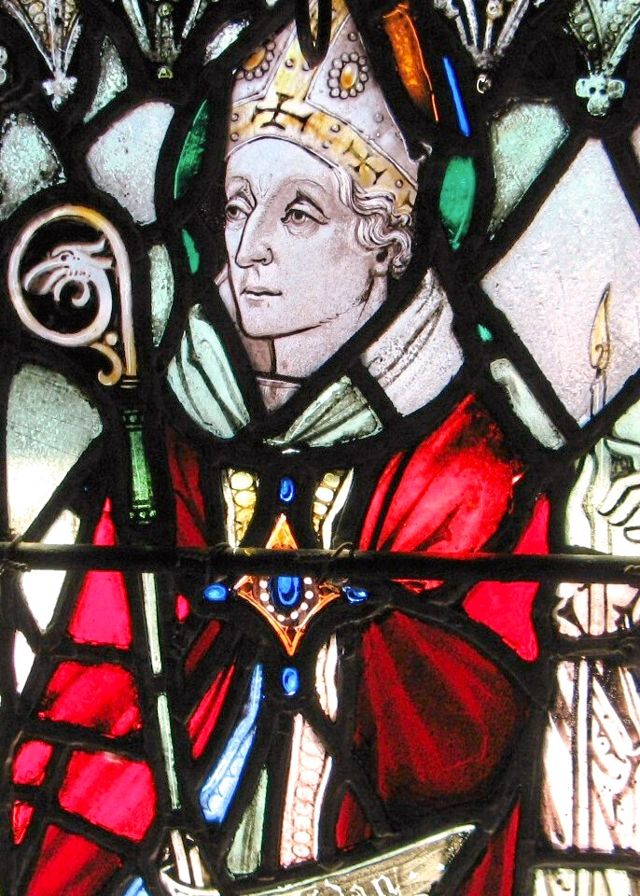
At these words, everyone turned their attention to Aidan. His opinion was thoughtfully considered, and the discussion concluded with the recognition that he was the right person for the mission, as he possessed the discernment that is the foundation of all virtues. There was a bishop in the monastery of Iona, and Aidan received his consecration from him for the work of God in Northumbria. He received his mission from the entire brotherhood and from Seghen, the Abbot of Iona, who was the fourth successor of Columba in the monastic center of the Hebrides.
Aidan discovered that everything needed to be done, or redone, in the once Christian Northumbria. In the south, in Deira, the destruction caused by Cadwallon and Penda seemed to have erased any evidence of the mission of Paulinus, except for the solitary church at York. There, the deacon, James, had continued the celebration of Christian worship, and the church, which had been started by Edwin, was completed by Oswald. In Bernicia, the Roman bishop, Paulinus, had limited himself to traveling missions followed by general baptisms, but he had not established any permanent church there. It is said that until the Cross was erected by Oswald on the eve of his victory over the Britons, no one had ever seen a church, an altar, or any symbol of the Christian faith.
Thus, a difficult task lay ahead, one worthy of a follower of Columba, which confronted the monk of Iona, who had been trained in the school of that great missionary. Aidan brought several of his brethren with him, and the number of Celtic monks who came to assist him grew daily. It became necessary to assign them, or rather to create for them, a center of operations.
The king allowed Aidan to choose the location of his bishopric. Although his diocese covered all of Northumbria, he did not seem to consider taking the vacant see of York. Whether he refrained from this due to the biases and dislikes that separated the Scots from Roman practices, or whether he was reluctant to leave the northern area where Paulinus's mission had left the fewest traces, and where he consequently had the most work to do, it is certain that he chose to establish his episcopal monastery away from the churches founded by the Roman monks in the southern part of the country.
He preferred a location that was somewhat more central, near the royal residence of Oswald, and on the coast, but much closer to the Firth of Forth than to the mouth of the Humber, which marked the northern and southern extremes of Oswald’s kingdom.
This choice of residence shows that, as a monk of Iona, eager to follow the example of the great apostle of his people, who founded the sanctuary from which he came, Saint Aidan enjoyed imitating Saint Columba even in local details. Like him, he settled his community on an island near the shore, almost as small, insignificant, and barren as Iona was when the holy exile from Ireland arrived there. Its location was, in some respects, a repetition of Iona's position, situated in the North Sea to the east of Great Britain, compared to Iona on the opposite coast along the Atlantic.
Amid the waves of the North Sea, opposite the green hills of Northumberland and the sandy beach that stretches between the border town of Berwick in the north and the impressive feudal fortress of Bamborough in the south, lies a low, flat, and gloomy island surrounded by basaltic rocks. This island has a square shape and terminates to the northwest in a long point of land that stretches toward the mouth of the Tweed River and Scotland. The island has an air of melancholy and barrenness. It could only have produced the poorest crops and some meager pastures. There are no trees, no hills, and no notable features, except for a small conical hill to the southwest, which is now topped by a strong castle of picturesque design but built recently.
On this desolate islet, the first Christian church of the entire region was established, which is now so populous, wealthy, and industrious, extending from Hull to Edinburgh. This was Lindisfarne—meaning the Mother Church, the religious capital of North England and South Scotland, the residence of the first sixteen bishops of Northumbria, and the sanctuary and monastic stronghold of the surrounding area—the Iona of the Anglo-Saxons. The resemblance of Lindisfarne to Iona, of the colony to the metropolis, and of the daughter to the mother, is striking. These two islands, once so celebrated, renowned, and influential over two great opposing races, share the same dark and melancholic appearance, filled with a wild and savage sadness.
The island chosen by Aidan is, however, only an island for part of each day. Like Saint Michael’s Mount in Cornwall, twice in twenty-four hours the receding tide leaves the sands exposed, allowing passage on foot to the nearby shore, though not always without danger, as many stories are told of travelers who drowned while trying to cross to the holy isle at low tide. From this new home, Aidan, looking southward, could see far off the rock and stronghold of Bamborough, where Oswald, following the example of his grandfather Ida, had established his capital. His eye, like his heart, could there greet the young and glorious prince who was his friend, helper, and rival.
Nothing is told to us by Bede about the early history of Saint Aidan. However, the Irish Kalendars state that he was the son of Lugair, from the lineage of Eochaidh Finn Fuath-nairt, from whom Saint Bridgit was descended. They claim that he was first a bishop at Inis Cathaigh (Scattery Isle, County Clare), but this is certainly a mistake. He may have lived there as a cenobite (a member of a religious community), but not as a bishop, before joining the community of Iona. When he first appears to us, he is already a monk at Iona and holds a certain authority among his fellow monks. Even when he was elevated to the episcopate, he remained a monk, not only in spirit but also in practice. Almost all his Celtic fellow workers, whether from Ireland or Scotland, were monks like him and followed the cenobitical rule of their order and country. A hundred years after Aidan, the system he established at Lindisfarne was still thriving; and, as in his time, the bishop was either the abbot of the insular community or lived there as a monk, subject, like the other religious, to the authority of the abbot, who was elected with the consent of the brotherhood. The priests, deacons, choristers, and other officials of the cathedral were all monks. However, this monastic discipline and order would have meant little if the missionary leader of the institution had not possessed the character typical of great servants of the truth and been endowed with the virtues that the apostolic office requires.
Bede, who was born twenty years after the death of the monk-bishop and lived his entire life in the region that cherished the memory of Aidan’s virtues, has created one of the most eloquent and appealing portrayals of his character and life ever written by the venerable historian. The praise he gives to Aidan is not only more expressive and distinct than that given to any other monastic apostle of England, but it is also less likely to be seen as biased, as it is accompanied by strong protests against the Celtic Church and its apostles for their adherence to Celtic practices, such as the celebration of Easter. The clergy of South Ireland had abandoned these practices in favor of Roman customs, but the Scots of North Ireland and all of Caledonia stubbornly preserved them as they had received them from their ancestors.
“Aidan was,” Bede tells us, “a bishop inspired with a passionate love of goodness; but at the same time full of a surpassing gentleness and moderation.” Faithful to all the noble teachings of his monastic upbringing, he appeared to the future clergy of Northumbria as a marvel of self-denial and austerity. He was the first to practice what he taught, and no one could ever accuse him of failing to fulfill, to the best of his ability, all the precepts of the Gospels, the apostles, and the prophets. Indifferent to all worldly possessions, Aidan gave away in charity all that he received from kings and wealthy individuals.
To the astonishment of the Saxons, who, like modern Englishmen, were excellent horsemen and valued nothing more highly than horses, it was always on foot that the bishop traveled through towns and countryside, going everywhere—now among the rich, now among the poor—baptizing those who were still heathens, confirming in the faith those who were already Christians, and encouraging everyone to give to charity and do good works. All who accompanied him, whether monks or laypeople, had to devote a certain portion of each day to meditation—that is to say, to reading the Bible and learning the Psalter. Unwearied in study, humble and peaceful, charitable and sincere, he was especially distinguished by his zeal against the sins of the rich. Far from sparing any of their vices or excesses, he rebuked them with the greatest sharpness; and contrary to the usual custom, he never made any gifts to the chiefs or nobles, limiting himself to simple hospitality when they came to visit him, and giving away to the needy the gifts they heaped upon him.
But the priestly courage that armed him against the pride of the powerful was transformed into a wonderful tenderness and watchful care when he had to defend the weak, relieve the needy, or comfort the unfortunate. His was, in a word, the heart of a true priest and apostle, disdainful of false grandeur and vain prosperity, and victorious over all the mean and perverse tendencies of his time, and of all times.
Aidan kept nothing for himself from all the land gifts that the generosity of the Saxon kings and nobles provided to the Church, whose teachings they had just accepted. He was satisfied with Lindisfarne and the small fields of his poor little island. However, he always tried to secure a location for a chapel, with a small room attached, where he prepared his sermons and stayed during his constant and lengthy travels. Like Saint Gregory the Great, whom he admired and sought to emulate in good deeds, he took a special interest in educating children and freeing slaves. From the start of his mission, he gathered twelve English youths, whom he educated with great care for the service of Christ, and at least one of them became a bishop. Every church and monastery he founded quickly became a school where the children of the English received an education as thorough as that found in any of the great Irish monasteries. Regarding slaves, he mainly used the gifts he received from the generosity of the Anglo-Saxons to redeem them, especially focusing on those who, as Bede described, had been “unjustly sold.” This likely refers to those who were not foreign prisoners or who had not been condemned to slavery as punishment for a crime. The Saxons, like the Celts, had no qualms about selling their own people and children like livestock. The freedmen were carefully taught by Aidan, counted among his disciples, and often elevated to the priesthood. Thus, heathen barbarism was attacked and weakened at its very core by monks from both the north and the south, as well as by slaves who were promoted to the rank of priests. An account of the combined efforts of Saint Oswald and Saint Aidan has already been provided in this volume, and the reader is referred to it. The battle of Maserfield ended the life and good works of the blessed Oswald, one of the noblest, purest, and most dedicated kings known in history.
Oswin claimed and took the throne of Deira, and Aidan was as beloved and respected by this young prince as he had been by Oswald. The touching story of their friendship and the early death of Oswin has already been told in this volume. The fierce Penda, leading his Mercians and the Britons, ravaged Northumbria for thirteen years; however, he seems to have had less hostility towards his neighbors, the Deirians and their king, than towards the Bernicians and Oswy, the brother of Oswald, his last victim. In the northern part of the two kingdoms, we find him spreading destruction everywhere and trying to set the royal fortress of Bamborough on fire. There, we also find Aidan, the benefactor and protector of the land.
Penda, unable to capture the fortress either by attack or siege, ordered a massive pile to be built all around the rampart. He gathered all the wood from the surrounding forests, driftwood from the beach, beams, and even the thatch from the cottages in all the nearby villages that he had destroyed. Then, as soon as the wind blew from the west, he set fire to the pile, hoping to see the flames reach the town. At that time, Aidan was on the islet of Fame, an isolated rock in the open sea, a little south of Lindisfarne and nearly opposite Bamborough, to which he often traveled, leaving his episcopal monastery to devote himself to prayer in solitude and silence. While he prayed, he saw a cloud of black smoke and jets of flame covering the sky above the town where his dear Oswald had once lived. Lifting his eyes and hands to heaven, he cried with tears, “My God, behold all the evils that Penda does to us!” At that moment, the wind changed, and the flames turned upon the besiegers, destroying many of them, and they quickly abandoned the siege of a place so clearly under Divine protection.
As if this formidable and merciless enemy was not enough to devastate Northumbria, Oswy, driven by jealousy, waged war against Oswin, King of the Deirians. Thus, Northumberland was caught in a cycle of internal conflict as well as devastation from the ruthless invasions of Penda. Oswin was defeated and killed; and twelve days later, the glorious Bishop Aidan followed the king he loved to the grave. He fell ill during one of his many missionary journeys and died under a tent that had been hastily set up to shelter him behind a modest church he had just built. He passed away with his head resting against one of the buttresses of the church. It was a death fitting for a soldier of the faith on his own rightful battlefield.
The body of Aidan was placed in his monastic cathedral at Lindisfarne. England, and certainly all of the North, looks to Aidan as her apostle much more than to Augustine.
Footnotes
- Lindisfarne means the Mother Church, the religious capital of North England and South Scotland.
- Saint Michael’s Mount is a rocky island in Cornwall with a castle and church.
- Inis Cathaigh is Scattery Isle, located in County Clare.
- Cenobite refers to a member of a religious community.
- Bede tells us, “a bishop inspired with a passionate love of goodness; but at the same time full of a surpassing gentleness and moderation.”
- Bede’s expression refers to those who were not foreign prisoners, or who had not been condemned to slavery as a punishment for crime.
Baring-Gould’s own footnotes, in modern English.
Read the original 1870s text
Baring-Gould’s sources: Roman Martyrology. York Kalendar, Bede, Ado, Usuardus, Aberdeen Breviary. Donegal and other Irish Kalendars. Authority: — Bede in his Eccl. History of England.1] When S. Oswald sought to convert his kingdom of Northumbria to Christ, as has been already related in his life, he turned to Iona for a missionary. The Scottish monks answered his appeal with heartiness. But the first effect of their zeal was not fortunate. Their first representative seems to have been a man of harsh, unbending disposition, of that tone of mind prone to look on the gloomy side of affairs, to rebuke and threaten, and meditate and preach on hell fire and outer darkness rather than on the love and mercy of God, and on the glories of Paradise — a temper of mind which was perhaps a national characteristic, to culminate eventually in stern Calvinism. This missionary, by name Corman, attempted in vain to preach the Gospel to the Northumbrians, who heard him with opposition and dislike. After some time he returned to Iona; and in rendering an account of his mission to the fathers of the monastery, he declared that he could make nothing of the Angles, that they were a race of untamable savages, and of a stubborn and barbarous spirit. This report greatly perplexed the fathers of the synod, who ardently desired to impart to the English people the gift of salvation which had been asked from them. They deliberated for a long time, until at length one of the assembly, Aidan, a monk of Iona, said to the discomfited preacher, “ It seems to me, my brother, that you have been too hard on these ignorant people: you have not, according to the 1 The greater part of this life is taken from Montalembert’s Monks of the West. apostolic counsel, offered them first the milk of gentle doctrine, to bring them by degrees, while nourishing them with the Divine Word, to the true understanding and practice of the more advanced precepts."
At these words every eye was turned to Aidan: his opinion was thoughtfully discussed, and the debate ended in an acknowledgment that he was the man wanted for the mission, since he was endowed with that discernment which is the source of all virtues. There was a bishop in the monastery of Iona, and Aidan received consecration from his hands for the work of God in Northumbria [the Anglo-Saxon kingdom of northern England and south-east Scotland]. He received his mission from the whole brotherhood and from Seghen, Abbot of Iona, the fourth successor of Columba in the monastic metropolis of the Hebrides. Aidan found that everything had to be done, or done over again, in the once Christian Northumbria. To the south, in Deira, the ravages of Cadwallon and Penda do not seem to have left any traces of the mission of Paulinus except the solitary church at York, where the deacon, James, had maintained the celebration of Christian worship, and which, begun by Edwin, was completed by Oswald. In Bernicia the Roman bishop, Paulinus, had restricted himself to itinerating missions, followed by general baptism, but he had not founded there any permanent station, since, until the Cross was planted by Oswald on the eve of his victory over the Britons, it is said that no one had ever seen a church, or an altar, or any emblem of the Christian faith. It was thus a hard task, and one well wor thy of a followed of Columba, which presented itself to the monk of Iona, trained in the school of that great missionary. Aidan had brought with him several of his brethren, and the number of Celtic monks who came to help him increased from day to day. It became necessary to assign to them, or rather to create for them, a centre of operations. The •S'. Aidan.
King left to Aidan the choice of the seat of his bishopric. Although his diocese comprised the whole of Northumbria, he does not seem to have thought of occupying the vacant see of York [a bishop’s “see” is his diocese, named from his seat (Latin sedes)]. Whether he yielded in this to the prejudices and dislikes which separated the Scots from Roman usages, or whether he was unwilling to quit the northern district, where the mission of Paulinus had left the fewest traces, and where, consequently, he had most work to do, it is certain that he chose to place his episcopal monastery at a distance from the churches founded by the Roman monks in the southern part of the country.
He preferred a position a little more central, near the royal residence of Oswald, and on the coast, but much nearer the Firth of Forth than the mouth of the Humber, which mark the two extreme limits of Oswald’s kingdom to the north and south.
This choice of a residence shows that, as a monk of Iona, ambitious of following in every respect the example of the great apostle of his race, founder of the sanctuary whence he issued, S. Aidan [Irish monk, founder of Lindisfarne (d. 651)] took pleasure in imitating S. Columba [Irish abbot of Iona (d. 597), apostle of Scotland] even in local particulars. Like him he settled his community in an island near the shore, almost as small, as insignificant, and as barren as Iona was when the holy exile from Ireland landed there. Its position was even, in some respects, a repetition, in the North Sea and to the East of Great Britain, of the position of Iona upon the opposite coast and on the shore of the Atlantic.
Amid the waves of the North Sea, opposite the green hills of Northumberland, and the sandy beach which extends between the border town of Berwick on the North, and the imposing scene of the feudal fortress of Bamborough on the South, lies a low island, flat and sombre, girt with basaltic rocks, forming a kind of square block, which tenninates to the north-west in a long point of land stretching towards the ijy — iji mouth of the Tweed and Scotland. This island bears the impress of melancholy and barrenness. It can never have produced anything but the sorriest crops and some meagre pasturage. There is not a tree, not an undulation, not one noticeable feature, save a small conical hill to the southwest, now crowned by a strong castle of picturesque form but recent construction.
In this poor islet was erected the first Christian church of the whole district, now so populous, rich, and industrious, which extends from Hull to Edinburgh. This was Lindisfarne— that is to say, the Mother Church, the religious capital of the North of England and the South of Scotland, the residence of the first sixteen bishops of Northumbria, the sanctuary and monastic citadel of the whole country round — the Iona of the Anglo-Saxons. The resemblance of Lindisfarne to Iona, of the colony to the metropolis, the daughter to the mother, is striking. These two isles, once so celebrated, so renowned, so influential over two great hostile races, have the same sombre and melancholy aspect, full of a wild and savage sadness.
The island chosen by Aidan is, however, an island during only a portion of each day. As at S. Michael’s Mount in Cornwall, twice in twenty-four hours the ebbing tide leaves the sands uncovered, and the passage can be made on foot to the neighbouring shore, though not always without danger, for many stories are told of travellers drowned in attempting to cross to the holy isle at low water. From this new abode Aidan, looking southward, could descry far off the rock and stronghold of Bamborough, where Oswald, after the example of his grandfather Ida, had established his capital. His eye, like his heart, could there hail the young and glorious prince who was his friend, his helper, and his rival.
Nothing is told us by Bede [English monk and historian (d. 735)] of the early history of S. Aidan. But the Irish Kalendars state that he was the son of Lugair, of the race of Eochaidh Finn Fuath-nairt, from whom S. Bridgit was descended. They state that he was bishop first at Inis Cathaigh (Scattery Isle, County Clare), but this is certainly a mistake. He may have resided there as a cenobite, but not as a bishop, before entering the community of Iona. When he first appears to us he is already a monk at Iona, and clothed with a certain authority among his brethren. Even when raised to the episcopate, he remained always a monk, not only in heart, but in life. Almost all his Celtic fellow-workers, whether from Ireland or Scotland, were monks like himself, and followed the cenobitical rule of their order and country. A hundred years after Aidan, the system which he had established at Lindisfarne was still in full vigour; and, as in his day, the bishop himself was either himself the abbot of the insular community, or lived there as a monk, subject, like the other religious, to the authority of the abbot, elected with the consent of the brotherhood. The priests, deacons, choristers, and other officials of the cathedral, were all monks. But this monastic discipline and order would have availed little if the missionary-head of the institution had not possessed the character common to great servants of the truth, and been endowed with those virtues which the apostolic office demands.
Bede, who was born twenty years after the death of the monk-bishop, and who lived all his life in the country which was fragrant with the memory of Aidan’s virtues, has made his character and life the subject of one of the most eloquent and attractive pictures ever drawn by the pen of the venerable historian. The praise which he awards to him is not only more expressive and more distinct than that given to any other monastic apostle of England, but also so much the less to be suspected of pardality, that it is qualified by most energetic protests against the Celtic Church and its apostles for their fidelity to Celtic observances as to the celebration of Easter, which the clergy of the South of Ireland had abandoned out of deference to the Roman usage, but which the Scots of the North of Ireland and of all Caledonia obstinately preserved as they had received them from their fathers.
“ Aidan was,” Bede tells us, “ a pontiff inspired with a passionate love of goodness; but at the same time full of a surpassing gentleness and moderation.1' Faithful to all the noble teachings of his monastic cradle, he appeared to the future clergy of Northumbria as a marvel of self-denial and austerity. He was the first to practise what he taught, and none could ever reproach him with having failed to fulfil, to his best ability, all the precepts of the Gospels, of the apostles, and the prophets. Indifferent to all worldly possessions, Aidan expended in alms all that he received from the kings and rich men. To the astonishment of the Saxons, who, like modern Englishmen, were excellent horsemen, and valued nothing more highly than the horse, it was always on foot that the bishop went through town and country, penetrating everywhere — now among the rich, now among the poor — baptizing those who were still heathen, confirming in the faith those who were already Christians, and stimulating all to alms-giving and good works. All who accompanied him, monks or laymen, had to devote a certain portion of each day to meditation— that is to say, to reading the Bible and learning the Psalter. Unwearied in study, humble and peaceful, charitable and sincere, he was especially distinguished by zeal against the sins of the rich. Far from sparing any of their vices or excesses, he rebuked them with the greatest sharpness; and contrary to the received custom, he never made any present to the chiefs or nobles, restricting himself to •S'. Aidan.
simple hospitality when they came to visit him, and giving away to the necessitous the gifts they heaped upon him. But the priestly courage which armed him against the pride of the powerful was transformed into a wonderful tenderness and watchful solicitude when he had to defend the feeble, to relieve the needy, or to comfort the unfortunate. His, in a word, was the heart of a true priest and apostle, disdainful alike of false grandeur and vain prosperity, and victorious over all the mean and perverse tendencies of his time, of all times.
Aidan retained nothing for himself of all the gifts of land which the generosity of the Saxon kings and nobles bestowed upon the Church, whose doctrines they had just embraced. He was content with Lindisfarne and the scanty fields of his poor little isle. But he reserved for himself, wherever it was possible, a site for a chapel, with a small chamber attached, where he prepared his sermons, and in which he lodged during his incessant and prolonged journeys. Like S. Gregory the Great, whom, though not his disciple, he emulated in well-doing, he took an especial interest in the education of children and the emancipation of slaves. From the beginning of his mission he attached to himself twelve English youths, whom he educated with the greatest care for the service of Christ, and of whom at least one became a bishop. Every church and monastery founded by him became immediately a school where the children of the English received from Aidan’s monks an education as complete as that to be had in any of the great Irish monasteries. As to slaves, he devoted principally to their redemption the gifts which he owed to the munificence of the Anglo-Saxons, endeavouring especially to save such as, to use Bede’s expression, had been “unjustly sold” — which means, probably, those who were not foreign prisoners, or who had not been condemned to slavery as a punishment for crime. For the Saxons, as well as the Celts, made no scruple of selling their brethren and children like cattle. The freedmen were carefully instructed by Aidan, numbered among his disciples, and frequently raised to the priesthood. Heathen barbarism was thus assailed and undermined in its very citadel by monks, both from the north and from the south, and by slaves promoted to the rank of priests. An account of the united labours of S. Oswald and S. Aidan has been already given in this volume, and to it the reader is referred.1 The battle of Maserfield closed die life and good work of the blessed Oswald, one of the noblest, purest, and most earnest kings known to history.
Oswin claimed and seized on the throne of Deira, and Aidan was as much beloved and respected by this young prince as he had been by Oswald. The touching story of their intimacy and of the early death of Oswin has already found its place in this volume.1 The fierce Penda, at the head of his Mercians and the Britons, for thirteen years ravaged Northumbria; but he seems tohave entertained less unfriendly feelings towards his neighbours the Deirians and their king than to the Bernicians, and Oswy, the brother of Oswald, his last victim. It is in the north of the two kingdoms that we find him carrying everywhere fire and sword, and attempting to give to the flames the royal fortress of Bamborough. There also we find Aidan, the benefactor and protector of the country. Penda, not having been able to reduce the fortress either by assault or by investment, caused an enormous pile to be erected all round the rampart. He heaped on it all the wood of the surrounding forests, the drift wood from the beach, the beams, and even the thatch of the cottages in all the neighbouring villages which he had destroyed; then, as soon as the wind blew from the West, he set fire to 6". Aidan.
the mass, with the hope of seeing the flames reach the town. Aidan was at this time in the islet of Fame, an isolated rock in the open sea, a little to the south of Lindisfarne, and nearly opposite Bamborough, to which he often went, quitting his episcopal monastery to devote himself in solitude and silence to prayer. While he prayed he saw a cloud of black smoke and jets of flame covering the sky above the town where once his dear Oswald had dwelt. Lifting his eyes and hands to heaven, he cried with tears, “ My God, behold all the evils that Penda does us 1” At the same moment the wind changed, the flames whirled upon the besiegers, destroying many of them, and they speedily abandoned the siege of a place so evidently under Divine protection.
As if this formidable and pitiless enemy was not enough to desolate Northumbria, Oswy, moved by jealousy, made war against Oswin, King of the Deirians. Thus Northumberland was a prey to internecine war as well as desolation from the invasions of the ruthless Penda. Oswin was defeated and put to death; and twelve days afterwards the glorious Bishop Aidan followed the king he loved to the tomb. He fell sick during one of hi's innumerable missionary expeditions, and died under a tent which had been pitched in haste to shelter him at the back of a modest church he had just built. He expired with his head resting against one of the buttresses of the church. It was a death which became a soldier of the faith upon his own fit field of battle.
The body of Aidan was laid in his monastic cathedral of Lindisfarne. To Aidan far rather than to Augustine may England, certainly all the North, look as to her apostle.