The judge said, “Sacrifice to the gods, for it is better for you to live than to die by torture.” Afra replied, “My sins are enough, which I have committed in ignorance, without adding this also, which you command me to do.”
Gaius said, “Go to the capitol and sacrifice.” Afra responded, “Christ is my capitol, whom I always keep before my eyes, and to whom I daily confess my wrongdoings, and offer myself as a willing sacrifice.”
The judge Gaius said, “As I hear, you are a courtesan. Sacrifice, then, for you have no part with the God of the Christians.”
Afra replied, “My Lord Jesus Christ said that He came down from heaven for sinners.” The judge said, “Sacrifice, and you will regain the love of your lovers, and they will pour their money into your lap.” Afra answered, “I will never accept their hateful money; what money I had, I have thrown away as worthless.” The judge Gaius said, “You cannot be a Christian, you who are a harlot.”
Afra replied, “My only claim to the title of Christian is through the mercy of God.” Gaius asked, “How do you know that Christ accepts you?” Afra said, “Because He allows me to confess Him before your judgment seat.”
Gaius said, “These are fables, mere fables; sacrifice!” Afra answered, “Christ is my salvation: who, hanging on the cross, promised paradise to the confessing thief.” The judge said, “Do not keep me so long arguing with you; sacrifice, and be done with this nonsense, or I will have you tortured and burned alive.”
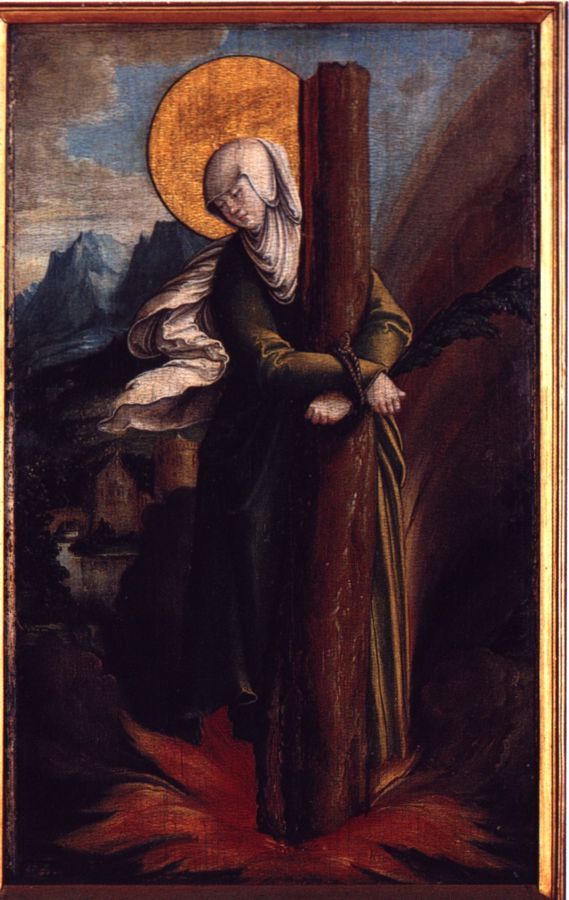
Afra said, “Let the body that has sinned suffer.” Then the judge gave his sentence; and she was immediately seized by the executioners and dragged to an island in the river Lech, where they stripped her and bound her to a stake.
Then she, lifting her eyes to heaven, prayed while weeping, “Lord Jesus Christ, Almighty God, who came to call sinners, not the righteous, to repentance; receive in this hour the sorrow of my passion, and by this temporary fire, prepared to consume my body, save me from the eternal fire that consumes both body and soul together!”
Then the flames rose and surrounded her, and even from the fire, her voice was still heard raised in prayer, “I give You thanks, Lord Jesus Christ, who have deemed me worthy to suffer for Your name, who offered Your body on the cross as a sacrifice for all the world, the just for the unjust, the good for the evil, the blessed for the cursed, the sweet for the bitter, the pure from sin for those stained with evil. To You I offer my sacrifice, who live and reign with the Father and the Holy Spirit, God through ages of ages. Amen.”
And having said this, she fell silent and died in the midst of the fire.
Now when the pyre was dead and cold, Digna, Eumenia, and Euprepia, servants of Afra, took her body and buried it in a burial chapel built at the second milestone from the city. When Gaius heard this, he sent soldiers, who stacked wood around the chapel and burned the servants and Hilaria, the mother of the martyred Afra.
The name Afra suggests that the martyr came from Africa, probably from Egypt. There is little doubt that she followed the soldiers of the Theban legion, of which one group was perhaps stationed at Augusta Vindelicorum. It does not necessarily mean that she was a courtesan.
So far, this information is trustworthy; what follows appears to be a later addition. The martyrologists before the 6th century referred to her as a virgin, indicating that at that time, the complete legend of her conversion from a life of sin had not yet been created, and the earlier “Passion” was adapted to fit this version of the story. The Roman soldiers were often allowed to bring their wives and daughters with them, and Afra may have accompanied her father from Egypt to Germany.
However, after the 6th century, the martyrologists could not explain how a young woman could have followed the soldiers from the East into the West unless she were a camp follower of ill repute. They therefore removed the title of virgin, and the tale of her being a harlot emerged.
That African troops were stationed in Germany is shown by Roman seals of a "Cohors Mauretanorum" that have been found at Xanten, the burial inscription of a Mauritanian prefect of a cohort that was discovered at Bedburg near Cleves, and a black skull, along with Roman pottery and coins at Cologne. The relics of S. Afra are believed to have been discovered in A.D. 955 by S. Ulric. They now rest in the beautiful church of SS. Ulric and Afra, located at the southern end of Augsburg.
Footnotes
- The name Afra suggests that the martyr came from Africa, probably from Egypt.
- So far, this information is trustworthy; what follows appears to be a later addition.
- The term "Cohors Mauretanorum" refers to a cohort of troops from Mauretania.
- A.D. stands for Anno Domini, meaning "in the year of our Lord."
Baring-Gould’s own footnotes, in modern English.
Read the original 1870s text
Baring-Gould’s sources: At Augsburg on Aug. 7; as also at Mainz, Wurzburg, Spires, Osnabrück, &c. But in the so-called Martyrology of S. Jerome, and in the Roman Martyrology, on Aug. 5, as also Usuardus, Ado, and Hrabanus Maurus. Authority: — The Acts of S. Afra, consisting of two parts, the “ Conversio ” and the “ Passio,” which existed in the 9th. cent., but when written it is impossible to decide. But it is certain that they are by no means contemporary. The “Conversio” is certainly much later than the “Passio,” is founded on tradition, and is probably apocryphal. But the “Passio” may be based on the ancient and authentic Acts. In style it resembles genuine Acts of the Martyrs; this cannot be said for the “Conversio.” ’] ACCORDING to tradition, not very trustworthy, Afra was a harlot living in Augsburg in the beginning of the fourth century. S. Narcissus, Bishop of Gerona (March 18), being driven from his see in the persecution of Diocletian, came to Augsburg, and lodged in the house of Afra. She and her mother Hilaria were converted and baptized by the bishop. When the persecution of the Christians broke out in Rhaetia, Gaius, the judge, having learned that Afra was a Christian, ordered her to be brought before him. The fol- The fact that before the 6th cent, the Martyrologies give S. Afra as a virgin and martyr proves that the “ Conversio ” was not then in existence. lowing account of the examination and martyrdom of S. Afra is probably in the main genuine.
The judge said, “Sacrifice to the gods, for it is better for thee to live than to perish by torture.” Afra answered, “ My sins suffice, which I have committed in ignorance, without my adding this also, which thou commandest me to do.”
Gaius said, “ Go to the capitol and sacrifice.” Afra said, “ Christ is my capitol, whom I hold ever before my eyes, and to whom I daily confess my misdeeds, and offer myself as a willing sacrifice.”
The judge Gaius said, “ As I hear, thou art a courtesan. Sacrifice, then, for thou hast no part with the God of the Christians.”
Afra replied, “My Lord Jesus Christ said that he came down from heaven for sinners.” The judge said, “ Sacrifice, and thou wilt regain the love of thy lovers, and they will pour their money into thy lap.” Afra answered, “ I will never receive their hateful money; what money I had I have cast away as dross.” The judge Gaius said, “ Thou canst be no Christian, thou who art a harlot.”
Afra replied, “ My only claim to the title of Christian is through the mercy of God.” Gaius said, “ Howknowest thou that Christ accepts thee?” Afra said, “ In that he suffers me to confess him before thy judgment seat.”
Gaius said, “These are fables, mere fables; sacrifice !” Afra answered, “ Christ is my salvation: who, hanging on the cross, promised paradise to the confessing thief.” The judge said, “ Do not keep me so long arguing with you; sacrifice, and have done with this folly, or I will have thee tortured and burned alive.”
Afra said, “Let the body that has sinned suffer.” Thereupon the judge gave forth his sentence; and she was instantly seized by the executioners and dragged to an island in the river Lech, where they stripped her, and bound her to a stake.
Then she, lifting up her eyes to heaven, prayed weeping, “Lord Jesus Christ, Almighty God, who earnest to call the sinners, not the righteous, to repentance; receive in this hour the penitence of my passion, and by this temporal fire, prepared to consume my body, save me from the eternal fire which consumes body and soul together ! ” Then the flames rose, and enveloped her, and out of the fire her voice was still heard raised in supplication, “ I give thee thanks, Lord Jesus Christ 1 who hast deemed me worthy to suffer for Thy name, who didst offer Thy body on the cross as a victim for all the world, the just for the unjust, the good for the evil, the blessed for the cursed, the sweet for the bitter, the clean from sin for those stained with evil. To Thee I offer my sacrifice, who livest and reignest with the Father and the Holy Ghost, God through ages of ages, Amen.’' And so saying she was silent, and died in the midst of the fire.1 Now when the pyre was dead and cold, Digna, Eumenia, and Euprepia, servants of Afra, took her body and buried it in a sepulchral chapel erected at the second milestone from the city. Now when Gaius heard this, he sent soldiers, and they stacked wood round the chapel, and burned therein the servants, and Hilaria, mother of the martyred Afra. The name Afra points to the martyr having come from Africa, probably from Egypt. She, there can be little doubt, followed the soldiers of the Theban legion, of which one manipulus was perhaps quartered at Augusta Vindelicorum. It by no means follows that she was a courtesan. The 1 So far is trustworthy; what follows is a later addition, apparently. martyrologists before the 6th century call her a virgin, so that at that time the complete legend of her conversion from a life of sin was not made up, and the earlier “ Passion” was accommodated to agree with this version of the story. The Roman soldiers were often suffered to take with them their wives and daughters, and Afra may have accompanied her father from Egypt to Germany. But after the 6th century the martyrologists were unable to explain how a young woman could have followed the soldiers from the East into the West, unless she were a camp-follower of bad repute. They therefore omitted the title of virgin, and the fable of her being a harlot arose.
That African troops were quartered in Germany is proved by Roman seals of a “ Cohors Mauretanorum” having been found at Xanten, the sepulchral inscription of a Mauritanian prefect of a cohort having been discovered at Bedburg near Cleves, and a negro skull, together with Roman pottery and coins at Cologne.1 The relics [the bodily remains of a saint, or objects they used, kept with honor] of S. Afra are supposed to have been discovered in a.d. 955, by S. Ulric. They now repose in the beautiful church of SS. Ulric and Afra, at the south extremity of Augsburg.