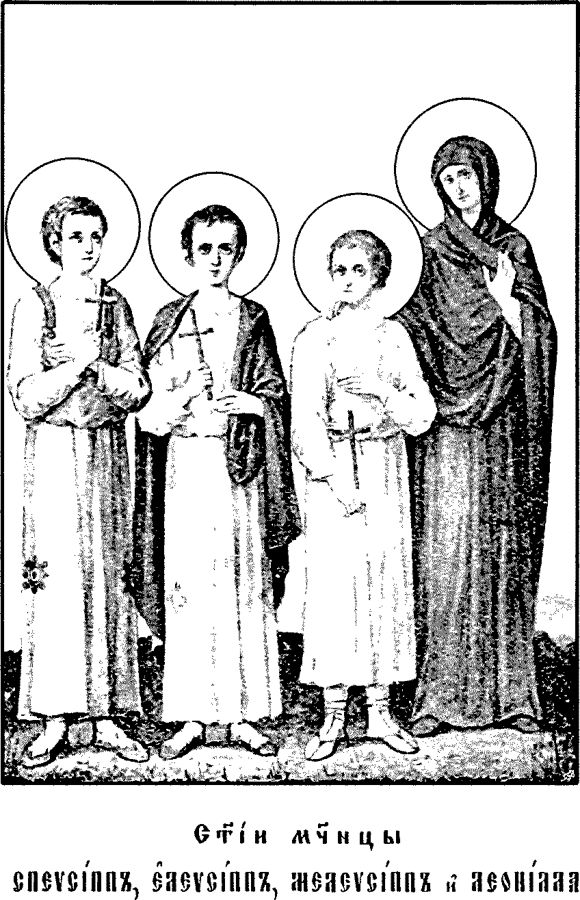
Peusippus, Eleusippus, and Meleusippus were three sons born to a believing mother and a pagan father. Their aunt, Leonilla, taught them the Christian faith. In their youthful enthusiasm, they rushed away from her side, where they had learned, to destroy the idols in the temples of their city. They were captured and burned on a single pyre, receiving the baptism of blood.
Jonilla, a woman nearby holding her little baby, cried out, "I also am a Christian; I believe in Christ, my God and my King." The judge then ordered her hands to be tied behind her back and that she should be hanged by her hair. Her husband, horrified by the sentence, begged her to save her life for his sake and for the sake of their child. But she replied, "It is true that I gave life to this dear little one, but it is also true that I owe my life to God, and I cannot place God after my child." Leonilla, the aunt of the brothers, was executed.
Then Neo, who wrote these Acts, closed his tablets, in which he had recorded what had happened. He gave them to his colleague, Turbo, and ran to the image of Nemesis, knocked it down, and stomped on the marble fragments. When the guardians of the temple saw this, they seized him and beat and stoned him until he died and yielded his soul to God. "Turbo, who also wrote about the victories of these confessors, suffered martyrdom not long afterward." With these words, the Acts conclude.
These saintly brothers are called in France Les SS. Jaumes, which means the Gemelli, or sometimes Geaumes.
Footnotes
- Turbo also, who wrote the victories of these confessors, suffered martyrdom not long afterward.
Baring-Gould’s own footnotes, in modern English.
Read the original 1870s text
Baring-Gould’s sources: Roman Martyrology and Greek Menæa. The relics of these Saints having been moved to Langres, in France, they are sometimes called Martyrs of Langres, and are supposed to have suffered there; but this is a mistake. A copy of the Acts of their martyrdom was sent from Langres by one Varnahair to S. Ceraunus, Bishop of Paris, in the beginning of the 7th century. The original Acts are said to have been written by SS. Neo and Turbo, but they have not come down to us without manifest corruption and interpolation.
…peusippus, Eleusippus, and Meleusippus were three sons at a birth of a believing mother and a heathen father. They were instructed in the Christian faith by their aunt, Leonilla, and then, in boyish enthusiasm, they rushed from her knee, where they had been taught, to demolish the idols in the temples of the city they inhabited. They were taken and burnt in one pyre, and received the baptism of blood. Jonilla, a woman standing by, with her little babe in her arms, cried out, "I also am a Christian, I believe in Christ, my God and my King." Then the judge ordered her hands to be bound behind her back, and that she should be hung by her hair. Her husband, horrified at the sentence, implored her to save her life for his sake and that of the babe; but she answered, "True, that I gave life to this dear little one, but it is true also that I owe my life to God, and I cannot set God after my child." Leonilla, the aunt of the brothers, was executed. Then Neo, who wrote these Acts, closing his tablets, in which he had inscribed what had taken place, gave them to his colleague, Turbo, and ran to the image of Nemesis, and cast it down, and stamped on the marble fragments. And when the guardians of the temple saw this, they seized him and beat and stoned him till he yielded up his soul to God. "Turbo also, who wrote the victories of these confessors, not long afterwards suffered martyrdom." With these words the Acts close.
These saintly brothers are called in France Les SS. Jaumes , that is to say Gemelli, for Tergemini; sometimes Geaumes .