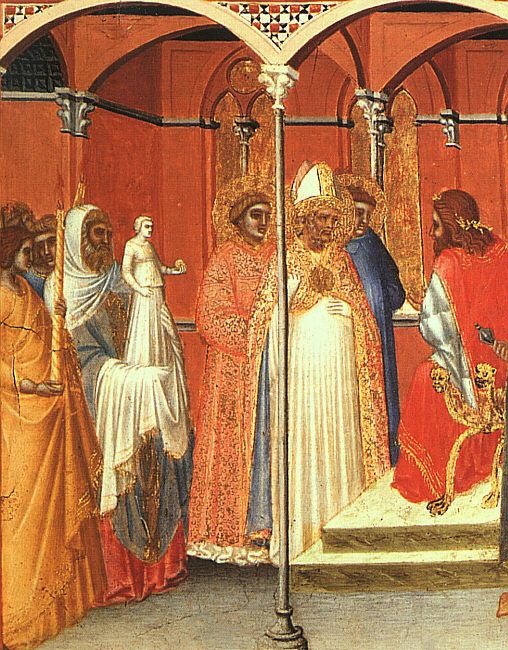
Venustianus was very angry and ordered that Sabinus's hands be cut off. He also commanded that Marcellus and Exuperantius be hung on the Little Horse (a type of torture device) in front of their bishop, with fire placed underneath them, and their sides torn with hooks and scrapers.
The deacons died under torture. Sabinus was then taken back to prison. A fisherman-priest took the bodies of the martyrs and buried them on the third of the kalends of December. This priest had been caring for Bishop Sabinus in prison and led to him his son Prisdanus, who was blind. The martyr raised his severed arms toward the blind boy's dark eyes, and scales fell from them, allowing Prisdanus to see clearly. Then the fellow prisoners of the saint fell at his feet and begged for baptism. Nine or ten were baptized in the prison.
What had happened was reported to Venustianus, who himself suffered from inflamed eyes that prevented him from enjoying food or sleep. He sent his wife to the prison to bring Sabinus to their home. When Sabinus arrived, Venustianus, his wife, and their two sons prostrated themselves at his feet and asked for baptism, which Venustianus had learned was good for sore eyes. According to the story, when he emerged from the baptismal font, his eyes were miraculously healed. When the emperor Maximian heard that the prefect of Tuscany had converted to Christianity, he sent his tribune Lucius to execute Venustianus, Sabinus, and the wife and sons of the governor. When all were executed at Assisi, Serena took their bodies to Spoleto and buried them there on December 7. She placed the hands of the bishop in a glass bottle with aromatic herbs.
Relics are kept at Spoleto and Faenza, but since there are many saints named Sabinus, some of those scattered throughout Italy may be incorrectly attributed to the martyr from Assisi.
Footnotes
- December 3 is the third of the kalends of December.
Baring-Gould’s own footnotes, in modern English.
Read the original 1870s text
Baring-Gould’s sources: Roman Martyrology and most Western Kalendars. Usuardus, Bede, Ado, &c. Authority: — The Acts in Surius, not trustworthy.] Sabinus, bishop of Assisi, was arrested at Assisi by Venustianus, governor of Tuscany, and was cast into prison along with his deacons, Marcellus and Exuperantius. Venustianus produced a little statue of Jupiter which he kept in his bedroom, and which was habited in a gilded mantle, and required Sabinus to venerate it The bishop took the image in his hands, flung it on the pavement, and broke it.
Venustianus was highly incensed, and ordered the hands of Sabinus to be cut off, and Marcellus and Exuperantius to be hung on the Little Horse before the eyes of their bishop, fire to be placed under them, and their sides to be tom with hooks and scrapers.
The deacons died under torment Sabinus was then led back to prison. A fisherman-priest 1 took the bodies of the martyrs, and buried them on the third of the kalends of who had the care of Bishop Sabinus in prison, led to him / her son Prisdanus, who was blind. The martyr raised his lopped arms towards the dark eyes, and scales fell from them, and Prisdanus saw plainly. Then those who were the fellow prisoners of the saint cast themselves at his feet, and besought baptism. Nine or ten were regenerated in the prison.
What had taken place was reported to Venustianus, who himself suffered from inflamed eyes, which prevented him from enjoying either food or sleep. He sent his wife to the prison to bring Sabinus to his house. And when Sabinus arrived, Venustianus and his wife and two sons prostrated themselves at his feet, and besought baptism, which Venustianus had now learned was good for sore eyes. On his issuing from the font his eyes were miraculously healed. When the emperor Maximian [Diocletian’s co-emperor in the West, 286–305] heard that the prefect of Tuscany believed in Christ, he sent his tribune Lucius to execute Venustianus, Sabinus, and the wife and sons of the governor. When all were executed at Assisi, Serena took their bodies to Spoleto, and there buried them, on Dec. 7. But she put the hands of the bishop in a glass bottle with aromatic herbs.
Relics at Spoleto and Faenza; but as there are many saints of the name of Sabinus, some of those scattered about Italy may be incorrectly attributed to the martyr of Assisi.