Their Story
The Catholic Encyclopedia records that the seventh-century itineraries to the graves of the Roman martyrs mention, in the catacomb of Priscilla, two female martyrs called Potentiana and Praxedis, buried in adjoining graves. Of the manuscripts of the Martyrologium Hieronymianum, only the Echternach Codex gives St. Praxedes on 21 July, and that entry looks like a later addition rather than a reading from the fourth-century Roman Martyrology (the Church's official list of saints for each day). St. Potentiana appears under 19 May in the Martyrology of Reichenau. Both were venerated as martyrs at Rome.
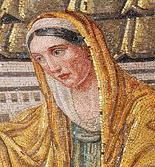
Later legends connect them with the founder of the old title-church of Rome called the titulus Pudentis, also the ecclesia Pudentiana. In that account Pudens is made a pupil of St. Peter, and Praxedes and Potentiana his daughters. Potentiana came customarily to be called Pudentiana, probably because the ecclesia Pudentiana was read as the church of St. Pudentiana and the two names were identified. The Catholic Encyclopedia treats this household story as legend. The two female figures offering their crowns to Christ in the apse mosaic of St. Pudentiana are probably Potentiana and Praxedes.
By the fourth century their veneration was tied in a particular way to the Titulus Pudentis. About that time a new church, the titulus Praxedis, rose near Santa Maria Maggiore, and the cult of St. Praxedes became especially connected with it. When Paschal I (817–824) rebuilt that church in its present form, he translated to it the bones of Sts. Praxedes, Potentiana, and other martyrs. St. Pudentiana's feast is observed on 19 May; St. Praxedes's on 21 July. Baring-Gould also commemorates Pudens, named in the Roman Martyrology as her father, but warns that the Acts (the written account of a martyr's trial and death) ascribed to St. Pastor are of very questionable authenticity.