Sts. Dymphna and Gerebern

This is a legend, and the source notes that its early part closely follows a widespread folk tale.

Read the essentials →
Feast May 15 · Martyr, Priest

Sts. Dymphna and Gerebern

Current feast

May 15 (also listed: May 30)
Secondary source · Wikipedia infobox

Traditional feast

May 15
1914 / pre-1969 calendar, per Baring-Gould (1897)

Represents

Martyr
Priest

Feast days

Feast: May 15

Their Story

Adapted in modern English from Baring-Gould (1897–98) · original text below

In the seventh century, it relates, a heathen Irish prince (in another version a British king) lost his beautiful wife. She left a baptized daughter of sixteen, Dymphna, who was her living image. The grieving king vowed to marry only someone just like his wife, and finding no one else, he resolved to marry his own daughter.

Horrified, Dymphna turned to her mother's aged chaplain, the priest Gerebern, who advised her to flee. They sailed to Antwerp and crossed the heathland of the Kempen to a little chapel of St. Martin, hoping to serve God in peace among the villagers. The king pursued them with armed men. His scouts were tracked down, the story goes, by the foreign coins they spent at an inn near Herenthals, and the king found his daughter's refuge.

He ordered her to prepare for the wedding. Mildly but firmly, she refused. She knelt and asked God's protection. The king ordered his men to kill her, but none would move. Then he seized her by the hair himself, mortally wounded Gerebern when the old priest threw himself between them, and beheaded his daughter as she lay fainting beside her friend.

So many miracles happened at the spot, the legend says, that the people dug for their bones and found two marble tombs, probably Roman sarcophagi. People with mental illness were said to recover at Dymphna's tomb, and she became their patroness. Families brought the mentally ill to the village of Gheel, where they boarded with local families, and many went home healed. Around 1200 a church was built there in her honour. Her relics are carried round Gheel in procession every May 15, and Gerebern's head is also kept there.

What they represent

How they teach us to live

Drawn from themes in the original account

Celebrate their feast day. Remember them on May 15 with a short prayer, and ask for their help.

The full story

Baring-Gould’s account retold in modern English

Read the full story · 1,545 words · about 7 min

In the 7th century, the legend says, a pagan Irish prince — according to another version, a British king — had a very beautiful wife, whom he loved deeply. However, she died, leaving behind a daughter who was sixteen years old, beautiful, and the living image of her mother. The maiden had been baptized and was named Dymphna.

The king decided that he would marry no one who was not as beautiful as his wife and who resembled her, so that her image would never fade from his heart. When he could not find anyone else who met these criteria, he resolved to marry his own daughter. Alarmed, Dymphna sought advice from her mother’s elderly chaplain, a priest named Gerebern. He advised her to flee the country with him. She escaped with the old man on a ship bound for Antwerp. Upon landing there, they traveled across the heath-covered Kempenland to a small chapel dedicated to Saint Martin, where they intended to serve God in prayer and peace among the simple villagers and in the tranquility of nature.

Meanwhile, the king discovered that his daughter and the aged Gerebern had fled. He pursued them with great urgency, tracked their route, and followed them with an armed force. Upon arriving in Antwerp, he sent out scouts in every direction to search the country and report their whereabouts. While stopping at a village not far from Herenthals called Oolen, a group of these scouts tried to pay at the inn where they were staying with some coins that the hostess refused to accept. She claimed that she had already been troubled enough with similar coins, which she had found very difficult to spend. Further inquiries led to the discovery of the princess's hiding place.

No sooner did the king learn of the situation than he rushed to the indicated location. Upon entering the house where his daughter was, he commanded her to prepare for her marriage to him. Dymphna calmly but firmly stated that nothing would convince her to agree to such a repulsive proposal. The king's rage was boundless. Dymphna did not lose her composure or waver in her response; she fell to her knees and prayed for God's protection. The tyrant, now more enraged than before, ordered his attendants to seize the maiden and kill her. However, none of them moved; they seemed intimidated by the youth, beauty, and innocence of the defenseless victim. At this, the king, unable to contain himself any longer, attacked her himself, grabbing her by her long flowing hair and mortally wounding Gerebern, who had tried to intervene. With a cry of horror, Dymphna collapsed at his feet, covered in the blood of her old and trusted friend. As she lay there, faint and helpless, the cruel father severed her beautiful head from her body. After committing this crime, he hurried away and returned to his northern home.

The blood of these saintly martyrs, however, had nourished the ground for a purpose. According to the legend, so many miracles occurred at the consecrated spot that the locals began searching for their bones among the heather covering the area. Excavations were conducted, and to the surprise of those overseeing the work, they discovered two magnificent white marble tombs, adorned with intricate sculptures and embellished with gilding. These were believed to be the work of angels who had come down from heaven at night to enshrine their remains, but they were likely two Roman sarcophagi repurposed for this use, as Roman remains found in the vicinity of Gheel indicate that the area was occupied by the conquerors of the world.

According to the story, people suffering from madness were healed at the tomb of Dymphna, and from then on, she became the patroness of the insane. Residents in the area sent their mentally ill relatives to the village that formed around Saint Martin's chapel, believing that being close to the shrine of the saintly virgin would help them regain their sanity. The patients were allowed to stay with local peasants, and many returned healed, which spread the fame of Gheel.

Around the year 1200, a church was dedicated to the saint at the site of the murder. This church still holds curious interest. Above the altar is a figure of Dymphna, surrounded by clouds, imploring divine mercy for several lunatics gathered around her, their hands and feet bound by golden chains, similar to those still used to restrain the most violent individuals.

Gheel is managed by four doctors and one superintendent. The local peasants work as nurses and take in one or two patients to live with them. They must comply with the doctors' inspections and the rules set by the administration. Once a patient is settled in their home, they become part of the family, and there have been many touching scenes of affection when they have had to part for some reason. The nurse takes pride in caring for their charge; their own children grow up alongside the patient, and it is said that a person from Gheel would be the last to lose their sanity.

The patient gradually becomes interested in those around them; they observe them working in the fields and often follow their example, encouraged by small payments. An active patient is very valuable to their caregiver, which is why those who might be violent are often preferred. Thus, the unfortunate patient, confined elsewhere, enjoys freedom in Gheel while being cared for by the most experienced individuals. The fresh country air is refreshing, daily work helps reduce sadness, and, most importantly, the kindness of the nurses allows the patient to live a peaceful life. Their mind, no longer troubled by confinement and asylum rules, shows good potential for recovery.

The relics of Saint Dymphna are displayed in Gheel in a beautiful shrine and are carried in a procession around the village, followed by the locals and patients, every year on May 15th. During each day of the octave, the patients crawl on all fours around and under the shrine nine times, and the same is done by those seeking the saint's intercession for relatives or friends who are mentally afflicted.

The relics of Saint Gereben were moved to Sonsbeck, near Xanten, on the Rhine, but the head is still kept in Gheel.

Saint Caesarea, Virgin (date uncertain). Her feast is celebrated on the Feast of the Ascension, which is movable but generally falls in May. The story is legendary and closely resembles that of Saint Dymphna, except for its ending.

The romantic tale of Saint Caesarea is an Italian version of the Flemish legend of Saint Dymphna, but it includes elements of beauty that are absent from the history of the northern saint. There was a wealthy man named Aloysius, from Francavilla, near Castro by Otranto in Southern Italy, who was married to a beautiful woman named Lucretia. After Lucretia's death, Aloysius was heartbroken and decided to marry his daughter Caesarea, who looked exactly like her mother. The young woman sought advice from a hermit named Joseph Benigni, who had guided her mother, and he advised her to escape.

So one night, she told her father that she was going to take a bath. She tied two pigeons together by their legs and threw them into a tub filled with water. When Aloysius heard the splashing in her room caused by the birds flapping their wings, he did not suspect anything. The next morning, he discovered that she had escaped and set off in pursuit. During the night, she had wandered near the sea, and her father saw her in the distance on the shore. With a shout, he chased after her, but just as he got close, a sea mist rose and surrounded him, causing him to lose his way. He fell over some rocks and drowned, while the rock opened for her, revealing a cavern filled with light. She entered, and the rock closed behind her.

There sits the virgin Caesarea in a brilliantly lit hall in the sea cliff, visible only to fortunate mortals. On Ascension Eve and throughout the Octave, sometimes those on the shore or boatmen at sea see the cave open, and rays of light shine out from it. Once, a little boy who had wandered on the sands went missing. A year later, he returned to his parents and told a wondrous story about a beautiful maiden in a lit hall in the rock who had sheltered him from the rising tide. He believed he spent only half an hour in her presence, but an entire year had passed.

Throughout the Octave of the Ascension, people from the surrounding area visit the cave of Saint Caesarea on the shore and take water from a fountain that is strongly infused with hydrogen sulfide, which rises from the floor. Near the cave is a church dedicated to the saint, where a mass is sung in her honor on Ascension Day, attended by the chapter of the collegiate church of Castro. Afterward, a fair is held there.

In this case, it is very clear that popular tradition has added legendary elements of a mythological nature to the memory of a virtuous and persecuted young woman, who likely died among the rocks at Castro.

Footnotes

  1. There is every appearance of all the earlier part of the story being localization of the wide-spread household tale “Catskin,” the German "Allerleirauch,” Grimm’s Kinder Märchen 65. The story is found among the Highlanders, Neapolitans, Greeks, Germans, Lithuanians, Hungarians, etc.
  2. Maniacs recovered at the tomb of S. Dymphna, and thenceforth S. Dymphna became the patroness of the insane.
  3. The sufferers were allowed to board with the peasants, and as many went away healed, the fame of Gheel spread.
  4. This church retains its curious interest.
  5. The relics of S. Dymphna are exhibited at Gheel in a handsome shrine.
  6. The relics of S. Gerebem were translated to the Sonsbeck, near Xanten, on the Rhine.
  7. For further information about this very original and interesting colony see Mrs. Byrne’s “Gheel, or the City of the Simple.” Chapman and Hall, 1869.

Baring-Gould’s own footnotes, in modern English.

Read the original 1870s text

Baring-Gould’s sources: Roman and Belgian Martyrologies. The translation of S. Dymphna on Oct. 27th, that of S. Gerebern on July 20th. There is no ancient account of the martyrdom of these saints, which rests on tradition, and there can be little doubt that there is much fable in the story — indeed, it is difficult to conjecture how much of truth is enshrined in the popular romance of S. Dymphna.1] Gheel is one of the villages of North Brabant, situated in the sandy Kempenland, near the ancient town of Herrenthals. It has that quaint Dutch toy-like character which marks, more or less, all Flemish villages. It consists principally of one long straggling street, which appears wider than it really is, because of the unpretending architecture and low stature of the houses. But it contains two ancient churches, one of which contains the shrine of S. Dymphna, and around this shrine the interest and importance of Gheel centres.

In the 7th century, the legend relates, a heathen Irish prince — according to another version a British king — had a very beautiful wife, whom he passionately loved. But she died, leaving behind her a daughter aged sixteen, as 1 There is every appearance of all the earlier part of the story being localization of the wide-spread household tale “Catskin,” the German "Allerleirauch,” Grimm’s Kinder Mahrchen 65. The story is found among the Highlanders, Neapolitans, Greeks, Germans, Lithuanians, Hungarians, &c. beautiful, and the living image of herself. The maiden had been baptized, and was called Dymphna.

Now the king had resolved to marry no one who was not as beautiful as his wife, and one who resembled her, so that her image might never fade from his heart; and when no one else could be found combining these qualities, he resolved to marry his own daughter. Dymphna, in alarm, took counsel of her mother’s aged chaplain, a priest named Gerebem, and he advised her to fly the country with him. She accordingly escaped with the old man in a ship bound for Antwerp, and landing there, took their course over the heathy Kempenland to a little chapel dedicated to S. Martin [St. Martin of Tours (d. 397), soldier turned bishop], where they purposed to serve God in prayer and in peace, among the simple villagers, and in the face of calm nature.

Meanwhile the king, having discovered the flight of his daughter and the aged Gerebern, tracked them in hot haste, discovered the route they had followed, pursued them with an armed force, and arriving at Antwerp, sent emissaries in every direction, to scour the country, and report their whereabouts. Halting at a village not far from Herenthals, called Oolen, a party of these scouts tendered in payment at the inn where they were lodged, some pieces of money which the hostess refused to accept, alleging that she had already been troubled enough with some similar coins, which she had had the greatest difficulty to pass. Further enquiries led to the discovery of the place of refuge of the princess.

No sooner was the king apprised of the fact than he started for the spot indicated, and entering the house where his daughter was, commanded her at once to make preparations for her marriage with him. Dymphna, mildly but firmly declared that nothing would induce her to consent to so odious a proposal. The king’s rage knew no bounds. May i^o SS. Dymphna and Gerebern. 209 Dymphna neither lost her composure, nor wavered in her reply- she fell on her knees and besought the protection of God. The tyrant, now more exasperated than before, called to his attendants to seize the maiden and despatch her. But not one of them moved 3 they seemed awed by the youth, beauty, and innocence of the defenceless victim. On this the king, no longer able to contain himself, fell upon her himself, seizing her by her long waving hair, and mortally wounding Gerebern, who tried to throw himself between them. With a cry of horror Dymphna sank at his feet, bathed in the blood of her old and trusted friend, and as she lay there swooning and helpless, the barbarous father severed her beautiful head from her body. Having perpetrated this crime, he hastened from the spot, and returned to his northern home.

The blood of these saintly martyrs had, however, irrigated the ground for some purpose; for, says the legend, so numerous were the miracles which occurred on the consecrated spot, that the circumstance led the inhabitants to search for their bones among the heather which covered the place. Excavations were accordingly made, and, to the surprise of those who directed the operations, they came upon two magnificent white marble tombs, adorned with elaborate sculpture and enriched with gilding, the handiwork of angels, who in the night time had come down from heaven to enshrine their remains, but which were in all probability two Roman sarcophagi used for the purpose, for Roman remains found in the neighbourhood of Gheel show that the place was occupied by the conquerors of the world.

Maniacs recovered at the tomb of S. Dymphna, and thenceforth S. Dymphna became the patroness of the insane. All the people in the neighbourhood sent their lunatics to the village which formed itself round S. Martin's chapel, believing that proximity to the shrine of the saintly virgin would be the means of their recovering their reason. The sufferers were allowed to board with the peasants, and as many went away healed, the fame of Gheel spread.

About the year 1200, a church was dedicated to the saint, on the spot where the murder had been committed. This church retains its curious - interest. Above the altar is a figure of S. Dymphna, in a cloud, imploring the divine mercy for several lunatics grouped around her, their hands and feet bound by golden chains, similar to those still used to fetter the most violent maniacs.

Gheel is administered by four doctors and one superintendent. The peasants in the place are all nurses, and take in one or two patients to board with them. They have to submit to the inspection of the doctors, and to the rules imposed by the administration. The lunatic, once fixed in his abode, becomes one of the family, and many have been the touching scenes of affection, when for some reason they have been obliged to part. The nurse takes pride in his charge • his own children are brought up with the stranger, and it is affirmed that a Gheelois would be the last man on earth to lose his senses. The lunatic gradually takes an interest in those around him; he sees them at work in the fields, and gradually follows their example, being prompted thereto by offers of pocket money. An energetic lunatic is of great value to his keeper, and this is the reason why those inclined to be violent are always preferred. Thus the poor lunatic, imprisoned elsewhere, is free at Gheel, though cared for by the most experienced men. The country air is invigorating, daily labour checks melancholy, and above all the kindness of the nurses helps the lunatic to live a peaceful life. His S. C as area.

mind, no longer irritated by captivity and asylum rules, gives fair hope of recovery.1 The relics [the bodily remains of a saint, or objects they used, kept with honor] of S. Dymphna are exhibited at Ghee), in a handsome shrine, and are carried in procession round the village, followed by the inhabitants and lunatics, on May 15th, every year • on each day of the octave, the lunatics crawl on all fours round and under the shrine nine times, and the same is done by those who are seeking the intercession of the saint for relatives or friends mentally afflicted.

The relics of S. Gerebem were translated to the Sonsbeck, near Xanten, on the Rhine, but the head is still preserved at Gheel.

S. C^SAREA, V. (date uncertain.), [Her festival is observed on the Feast of the Ascension, which is moveable, bnt which generally falls in May. The story is legendary, and much resembles that of S. Dymphna, except in its termination.] The romantic story of S. Caesarea is an Italian version of the Flemish legend of S. Dymphna, but with elements of beauty absent from the history of the northern saint. There was a rich man named Aloysius, of Franca-villa, near Castro by Otranto, in South Italy, who was married to a beautiful wife, named Lucretia. On the death of Lucretia, Aloysius was inconsolable, and resolved on marrying his daughter Caesarea, who resembled her mother exactly. The maiden took counsel of a hermit who had directed her mother, and whose name was Joseph Benigni, and he advised her to fly. So one night she told her father xFor further information about this very original and interesting colony see Mrs. Byrne’s “Gheel, or the City of the Simple.” Chapman and Hall, 1869. she was going to have a bath, and she tied two pigeons together by the legs, and threw them into a tub full of water. Then he, hearing the splashing in her room, made by the birds fluttering their wings in the water, had not his suspicions aroused. Next morning he found that she had escaped, and he set off in pursuit. During the night she had wandered near the sea, and her father saw her in the distance on the shore. With a shout he pursued her, but just as he approached, a sea-mist rose and enveloped him, so that he lost his way, and falling over some rocks, was drowned, but to her the rock gaped, and she saw a cavern full of light, and she went in, and the rock closed behind her.

And there sits the virgin Caesarea in a brilliantly lighted hall in the sea-cliff, only seen by lucky mortals. On Ascension Eve, and through the Octave, sometimes those who are on the shore, or boatmen at sea, perceive the cave open, and rays of light shoot out from it • and once a little boy, straying on the sands, was lost. A year after he returned to his parents, and told a wondrous tale of a beautiful maiden in a lighted hall in the rock who had sheltered him from the rising tide, and in one half hour, as he thought, passed in her presence, a whole twelvemonth had rolled away.

Throughout the Octave of the Ascension the people of the neighbouring country visit the cave of S. Csesarea on the shore, and carry away water from a fountain strongly impregnated with sulphuretted hydrogen which rises in the floor. Near the cave is a church dedicated to the saint, and in it on the Ascension is sung a mass in her honour, attended by the chapter of the collegiate church of Castro; after which a fair is held there.

It is in this case very evident that popular tradition has attached legendary matter of a mythological character to May ig.] S, Britwin.

the memory of a virtuous and persecuted maiden, who probably perished among the rocks at Castro.
Help us add to this saint's story

Everything is read by a person before anything appears. Facts are checked against trusted sources first.

Facts are welcome; a source link helps (optional).With your permission we may share it on this page.

Nine days · Free

Pray the novena
with us.

One short email a day for nine days. The day's prayer, a line from Sts. Dymphna and Gerebern's story, and a nudge to keep going.

Also on May 15
T

Sts. Torquatus

May 15 · Feast
P

Sts. Peter

May 15 · Martyrs
B

St. Britwin of Beverley

May 15 · Abbot
← All 1970 saints in the library
Sources & notes

Feast-day sources

Story sources

Sources

Credits

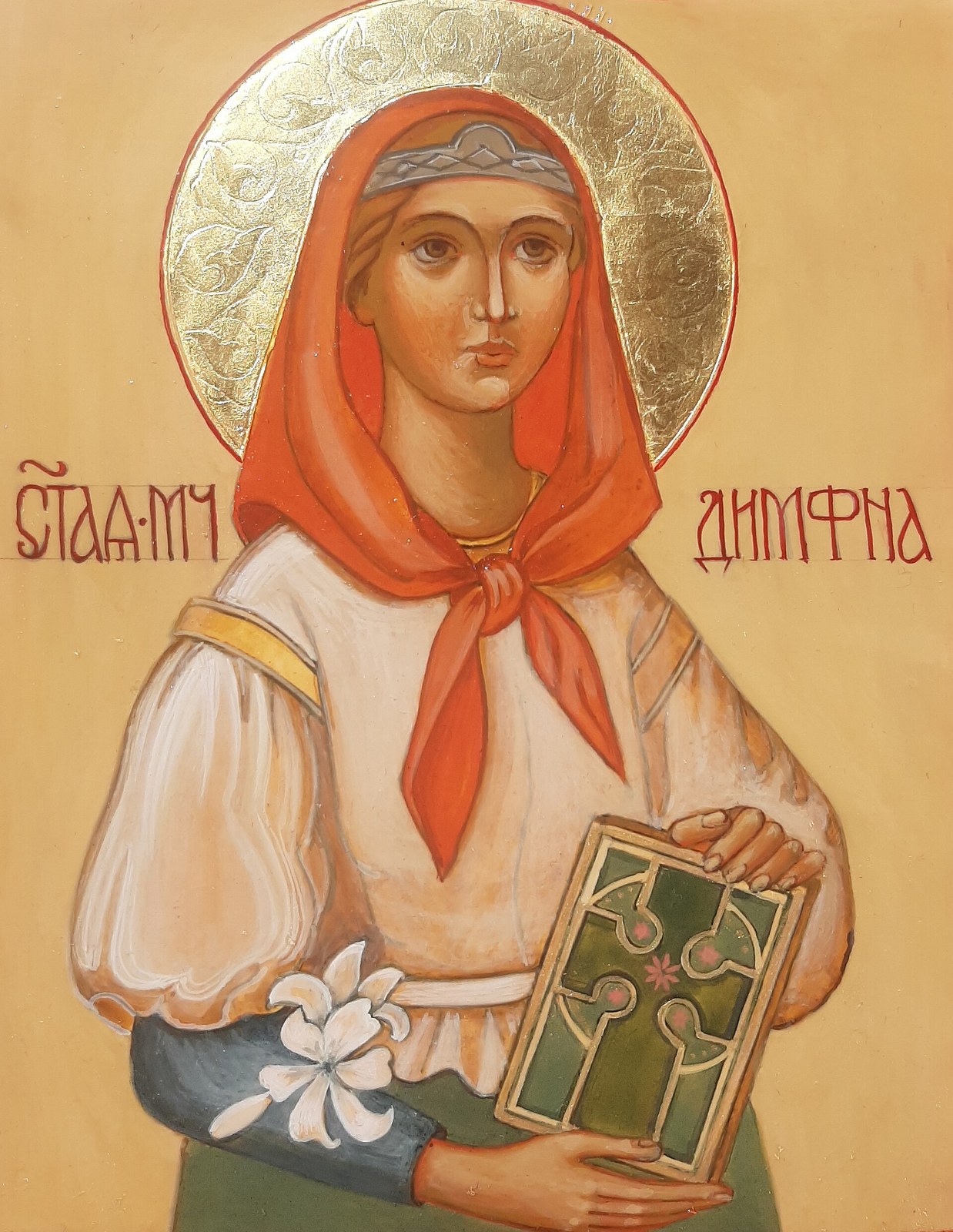
Image: Sv Dimfna Irska.jpg · Гибаничар, Orthodox icon of Saint Dymphna of Ireland, 2023, released as CC0. · CC0, via Wikimedia Commons

Image: Гибаничар, Orthodox icon of Saint Dymphna of Ireland, 2023, released as CC0., Wikimedia Commons (CC0)

Retold in plain modern English from Baring-Gould’s public-domain text, sentence by sentence, keeping the same facts and order. Short explanations in parentheses are ours.

From Sabine Baring-Gould, The Lives of the Saints, new edition in 16 vols. (London: John C. Nimmo, 1897–98); text from the Internet Archive scan (OCR, lightly cleaned; errors possible). Public domain in the United States. Reproduced unedited, except for short bracketed notes in grey that we added to explain names and terms (“S.” is the old abbreviation for Saint). Some history and judgments reflect 19th-century scholarship.