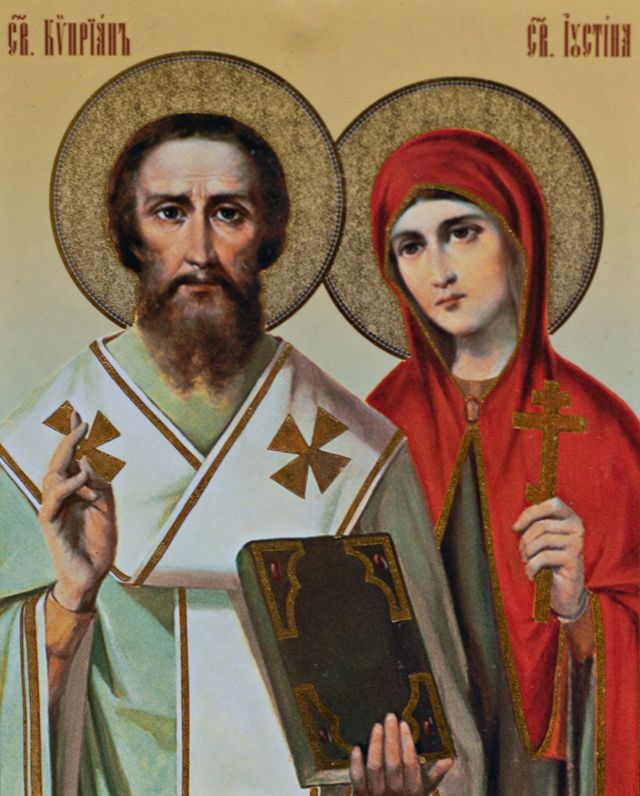
…mother, “The gods we worship are made of gold, silver, and lead; a Galilean, if he were to touch them, would break them into pieces.” But the mother replied, “Be quiet, do not let your father hear you speak like that.” Nevertheless, Cledonia told her husband all the words of Justina. That night, while they were asleep, Edusius and his wife dreamed of angels of God and Christ, who said, “Come to me, and I will give you the kingdom of heaven.” When the bishop heard this, he made Edusius cut off his beard as a sign that he was no longer a priest of idols. Then Edusius, his wife, and daughter were baptized together.
However, there was a young man named Aglaides who loved Justina. Now that she was a Christian, she would not listen to his sweet words and rejected his advances. This made him angry, and he tried to ambush her and carry her off when she was on her way to church. But the Christians and her father’s servants armed themselves to protect her, and Aglaides was forced to retreat. Finding that he could not take her by force, Aglaides turned to the magician Cyprian, who promised to send a demon to make Justina love him. However, Cyprian himself became infatuated with the young woman and decided to win her for himself.
He summoned a devil and sent him to Justina’s house in the middle of the night. When the Christian virgin saw the hideous demon, she made the sign of the cross and blew in his face. The demon fled, howling back to Cyprian. “Where is the maiden?” the magician asked. “I saw a sign she made, and it overcame me.” Cyprian ordered him to leave, and the next night he summoned a second devil. In the middle of the night, Justina had risen.
to pray, when she saw before her another devil, worse than the first. She blew in his face, made the sign of the cross, and he also fled howling. On the third evening, Cyprian summoned the devil himself, “the father of the others,” and sent him to the chamber of Justina. Satan entered, sat down on her bed, and began to argue with her against celibacy. But she again blew in his face, made the sign of the cross, and he vanished, “like wax melting in the fire.” Cyprian received the defeated devil with a torrent of abuse. The devil apologized and explained that before the sign of the cross, he was powerless. “What!” exclaimed the magician, “is the Crucified greater than you? Then I will have done with your tricks.” The devil, with a yell of rage, attacked him, and a furious struggle began. The magician was thrown down, and Satan was upon him and would have strangled him, had not Cyprian freed his hand and made the sacred sign with it. Instantly, the devil fled, roaring and smoking with defeated rage.
Cyprian went to the Bishop of Antioch, confessed the sins of his life, and was baptized. He was then quickly ordained bishop of Antioch in place of Anthimius, who had died. On the outbreak of the persecution of Diocletian, Eutolmius, Count of the East, ordered the arrest of Cyprian and Justina, and that they should be brought to Nicomedia. A great fire was lit, and a cauldron of pitch and tallow was made to boil on it, and Cyprian and the young woman were plunged into it. Although the pitch boiled furiously, they sang together a hymn without feeling the least discomfort. But when a heathen magician named Athanasius approached, a flame shot out and consumed him to ashes. The martyrs then got out of the cauldron and were sentenced to have their heads cut off. They were led out near the river and executed. A certain Theoctistus, converted by the miracles performed by them, suffered with them.
The bodies of these saints are in Rome at the Vatican, along with two more bodies with that of Theoctistus in Piacenza. A proper office in honor of these saints was granted to the church of Piacenza by the Congregation of Sacred Rites in 1608. The bodies in the Vatican were discovered and placed there by Pope Anastasius IV. There is a head of Saint Justina in Villeureux, Luxembourg. A fourth head is in Lucca. The bodies of Saints Cyprian and Justina were formerly also in Utrecht.
Footnotes
- Anthimias—no such bishop is known at either Antioch.
- In the Acts of S. Theda, his name is Thamyris.
- There is something similar in the Acts of S. Thecla, only there the virgin does battle herself with her hands and tears the clothes off the back of the man who would insult her in the street.
- All this seems to be taken from some Oriental tale of Jins. Compare with it the story of S. Joseph the Count, July 22, p. 512.
- We see in the story of Cyprian pursuing Justina the first traces of the popular romance of Faust and Margaret. Every magician in household legend had a beautiful woman at his side; Simon Magus had Helena, Virgilius had the Sultan’s daughter.
- It is needless to say that no such bishop of either Antioch is mentioned by any historian.
- The Congregation of Sacred Rites was a part of the Roman Catholic Church responsible for overseeing liturgical matters.
- Pope Anastasius IV was the pope from 1153 to 1154.
Baring-Gould’s own footnotes, in modern English.
Read the original 1870s text
Baring-Gould’s sources: Roman Martyrology. The Martyrologium Parvum, some copies of that of Jerome, so called, Hrabanus.Usuardus, Ado, York, Saturn, Hereford Kalendars, Anglican Reformed Kalendar. By the Greeks and Russians on Oct. 2. Theoctistus, who suffered with them, by the Greeks on Oct. 3. Authority: — The Acts, utterly fabulous, a religious romance, only possibly founded on fact. S. Gregory Nazianzen identifies him with the great S. Cyprian of Carthage. It is probable that the story is, in fact, a romance founded on the great S. Cyprian's conversion, and worked up with materials from various sources into a wonderful story for the amusement of Greeks, who felt the need of more moral romances than those of Petronius, Heliodorus, Achilles Tatius, and Xenophon of Ephesus. Several of these erotic novel writers became Christian bishops, and probably exercised their pens after their conversion in writing romantic tales of a moral tendency. The first part of the romance of Cyprian and Justina is taken from that of Thecla, the name of Paulus is changed into Praulus. The next portion is from the history of Joseph the Count (July 22); the martyrdom is of the usual style of these fabulous compositions. The fact that S. Cyprian of Carthage was a philosopher, and converted when advanced in age, served as the basis for the story. S. Gregory Nazianzen having identified the Cyprian of the romance with the great Cyprian, shows that in his time — the 4th cent. — the idea that Cyprian the magician and Cyprian the archbishop were different had not arisen. Justina — if there ever was such a person — was probably a martyr in the same place and at the same date.] The story of Cyprian and Justina is an early Christian romance, and does not merit to be treated as serious history. The story is as follows: — There was once upon a time a beautiful young girl called Justina, who lived with her father, Edusius, a heathen priest, and her mother Cledonia,1 near the grove of Daphne at Antioch.2 One day, as she sat in her window, she heard the deacon Praulus preaching in an adjoining house,3 and she was filled with faith, and believed, and said to her 1 In the story of S. Thecla, the mother is Theoclea. 2 Antioch in Syria. Thecla resided at Antioch in Pisidia. 3 Acts of Thecla “ And whilst Paulus was speaking of the great things of God in the house of Onesiphorus, one Thecla, a virgin... came and sat at a window, which was close to the roof, and listened to the words of Paulus.” SS. Cyprian and Justina.
…mother, “The gods we adore are of gold and silver and lead; a Galilean if he were but to touch them with his finger would break them to pieces.” But the mother said, “Silence, let not your father hear you talk thus." Nevertheless Cledonia told her husband all the words of Justina. And that night, in sleep, Edusius and his wife saw in a dream angels of God, and Christ, who said, “ Come to me, and I will give you the kingdom of heaven.” Now the bishop1 when he heard this, made Edusius cut oft his beard, in token that he was no longer a priest of idols, and then Edusius, his wife, and daughter were baptized together. But there was a young man named Aglaides,2 who loved Justina; and now that she was a Christian, she would not listen to his honeyed words, and repelled his advances. Then his anger was raised, and he sought to waylay her and carry her off when on her way to church, but the Christians and the servants of her father caught up arms to defend her, and Aglaides was forced to retire.3 Aglaides, finding that he could not carry her off by force, had recourse to the magician Cyprian, who promised him to send a demon to force Justina to love him. But Cyprian himself became enamoured of the maiden, and resolved to win her for himself. He conjured up a devil and sent him to the house of Justina in the middle of the night. When the Christian virgin saw the hideous demon, she made the sign of the cross and blew in his face. Thereupon he fled howling to Cyprian. “ Where is the maiden ?” asked the magician. “ I saw a sign she made, and it overcame me." Cyprian bade him be off; and next night he called up a second devil. In the middle of the night Justina had risen 1 Anthimias— no such bishop known at either Antioch, 2 In the Acts of S. Theda, his name is Thamyris. 3 There is something similar in the Acts of S. Thecla, only there the virgin does battle herself with her hands, and tears the clothes off the back of the man who would insult her in the street.
to pray, when she saw before her another devil, worse than the first. She blew in his face, made the sign of the cross, and he also fled howling.1 On the third evening Cyprian conjured up the devil himself, “ the father of the others/' and sent him to the chamber of Justina. Satan entered, and sat down on her bed, and began to argue with her against celibacy j but she again blew in his face, made the sign of the cross, and he vanished, “ like wax melting in the fire/’ Cyprian received the discomfited devil with a torrent of abuse. The devil apologized, and explained that before the sign of the cross he was powerless.2 “ What l” exclaimed the magician, “ is the Crucified greater than you ! Then I will have done with your impostures.” The devil with a yell of rage fell upon him, and a furious wrestle began. The magician was flung down, and Satan was upon him and would have strangled him, had not Cyprian disengaged his hand and made the sacred sign with it. Instantly the devil fled, roaring and smoking with discomfited rage.
Cyprian went to the Bishop of Antioch, confessed the sins of his life, and was baptized, then speedily ordained bishop of Antioch in the room of Anthimius who died.3 On the breaking out of the persecution of Diocletian [Roman emperor 284–305, who began the ‘Great Persecution’ of Christians in 303], Eutolmius, Count of the East, ordered the arrest of Cyprian and Justina, and that they should be brought to Nicomedia. A great fire was lighted, a cauldron of pitch and tallow was made to boil on it, and Cyprian and the damsel were 1 All this seems to be taken from some Oriental tale of Jins. Compare with it the story of S. Joseph the Count, July 22, p. 512. 2 We see in the story of Cyprian pursuing Justina the first traces of the popular romance of Faust and Margaret. Every magician in household legend had a beautiful woman at his side; Simon Magus had Helena, Virgilius had the Sultan’s daughter.
3 It is needless to say that no such bishop of cither Antioch is mentioned by any historian. 5. Nilus. plunged in it. Although the pitch boiled furiously, they sang together a hymn, without feeling the least discomfort. But when a heathen magician named Athanasius approached, a flame shot out and consumed him to ashes. The martyrs then got out of the cauldron, and were sentenced to have their heads cut off. They were led out near the river, and executed. A certain Theoctistus, converted by the miracles wrought by them, suffered with them.
The bodies of these saints are at Rome in the Vatican, two more bodies with that of Theoctistus at Piacenza; a proper office in honour of these granted to the church of Piacenza by the Congregation of Sacred Rites in 1 608. The bodies in the Vatican were discovered and placed there by Pope Anastasius IV. A head of S. Justina at Villeureux in Luxembourg. A fourth head at Lucca; the bodies of SS. Cyprian and Justina formerly also at Utrecht.