This Saint’s Story
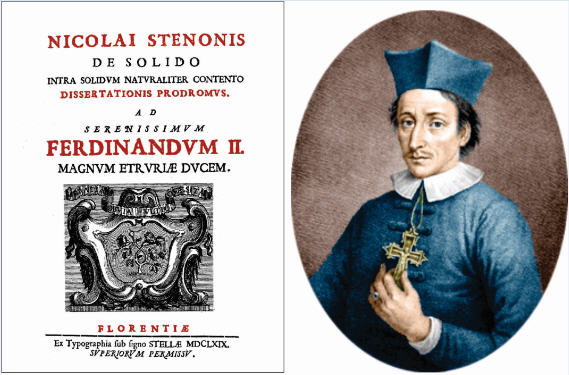
Niels Steensen—known in Latin as Nicolas Steno—was born in Copenhagen on January 1, 1638 (January 11 Gregorian), into a Lutheran family. His father, Steen Pedersen, was a goldsmith to the royal court; his mother was Anne Nielsdatter. After his father's death and a sickly childhood spent partly in isolation, he studied medicine and anatomy at Copenhagen under Thomas Bartholin, then continued abroad when plague struck the city, working in Amsterdam and Leiden.
In 1660 he described the duct of the parotid salivary gland, still called Stensen's duct. In Paris he gave a Discourse on the Anatomy of the Brain (1665). Settling in Florence under Grand Duke Ferdinand II de' Medici and the Accademia del Cimento, he showed that glossopetrae ("tongue stones") were fossil shark teeth and that layered rocks record a history of deposition—foundations of paleontology and modern stratigraphy. His 1669 geological treatise set out principles still taught today.
Raised Lutheran, he was received into the Catholic Church in Florence in 1667 after long conversations about the faith in France, Germany, and Italy. His interest shifted toward theology. He was ordained a priest on Easter Sunday, April 13, 1675. Pope Innocent XI named him Vicar Apostolic of the Nordic Missions and titular bishop of Titiopolis; St. Gregorio Barbarigo consecrated him on September 19, 1677. He served the Catholic diaspora in northern Germany—Hannover, Münster, Hamburg, and Schwerin—living simply, housing converts cut off by their families, and selling even his furniture and episcopal ring to aid the poor.
Exhausted by austerity and illness (likely kidney stones), he died in Schwerin on November 25, 1686 (December 5 Gregorian), aged forty-eight. Cosimo III de' Medici had his body brought to Florence; he rests in a side chapel of the Basilica of San Lorenzo (the Capella Stenoniana). His cause opened in Osnabrück in 1938; John Paul II declared him Venerable in 1984 and beatified (declared 'Blessed', the step before sainthood) him in St. Peter's on October 23, 1988, praising a life spent seeking truth in science and in faith. His feast is kept on December 5.
