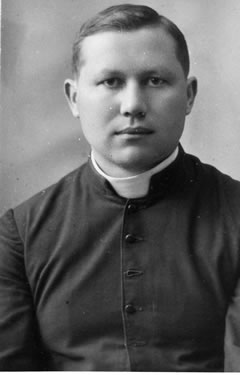
Bl. Jury Kashyra
Jury (in Polish, Jerzy) Kashyra was born on April 4, 1904, at Aleksandrowo in the Vilnius region, into a Belarusian peasant family that belonged to the Orthodox Church.
The story
Jury (in Polish, Jerzy) Kashyra was born on April 4, 1904, at Aleksandrowo in the Vilnius region, into a Belarusian peasant family that belonged to the Orthodox Church. He was baptized Orthodox and grew up in Vilnius, and in 1922, at eighteen, he became a Catholic.
In 1924 he joined the Marian Fathers (the Congregation of Marian Clerics of the Immaculate Conception) at Druya, a town on the border with Soviet Belarus where the congregation ran a school. He made his vows in 1929, studied philosophy and theology in Rome at the Angelicum and then in Vilnius, and was ordained a priest on June 20, 1935. He taught at the Druya school and in 1938 was sent to Rasna in Polesia. When the Soviets seized the Marians' house there in 1940, he spent many months in hiding before he could return to Druya in 1942.
He then went to help Fr. Antoni Leszczewicz in the parish of Rosica (Rositsa). In February 1943, during a German punitive operation against partisans, carried out by police units under SS command, the people of Rosica were rounded up and held in the church. Both priests chose to stay with their parishioners, hearing confessions and comforting them, and turned down an offer to be let go. On February 18, 1943, Fr. Kashyra was burned to death in a barn together with members of his parish. John Paul II beatified him in Warsaw on June 13, 1999, among the 108 Polish martyrs of the Second World War.
Struggles & surrender
Kashyra and Leszczewicz could have left Rosica when they heard the raid was coming, and later could have walked out of the church. Their letters show they chose to stay with their people to the end.
Blessed, not yet a saint
Jury Kashyra was beatified in 1999.
Sources
Sources & notes
- Santi e Beati, “Beato Giorgio Kaszyra”
- Wikipedia, “Jury Kashyra”
- Story written for this site from the sources above, in our own words.
- Further reading: Wikipedia, “Jury Kashyra”. Feast day and dates: Wikidata Q2986690.
- Image: Wikimedia Commons, Wikimedia Commons (Public domain)
