This Saint’s Story
Jesús Emilio Jaramillo Monsalve was born on February 16, 1916, in Santo Domingo, in the Colombian department of Antioquia. He began his studies for the Church in 1929 and joined the Xaverian Missionaries of Yarumal, a Colombian society founded to bring the Gospel to the country's remote and neglected regions. He made his novitiate in 1935–36 and his first vows on December 3, 1936, and was ordained a priest on September 1, 1940. He celebrated his first Mass in his home town a week later.
His first assignment was as a pastor at Sabanalarga, while he finished theological studies in Bogotá, earning a doctorate in 1944. In those years he also served as chaplain and adviser at a women's prison. From 1945 he was spiritual director of the society's seminarians and then novice master, and he taught dogmatic theology and Sacred Scripture, along with Hebrew and Greek. He was rector of the seminarians from 1951 to 1959 and then Superior-General of the Xaverian Missionaries of Yarumal from 1959 to 1966.
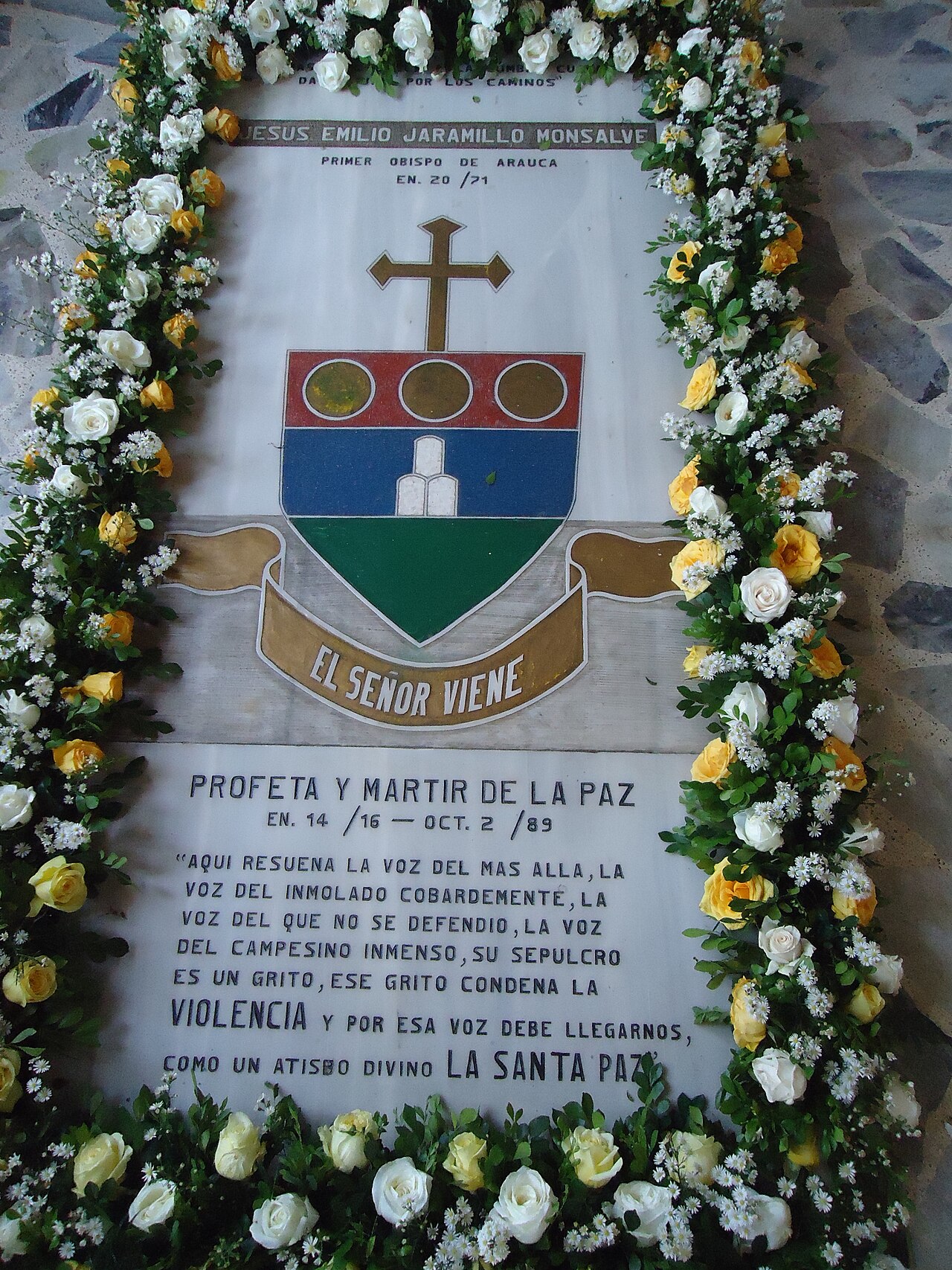
On November 11, 1970, Pope Paul VI named him Vicar Apostolic of Arauca, a frontier region on Colombia's border with Venezuela, and titular bishop of Strumnitza. He was consecrated on January 10, 1971. His episcopal motto was El Señor viene, "The Lord comes." When the vicariate was raised to a diocese in 1984, Pope John Paul II made him the first Bishop of Arauca. According to his postulator, he reached out to peasants and indigenous people in abandoned areas, set up institutions to help them, and started a hospital. He became known as a caring pastor who took the side of the poor and spoke against social injustice.
Arauca in those years was torn by armed conflict and the drug trade. Bishop Jaramillo publicly criticized the atrocities of the ELN (National Liberation Army), a guerrilla group active in the region. On October 2, 1989, while making parish visits, he and a priest companion were stopped by armed men and taken. The bishop asked that his companion be let go, and the priest was released, obeying his bishop's request. That night Bishop Jaramillo was killed, shot with his hands bound. Peasants found his body the next morning in a rural area near the Venezuelan border. He was 73. Pope John Paul II sent a telegram expressing his profound sorrow at this "unjustifiable violence," and the Colombian bishops' conference condemned the killing as vile and sacrilegious. Years later the ELN itself issued a statement giving its own reasons for the killing; the Church's cause examined the question and concluded that he died for the faith.
During the Great Jubilee (a holy year of pilgrimage to Rome) of 2000, his name was among those remembered at John Paul II's commemoration of the witnesses to the faith of the twentieth century. His cause opened that same year. The diocesan inquiry closed in 2006, and in 2017 the theologians and the cardinals and bishops of the Congregation for the Causes of Saints judged that he had been killed in hatred of the faith. Pope Francis approved the decree on July 7, 2017, and beatified (declared 'Blessed', the step before sainthood) him himself on September 8, 2017, at an open-air Mass in Villavicencio during his visit to Colombia, together with Father Pedro María Ramírez Ramos. In his homily the Pope called the two martyrs signs of "a people who wish to rise up out of the swamp of violence and bitterness." His memorial is kept on October 3.
