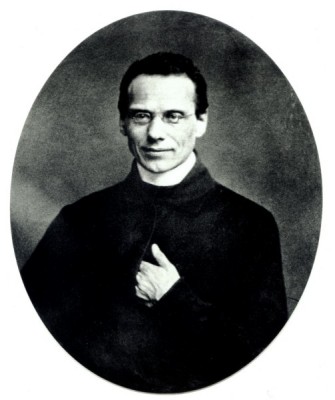
This Saint’s Story
He was baptized on the same day at St. Mang Church. From an early age, he showed a strong interest in the priesthood, often playing priest with his friends and serving as an altar boy. He attended the Institute of Saint Stephen in Augsburg for his middle school education and later pursued philosophy and theology at the Ludwig-Maximilians-Universität München, where he felt a calling to become a missionary.
In November 1842, Seelos joined the Redemptorist order, motivated by a desire to serve German-speaking immigrants in the United States. He traveled to France and then sailed to America, reaching New York City on April 20, 1843. After completing his novitiate and theological studies, he took his vows and was ordained a priest on December 22, 1844, in Baltimore, Maryland. His early ministry included serving at St. Philomena Parish in Pittsburgh, where he became known for his kindness and effective confessional ministry, welcoming people from various backgrounds and languages.
Seelos became a U.S. citizen in 1852 and continued his ministry in several parishes, including St. Alphonsus Parish in Baltimore, where he oversaw a large parish school. He faced health challenges, including a serious hemorrhage in 1857, but remained dedicated to his work. In 1862, he was appointed to St. Mary's Parish in Annapolis, where he also mentored future Redemptorists. During the Civil War, he advocated for the exemption of seminary students from military service, meeting with President Abraham Lincoln to discuss this matter.
In 1866, Seelos was assigned to St. Mary of the Assumption Parish in New Orleans, a challenging location due to its climate and disease prevalence. He dedicated himself to caring for yellow fever victims, displaying remarkable compassion and selflessness. Tragically, he contracted the disease himself and passed away on October 4, 1867, at the age of 48, after weeks of suffering.
Seelos's cause for canonization began in 1912, and he was beatified (declared 'Blessed', the step before sainthood) by Pope John Paul II on April 9, 2000. The pope highlighted Seelos's commitment to deepening the Church's union with Christ through the sacraments, encouraging all who serve in the Church to find inspiration in his example.
