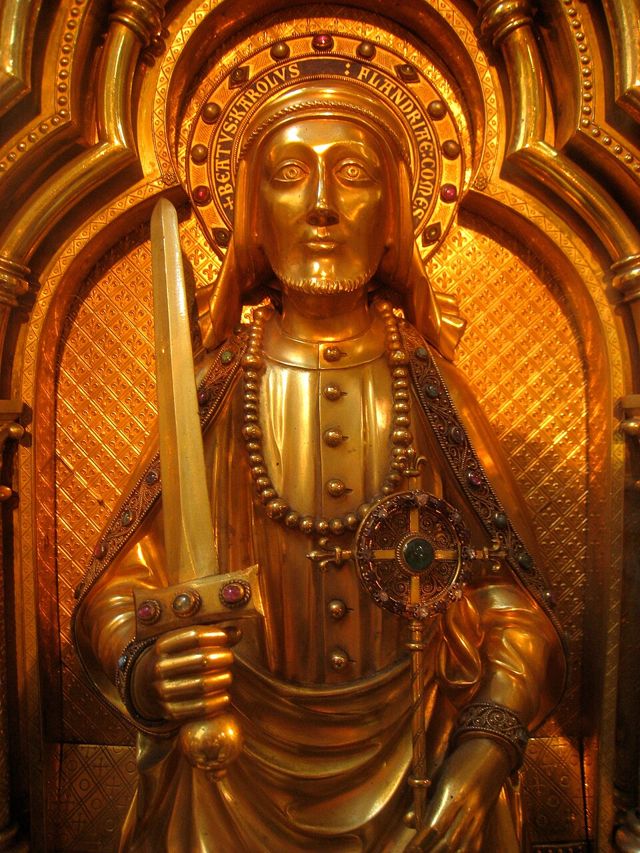
Charles the Good, Count of Flanders, was the son of Saint Canute, King of Denmark, and Adelheid, the daughter of Robert the Frisian. After the martyrdom of his father (see January 19th), he was taken to Bruges and received a careful education from Robert II, Count of Flanders, who was his uncle on his mother's side. Robert trained him to be a good knight, "without fear and without reproach," while also instilling in him the values of a good Christian.
Charles distinguished himself through his bravery in the Holy Land and in the war that his uncle waged against the English. After the death of Baldwin VII, who succeeded his father Robert II in 1111 and died without leaving any heirs, Charles was declared his successor by the acclamation of the nobility and the people, in accordance with his uncle's dying wish. However, his elevation was not accepted by every faction in the state, and his government, which began amid plots, ultimately ended in one.
He married Margaret de Clermont, who was the sister of the Bishop of Tournai and of royal blood from France.
On the sea banks, amidst the sand hills, there were colonies of Flemings who lived by piracy and fishing. Furnes was the center of this district. It was held by Clémence of Burgundy, the widow of Count Robert II, as her dowry. She had married one of her nieces to King Louis VI and another to William de Loo, Viscount of Ypres, who was the son of Philip, her brother-in-law. As a result, several ambitious and powerful factions were ready to claim the County of Flanders and wrest it from Charles's control.
The Flemings along the coast rose up at the instigation of Clémence and were secretly supported by the King of France, while at the same time, William de Loo asserted his claim.
The feudal nobles sought to take advantage of these circumstances to increase their own power. One of them, Godfrey of Louvain, married the dowager countess, Clémence. The Counts of Hainault, Boulogne, Saint Pol, and Hesdin took up arms. Clémence captured Audenarde, and the Count of Saint Pol invaded West Flanders. However, Charles suddenly attacked them with an army, subdued De Loo, stripped Saint Pol of his castle, and the countess of her dowry. He dispersed the armed forces of Hainault, Boulogne, and Coucy, and as Walter of Thérouanne states, "The land held its tongue before him." The King of France was the first to form an alliance with him.
These successes raised the suspicions of the king of England and the emperor Henry V. The latter, under the pretext of a war against the duke of Saxony, gathered an army in August 1124, crossed the Rhine River, and marched towards Metz, threatening to destroy Rheims, where Pope Callixtus II had recently excommunicated him. In this imminent danger, all the vassals of the king rallied around Louis VI. "The noble Count of Flanders," says the abbot Suger, "brought with him ten thousand brave soldiers, and if there had been time, he would have brought three times as many." Faced with these preparations to resist his invasion, the emperor withdrew to Utrecht.
Upon his death, all eyes turned to Charles, and the imperial crown was offered to him. He refused it, just as he also refused the crown of Jerusalem, which was offered to him by the Christians in the Holy Land. He then dedicated himself to the administration of his country with great zeal. He enacted wise laws and worked hard to ensure justice prevailed in all the courts. Nevertheless, a vague uneasiness spread among his subjects. The sea had overflowed the sand hills, fires had broken out and destroyed certain monasteries, and a solar eclipse foretold further troubles. The winter of 1125 was exceptionally harsh; ice and snow lasted until the end of March, and no sooner had the fields and woods begun to regain their green colors than fierce winds and a torrential downpour dashed the hopes of the farmers. A terrible famine followed. "Some," says Gualbert, "perished before they could reach the towns and castles, where food was available; others died while reaching out their hands for alms. In all our land, the natural color of the face had changed to the pallor of death. Despair was widespread, for those who were not themselves in need were overcome with grief at the sight of such suffering."
In these calamities, the Count of Flanders showed more greatness than if he had ruled in Aachen or Jerusalem. He exempted farmers from their taxes and rents and required them to house and feed many poor people. In Ypres, he distributed 1,800 loaves in one day. He forbade the use of barley for making beer so that it could be used for bread, and he ordered the immediate planting of fast-growing vegetables. The following winter was also harsh, but with the arrival of spring, the distress began to ease, as the crops were plentiful, and by autumn, there was abundance once more.
During the famine, Charles learned that Lambert, the brother of Bertulf, who was the dean of S. Donatus in Bruges, had bought up all the grain from the monasteries of S. Winoc, S. Bertin, S. Peter, and S. Bavo, along with all the foreign grain that had been brought into the ports from the Baltic Sea, and was hoarding it to sell at a huge profit. Charles summoned Lambert and the dean and harshly reproached them. The Count sent one of his councillors, Tankmar van Straten, to inspect the granaries of these two men, and they were found to be overflowing with stored grain. Tankmar offered a fair price for the grain, but it was angrily refused by the greedy men. Therefore, by the Count's orders, he insisted that they accept the offer, and after opening the granaries, he distributed the grain to the starving poor.
This angered the brothers, who had influential friends among the people of Furnes, and they plotted to assassinate the prince in revenge. One day, while he was attending mass in a chapel of the Cathedral of S. Donatus in Bruges, one of the conspirators struck him with a hatchet, severing his arm, while another struck his skull. His body was buried in the Church of S. Christopher, but was later moved to the Cathedral of S. Donatus, where it remained until the French Revolution, when the cathedral was destroyed. However, the relics of the holy martyr were preserved with respect, and on March 2nd, 1827, seven hundred years after Charles's death, they were solemnly placed above an altar in the Church of S. Sauveur, which is now used as the cathedral. The day of his feast attracts a large gathering of the faithful; those suffering from fever especially come from all around to seek healing by drinking from the skull of Blessed Charles the Good.
Footnotes
- January 19th: the feast day of Saint Canute, commemorating his martyrdom.
- Walter of Thérouanne: a chronicler from the 12th century.
- Gualbert was a Benedictine monk and writer.
- Lambert was the brother of Bertulf, the dean of S. Donatus in Bruges.
- The Cathedral of S. Donatus is located in Bruges, Belgium.
- The Church of S. Sauveur is now the cathedral in Bruges.
Baring-Gould’s own footnotes, in modern English.
Read the original 1870s text
Baring-Gould’s sources: Hermann Greven and Molanus in their additions to Usuardus, Galesinius, Canisius, Saussaye, and the Belgian Martyrologies. Authorities:—A life by a contemporary, Walter, archdeacon of Thèrouanne, another life by Gualbert of Bruges, written about two years after the death of the count, and another by Suger, abbot of S. Denys, d. 1151.
Charles the Good, Count of Flanders, the son of S. Canute, King of Denmark, and Adelheid, daughter of Robert the Frisian, was taken to Bruges after the martyrdom of his father, (see Jan. 19th), and received a careful education from Robert II., Count of Flanders, his uncle on his mother's side, who trained him to be a good knight, 'without fear and without reproach,' and at the same time to be a good Christian. Charles distinguished himself by his bravery in the Holy Land, and in the war carried on by his uncle against the English, and after the death of Baldwin VII., who succeeded his father, Robert II., in 1111, and died without issue, he was declared his successor by acclamation of the nobility and people, in accordance with the dying wish of his uncle. His elevation was not, however, acceptable to every party in the state, and his government, which began in the midst of plots, was brought to a close by one.
He was married to Margaret de Clermont, sister of the Bishop of Tournai, and of the royal blood of France.
On the sea-banks, in the midst of the sand-hills, living by piracy, and by fishing, were colonies of Flemings. Furnes is the centre of this district. It was held by Clémence of Burgundy, the widow of Count Robert II., as her dowry. She had married one of her nieces to King Louis VI., another to William de Loo, Viscount of Ypres, son of Philip, her brother-in-law. Consequently there were several ambitious and powerful parties ready to lay claim to the County of Flanders, and wrest it from the hands of Charles.
The Flemings of the sea-coast rose, at the instigation of Clémence, and were secretly favoured by the King of France; whilst, at the same time, William de Loo asserted his claim.
The feudal nobles desired to profit by these circumstances, to increase their own power. One of them, Godfrey of Louvain, married the dowager countess, Clémence. The Counts of Hainault, Boulogne, S. Pol, and Hesdin, took arms. Clémence took Audenarde, the Count of S. Pol invaded West Flanders, but Charles fell suddenly on them with an army, subjugated De Loo, deprived S. Pol of his castle, and the countess of her dowry, dispersed the armed men of Hainault, Boulogne, and Coucy, and as Walter of Thérouanne says, "The land held its tongue before him." The king of France was the first to strike an alliance with him.
These successes excited the mistrust of the king of England and the emperor Henry V. The latter, under pretext of a war against the duke of Saxony, assembled an army in August 1124, crossed the Rhine, and marched towards Metz, threatening to destroy Rheims, where pope Callixtus II. had lately excommunicated him. In this imminent peril, all the vassals of the king rallied around Louis VI. "The noble Count of Flanders," says the abbot Suger, "brought with him ten thousand brave soldiers, and if there had been time, he would have brought thrice as many." In face of these preparations to resist his invasion the emperor withdrew to Utrecht. On his death, all eyes turned to Charles, and the imperial crown was offered him. He refused it, as he did also the crown of Jerusalem, offered him by the Christians in the Holy Land. He now devoted himself to the administration of his country with great zeal. He enacted wise laws, and laboured to make justice prevail in all the courts of judicature. Nevertheless a vague uneasiness prevailed amongst his subjects. The sea had overleaped the sand-hills, fires had broken out and consumed certain monasteries, and an eclipse of the sun gave prognostication of further evils. The winter of 1125 was of unparalleled severity; ice and snow prevailed till the end of March, and no sooner had the fields and woods begun to resume their verdant tints, than furious gales and a deluge of rain dissipated the hopes of the farmers. A dreadful famine ensued. "Some," says Gualbert, "perished before they could reach the towns and castles, where food was obtainable; others died in extending their hands for alms. In all our land the natural colour of the face had become exchanged for the pallor of death. Despair was general, for those who were not themselves in want sickened with grief at the sight of such miseries."
In these calamities the Count of Flanders exhibited more greatness than if he had reigned at Aachen, or at Jerusalem. He exempted the farmers from their taxes and rents, and required them to house and feed so many poor. At Ypres he distributed 1800 loaves in one day. He forbade the consumption of barley for the manufacture of beer, that it might be used for bread, and he ordered the immediate sowing of such vegetables as are of rapid growth. The ensuing winter was also severe, but with the spring the distress gave signs of alleviation, for the crops were abundant, and in the autumn plenty reigned once more. During the stress of famine, Charles learnt that Lambert, brother of Bertulf, dean of S. Donatus, at Bruges, had bought up all the grain of the monasteries of S. Winoc, S. Bertin, S. Peter, and S. Bavo, together with all the foreign corn that had been brought into the ports from the Baltic, and was keeping it back so as to sell it at an enormous profit. Charles sent for Lambert and the dean, and bitterly reproached them. The Count sent one of his councillors, Tankmar van Straten, to examine the granaries of these two men, and they were found to be filled to overflowing with stored-up grain. Tankmar offered a reasonable price for the store, but it was indignantly refused by the avaricious men. He, therefore, by the Count's orders, insisted on their receiving it, and opening the granaries, distributed the corn to the starving poor. This aroused the wrath of the brothers, who had powerful friends among the people of Furnes, and to avenge themselves, a project was formed to assassinate the prince. One day, as he was hearing mass in a chapel of the Cathedral of S. Donatus, at Bruges, one of the conspirators cut off his arm with a hatchet, and another clave his skull. His body was buried in the Church of S. Christopher, but was afterwards translated to the Cathedral of S. Donatus, where they remained till the period of the French Revolution, when the cathedral was levelled with the ground. The relics [the bodily remains of a saint, or objects they used, kept with honor] of the holy martyr were, however, preserved with respect, and on March 2nd, 1827, seven hundred years after the death of Charles, were solemnly replaced above an altar in the Church of S. Sauveur, now used as the cathedral. The day of his festival attracts a great concourse of the faithful; those afflicted with fever especially come from all quarters to cure themselves by drinking out of the skull of the Blessed Charles the Good.