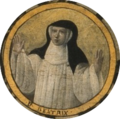
Bl. Beatrice of Nazareth
Beatrice was born about 1200 at Tienen (Tirlemont) in the Duchy of Brabant, in present-day Belgium, the youngest of six children of a well-to-do family.
The story
Beatrice was born about 1200 at Tienen (Tirlemont) in the Duchy of Brabant, in present-day Belgium, the youngest of six children of a well-to-do family. When her mother died, Beatrice was seven. Her father sent her for a time to the Beguines at Zoutleeuw, communities of laywomen who lived a life of prayer without taking formal vows, and then to the Cistercian convent of Bloemendaal, which he had founded, where she learned Latin and the copying of manuscripts.
She became a novice there in 1216 and was sent to La Ramée Abbey to learn manuscript work. There she met Ida of Nivelles, who became her close friend and spiritual guide. Beatrice helped to found a new house at Maagdendaal, returned to Bloemendaal, and made her final vows in 1225. In 1235 she moved with two of her sisters to the new convent of Our Lady of Nazareth near Lier, also founded by her father, and the next year she became its first prioress. She held that office until her death in 1268 (some sources give 1269).
She wrote spiritual notes in her own language, Middle Dutch. Most are lost and survive only through a Latin life written soon after her death, but one short treatise, The Seven Manners of Holy Love, was identified as hers in 1926. It describes the stages by which the soul grows in love for God, and it is the earliest surviving work of mystical prose in Middle Dutch.
Struggles & surrender
For long stretches, especially in 1217 and again from 1228 to 1231, Beatrice went through periods of deep sadness and spiritual dryness. She kept to her prayer through them, and her notes speak of later times of consolation that brought her relief.
Blessed, not yet a saint
Beatrice is honoured as Blessed by the Cistercians by long-standing local tradition. She has never been formally beatified.
Sources
Sources & notes
- Catholic Encyclopedia (1907), “Blessed Beatrix”
- Wikipedia, “Beatrice of Nazareth”
- Story written for this site from the sources above, in our own words.
- Further reading: Wikipedia, “Beatrice of Nazareth”. Feast day and dates: Wikidata Q454198.
- Image: Unknown artist, Wikimedia Commons (Public domain)