This Saint’s Story
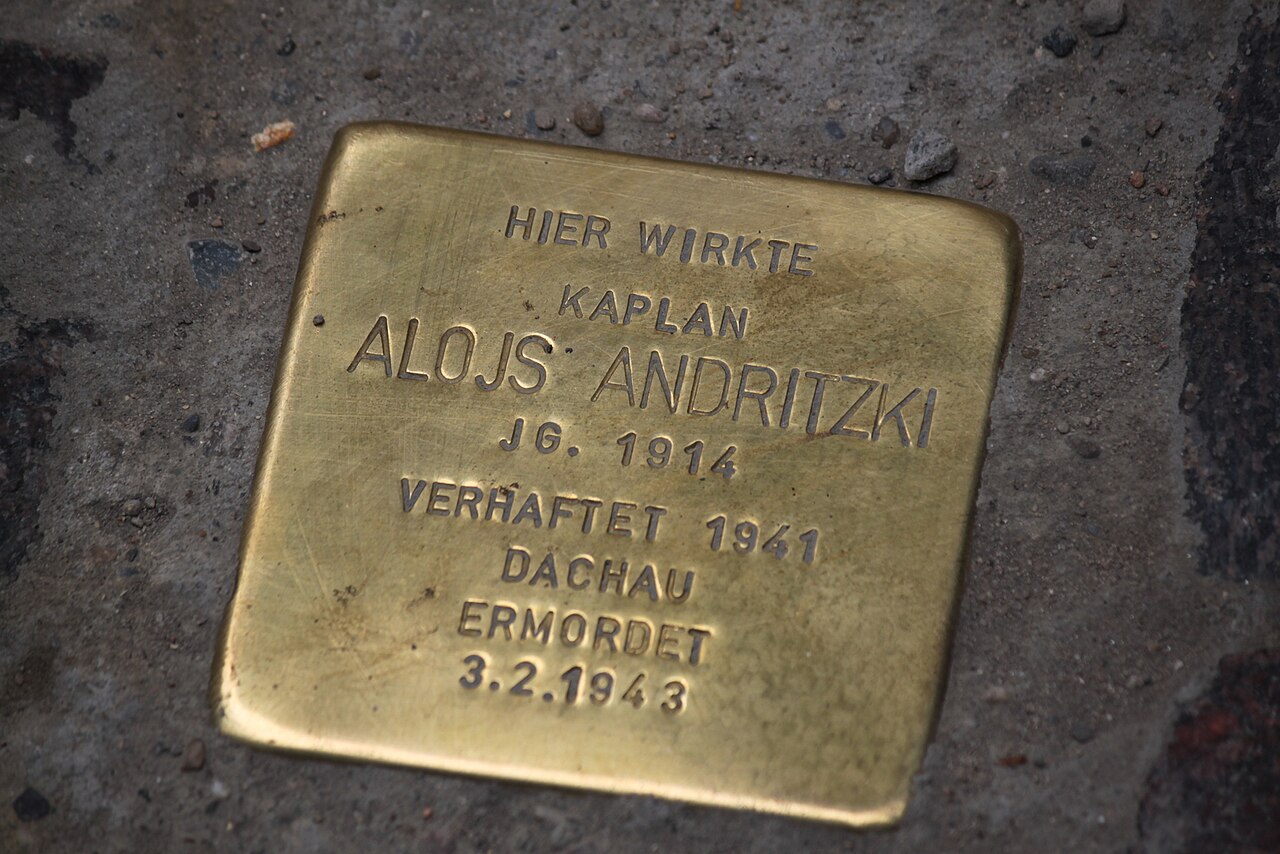
Alojs Andritzki (in Upper Sorbian, Alojs Andricki) was born on July 2, 1914, at Radibor in Saxony, Germany, into a devout family of the Sorbs, a Slavic-speaking minority living east of Dresden. His father, Johann, was a schoolteacher who took the children each month to visit shrines. Two of Alojs's brothers also studied theology, and one became a priest.
He studied philosophy and theology at Paderborn from 1934 to 1937, where he served as spokesman for the Sorbian students and edited their student newspaper. After seminary training at Schmochtitz, he was ordained a priest by Bishop Petrus Legge in St. Peter's Cathedral, Bautzen, on July 30, 1939, and celebrated his first Mass at Radibor on August 6, weeks before the outbreak of the Second World War.
He was appointed to youth ministry, served as chaplain at the Hofkirche (the court church, now the cathedral) in Dresden, and directed the Pueri Cantores boys' choir. Young people admired his honesty and his sporting spirit. He made no secret of his disregard for the National Socialist regime, and after he staged a Christmas play he was questioned by the Gestapo. "This is only the beginning," he told his young people.
On January 21, 1941, he was arrested and charged with "insidious attacks" against the state and party, and in July he was sentenced to six months. His father wrote to Berlin pleading for him, without result. Instead of being released, he was sent on October 2, 1941, to the Dachau concentration camp as prisoner 27829. On the way he met the Benedictine (monks following the Rule of St. Benedict) Maurus Münch, and the two promised never to complain and never to forget their priesthood. With other priests they formed a group that read Scripture together three evenings a week. A gifted musician and artist, Alojs painted a Nativity scene for the prisoners' makeshift chapel and cheered fellow inmates by walking on his hands.
Around Christmas 1942 he caught typhus, and on January 19, 1943, he was taken to the infirmary. When he asked to receive Holy Communion, a guard is reported to have mocked him: "He wants Christ? He will get an injection." He was killed by lethal injection on February 3, 1943, and the camp recorded his death as typhus. His ashes were sent to his family and buried in Dresden's Old Catholic Cemetery on April 15, 1943; in February 2011 they were moved to Dresden Cathedral.
The diocesan inquiry into his cause opened in 1998. On December 10, 2010, Pope Benedict XVI approved the decree recognizing that he was killed in hatred of the faith, and Cardinal Angelo Amato beatified (declared 'Blessed', the step before sainthood) him in Dresden on June 13, 2011, before some 11,000 people. His memorial is kept on February 3, and the Sorbian Catholics of Lusatia have long honored him.